Algeria
 Egypt
 Libya
 Morocco
 Sudan
 Tunisia
 Benin
 Burkina Faso
 Cabo Verde
 Côte d'Ivoire
 Ghana
 Guinea
 Guinea-Bissau
 Liberia
 Mali
 Mauritania
 Niger
 Nigeria
 Senegal
 Sierra Leone
 The Gambia
 Togo
 Cameroon
 Central African Republic
 Chad
 Equatorial Guinea
 Gabon
 Republic of the Congo
 São Tomé and Príncipe
 Burundi
 Comoros
 Djibouti
 Eritrea
 Ethiopia
 Kenya
 Madagascar
 Malawi
 Mauritius
 Mozambique
 Rwanda
 Seychelles
 Somalia
 South Sudan
 Tanzania
 Uganda
 Angola
 Botswana
 Eswatini
 Lesotho
 Namibia
 South Africa
 Zambia
 Zimbabwe
In Kinshasa, memory becomes a political battleground
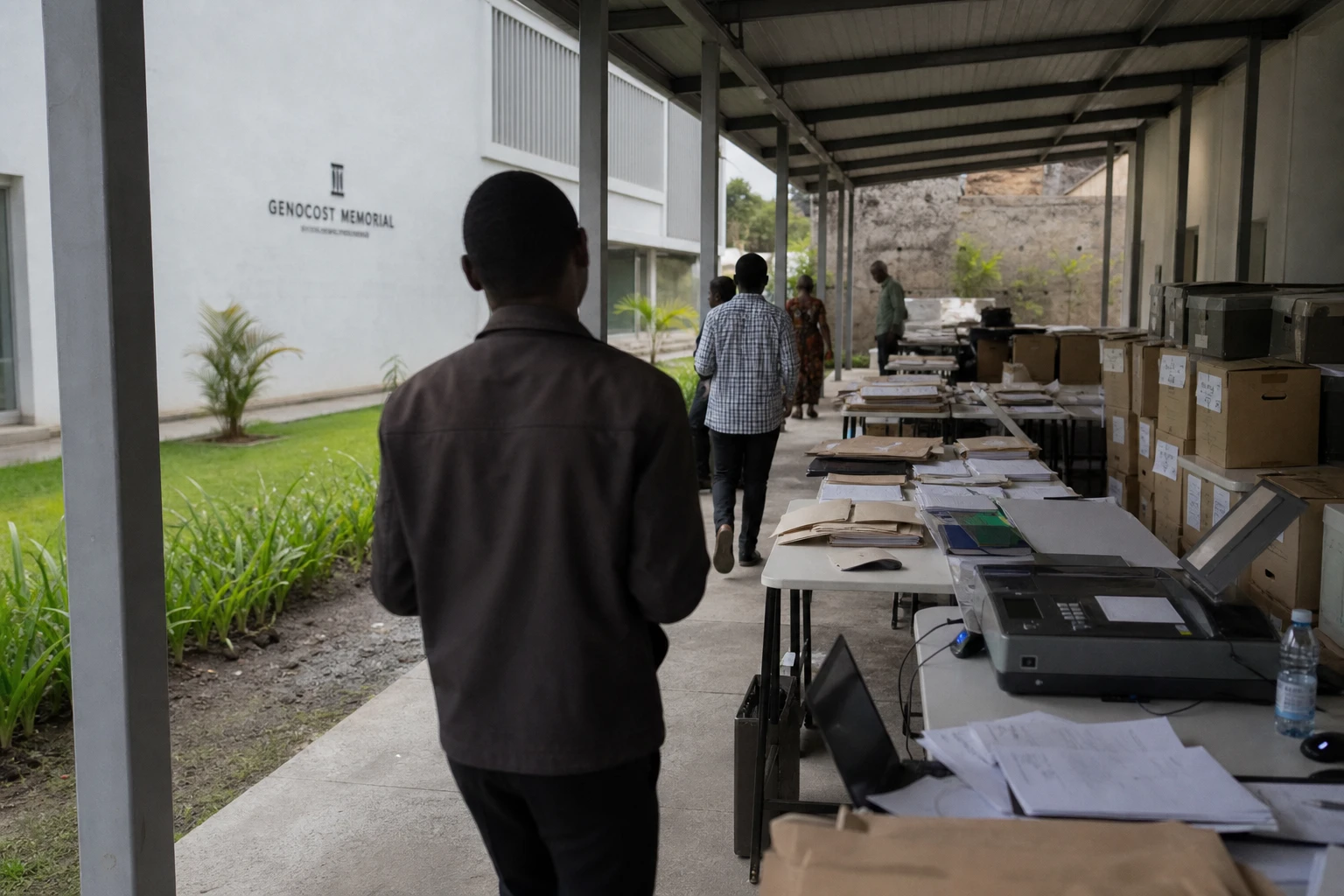
In the Democratic Republic of the Congo, remembrance is no longer just a ceremony. It now touches on justice, archives and the place the country wants to occupy in the history of violence in the east. In Kinshasa, Genocost Day has brought a simple yet weighty question back to the fore: how can crimes be named, evidence preserved and the victims’ case kept from being closed by forgetting?
The context matters. For years, the DRC has sought national and international recognition for crimes committed in the east, a region scarred by wars, forced displacement and sexual violence. The Congolese capital, Kinshasa, is now taking this campaign into its institutions, while the east continues to bear the effects of war, particularly in North Kivu and South Kivu.
What Kinshasa has announced
On 2 August 2025, and again in the wake of the 2026 commemorations, Félix Tshisekedi presided over the Genocost ceremony at the memorial erected in Kinshasa. He reaffirmed the state’s commitment to truth, justice, reparations and victims’ security, while calling on parliament to support a stronger legal framework for national remembrance. The Congolese presidency said a Genocost museum would be established to preserve archives, testimonies, physical evidence and scientific research relating to documented crimes.
This approach has not come out of nowhere. The Congolese government has already put in place instruments related to reparations and transitional justice, including FONAREV, the National Fund for Reparations for Victims of Conflict-Related Sexual Violence and Crimes against the Peace and Security of Humanity. In the same vein, the national strategy for the recognition of genocides committed in the DRC was validated in February 2026, according to the Congolese Press Agency, showing that Kinshasa wants to turn commemoration into lasting public policy.
The choice of the word Genocost is not incidental. It refers to the idea of a “genocide for economic gain”, an expression used by the authorities and several Congolese actors to describe the intertwining of war, resource predation and mass crimes. Ebuteli, a Congolese research centre, notes, however, that the battle over the word is also a battle over the national narrative: who names the crime, who proves it and who passes it on?
A war still present behind the ceremony
At the same time, the east of the country remains under pressure. The United Nations, Human Rights Watch and other sources have documented the M23 offensive and the role attributed by several reports to Rwanda in supporting the armed movement. In February 2025, the UN Security Council adopted Resolution 2773, condemning the ongoing offensives and calling for the withdrawal of Rwandan forces from Congolese territory.
The effects are felt in daily life. UNFPA has described a massive humanitarian crisis in the east, with more than 400,000 people displaced in a matter of weeks in early 2025 and millions already displaced across the country. The World Food Programme, for its part, warned in May 2025 that food insecurity was worsening in conflict-affected provinces. For cities such as Goma, the countryside around the North Kivu capital and isolated rural areas, war means less healthcare, less trade, less schooling and greater vulnerability.
It was in this context that a survivor, mentioned during the ceremony, recounted her husband’s death during the capture of Goma in 2025. Human Rights Watch, for its part, documented summary executions of civilians in Goma during the fighting in February 2025. This matters: official remembrance is not focused solely on past decades. It also draws on violence that is still fresh, which people in the east continue to experience.
The debate over the constitution, justice and power
The Genocost ceremony also served as a platform for a domestic controversy. Denis Mukwege, the Nobel Peace Prize laureate, has repeatedly warned against any plan to revise the constitution in the current context. In an open letter published in late June 2026, he argued that this path risked plunging the country into a new political crisis, as Félix Tshisekedi’s second term is due to end in 2028. Radio Okapi and Actualite.cd reported his position, which reflects concerns shared by several actors in Congolese civil society.
The substance of the debate is clear. For the government, strengthening national remembrance and transitional justice should help consolidate the state and secure international recognition of crimes committed in the DRC. For its critics, security, national unity and respect for the institutional balance must remain the priority. In a country where the war in the east is already weighing on the political calendar, any constitutional initiative is immediately viewed through the lens of mistrust.
What this moment says about the DRC and Central Africa
The significance extends beyond the DRC. In Central Africa, conflicts involving resources, porous borders and armed groups often leave an archival void in their wake. Kinshasa is trying to do the opposite: archive, name, teach and place victims within a formalised national memory. If this project succeeds, it could serve as a reference for other countries facing mass violence and the challenge of building public memory without denying political responsibility.
What happens next will depend on several fronts: the actual establishment of the announced museum, the adoption of transitional justice legislation, developments in the security situation in the east and the ability of Congolese institutions to keep remembrance at a distance from political calculations. In Kinshasa, Genocost is therefore more than a commemorative date. It has become a test of the Congolese state’s credibility and a signal to the entire Great Lakes region.