Algeria
 Egypt
 Libya
 Morocco
 Sudan
 Benin
 Burkina Faso
 Cabo Verde
 Côte d'Ivoire
 Ghana
 Guinea
 Guinea-Bissau
 Liberia
 Mali
 Mauritania
 Niger
 Nigeria
 Senegal
 Sierra Leone
 The Gambia
 Togo
 Cameroon
 Central African Republic
 Chad
 DR Congo
 Equatorial Guinea
 Gabon
 Republic of the Congo
 São Tomé and Príncipe
 Burundi
 Comoros
 Djibouti
 Eritrea
 Ethiopia
 Kenya
 Madagascar
 Malawi
 Mauritius
 Mozambique
 Rwanda
 Seychelles
 Somalia
 South Sudan
 Tanzania
 Uganda
 Angola
 Botswana
 Eswatini
 Lesotho
 Namibia
 South Africa
 Zambia
 Zimbabwe
A republic celebrated amid tension
In Tunis, Republic Day did more than recall the birth of the modern Tunisian state. For some citizens, it also became a moment of political reflection: a republic is measured not only by its symbols, but by the ability of institutions to function, protect freedoms and respond to everyday difficulties. On 25 July 2026, several hundred demonstrators marched in the Tunisian capital to challenge President Kaïs Saïed’s approach, while another rally expressed support for the process launched on 25 July 2021.
The event is part of a broader period of upheaval. Since 25 July 2021, Kaïs Saïed has suspended parliament, dismissed his head of government and ruled by decree, a turning point his opponents describe as an unprecedented concentration of power. At the same time, Tunisia is experiencing social pressure, strains on public services and growing restrictions on civic space.
In Tunis, the streets connect politics, freedoms and basic services
Images from Habib Bourguiba Avenue say something about Tunisia’s current moment. On one side, demonstrators denounced socio-economic policies and called for greater rights, freedoms and democratic safeguards. On the other, supporters of 25 July defended a government they described as necessary to reform the state, fight corruption and put institutions in order. This division goes beyond the commemorative calendar. It reflects a deeper struggle over what the word republic means in Tunisia today.
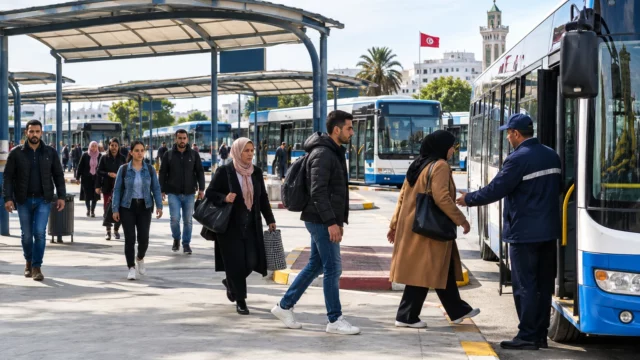
On the ground, the discontent is not limited to rhetoric. The heatwave affecting the country has worsened water and electricity cuts, while contributing to a rise in forest fires. On 22 July, the Tunisian Presidency itself convened several ministers, along with the management of STEG, SONEDE and the civil protection service, to address the prolonged outages and recent fires. Tunisian media subsequently reported hundreds of emergency responses and several active fires, while another press investigation cited six major fires in 15 days and more than 4,000 hectares of forest affected.
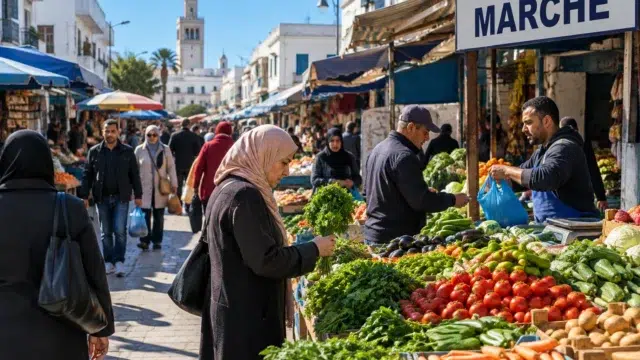
The overlap between the climate crisis, strained public services and social anger matters greatly. In Tunisia, repeated outages hit working-class neighbourhoods first, along with households reliant on the grid and small informal businesses without a generator or water reserves. They also affect farmers, local shops and residents of regions already exposed to summer droughts. When electricity falters, water often follows. When fires multiply, forests, farms and sometimes homes pay the price.
Civil liberties: another front in Tunisia’s crisis
The Tunis rally also brought the issue of prisoners of conscience to the fore. Demonstrators held up portraits of journalist Mourad Zghidi, imprisoned since May 2024, amid broader pressure on the media. Reporters Without Borders has in recent weeks denounced the growing criminalisation of journalism in Tunisia and appealed to the United Nations Special Rapporteur on freedom of expression. The organisation also points to the recent convictions of other journalists and commentators, a sign of a crackdown causing concern well beyond the press sector.
The presence of Mourad Zghidi’s family at the demonstration illustrates another feature of Tunisia’s current moment: political protests are now intertwined with concerns over individual freedoms. For his supporters, the debate is no longer just about the executive’s effectiveness, but about the space left for checks and balances, public expression and the right to criticise. Amnesty International has also documented the repression of dissenting voices and the use of criminal laws to prosecute people linked to public expression.
This has very tangible consequences. In a capital such as Tunis, institutional issues quickly become questions of everyday life: who speaks, who decides, who is held to account, and what safeguards are in place. For citizens, the issue is the predictability of public policy. For businesses, it is regulatory stability. For journalists, academics and activists, the very space for public debate is shrinking or being defended.
What this moment says about Tunisia and the Maghreb
In North Africa, Tunisia remains a country closely watched for its political trajectory since 2011. Its current crisis resonates across the Maghreb, where the question of balancing stability, reform and civil liberties remains central. Although the Arab Maghreb Union remains largely inactive politically, developments in Tunisia matter beyond its borders, particularly because the country stands at a crossroads between the Mediterranean, Africa and the Arab world.
The implications for the continent are twofold. On the one hand, Tunisia is a reminder that a political transition can stall if a concentration of power is accompanied by the weakening of checks and balances. On the other, it shows that climate crises and pressure on water, electricity and forests are no longer peripheral issues, but political factors in their own right. In a country where institutions are under pressure, the ability to respond to material emergencies is a test of national credibility.
The next steps will depend on the choices made among the street, the judiciary, security and the management of essential services. In Tunisia, the debate is no longer just about 25 July as a date. It is about what remains, in practical terms, of the republic when power is concentrated and daily life grows more difficult.