Algeria
 Egypt
 Libya
 Morocco
 Sudan
 Benin
 Burkina Faso
 Cabo Verde
 Côte d'Ivoire
 Ghana
 Guinea
 Guinea-Bissau
 Liberia
 Mali
 Mauritania
 Niger
 Nigeria
 Senegal
 Sierra Leone
 The Gambia
 Togo
 Cameroon
 Central African Republic
 Chad
 DR Congo
 Equatorial Guinea
 Gabon
 Republic of the Congo
 São Tomé and Príncipe
 Burundi
 Comoros
 Djibouti
 Eritrea
 Ethiopia
 Kenya
 Madagascar
 Malawi
 Mauritius
 Mozambique
 Rwanda
 Seychelles
 Somalia
 South Sudan
 Tanzania
 Uganda
 Angola
 Botswana
 Eswatini
 Lesotho
 Namibia
 South Africa
 Zambia
 Zimbabwe
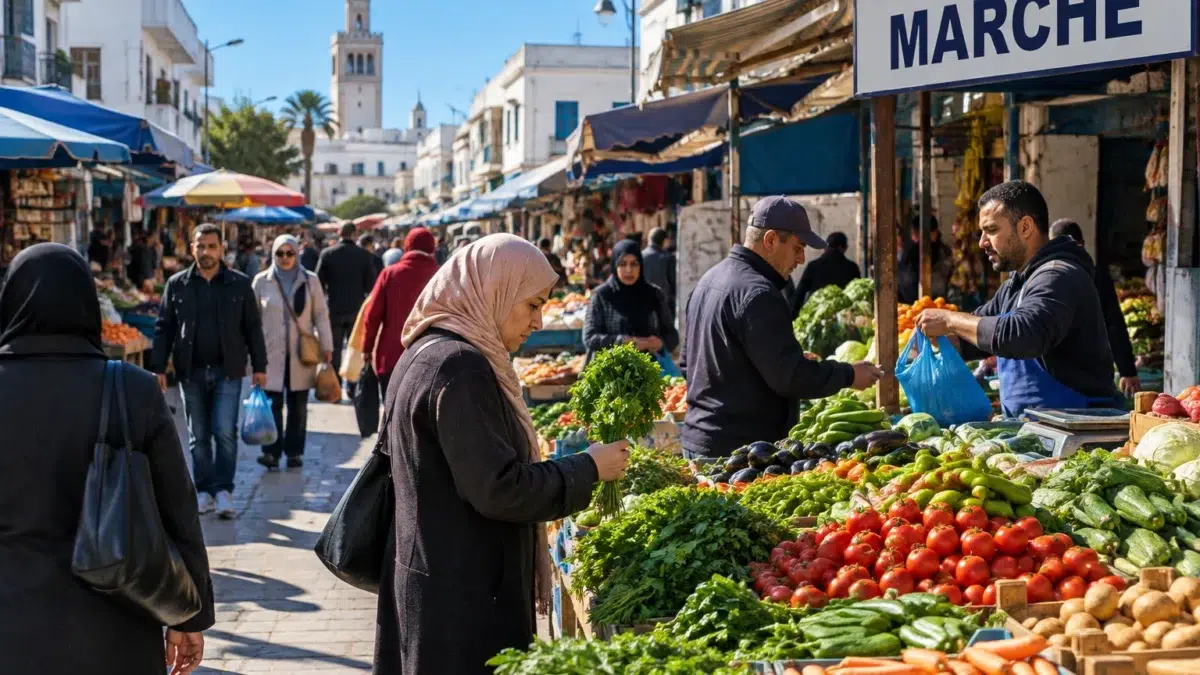
In Tunisia, debate over the 2027 budget has reached a practical question: how can the state be funded without asking more of households already facing a heavy tax burden? The finance minister’s remark about hidden money has reignited this tension, as the government says it wants to reduce the weight of taxation.
A budget debate under pressure
In Tunis, members of the Assembly of the Representatives of the People and the National Council of Regions and Districts are examining the 2027 budget guidelines. The discussions come as public finances remain under pressure: the state must cover its expenditure, fund its services and contain its deficit, while protecting purchasing power.
The debate is part of a recent political trajectory in which Tunisia’s institutions have been profoundly reorganised since 2021. The new chamber representing the regions and districts sits alongside the Assembly to examine the draft finance law. Regionally, Tunisia belongs to the Arab Maghreb Union (AMU), but the organisation is not a framework for economic integration as active as other communities on the continent. Tunis’s budget choices therefore play out first and foremost in the relationship between the state, taxpayers and domestic economic actors.
On 11 November, Economy and Planning Minister Samir Abdelhafidh told MPs that the draft finance law did not provide for an increase in tax rates. He announced a tax burden of 24.9% of gross domestic product in 2027, compared with an expected 25.7% in 2026. Tunisia’s TAP news agency reported these figures, which were also carried by Tunisian media. They are budget forecasts, not a result already secured.
A remark that went beyond its intended meaning
Two days later, on 13 November, Finance Minister Michket Slama Khaldi presented her ministry’s budget. “We have no other solution than taxes! Everyone must put their hand in their pocket today to help their country, and anyone with hidden money must bring it out,” she said, according to several Tunisian accounts of the session.
Her remarks drew criticism. The minister’s supporters interpreted them as an appeal directed at people concealing income, rather than an announcement of a general tax increase. But in a debate already shaped by the cost of living and the tax burden, the remark was more widely heard as a demand addressed to citizens.
Economist Aram Belhadj highlighted, in particular, the limits of collecting tax debts, the scale of informal activities and the state’s underuse of its land assets. His argument shifts the debate: before increasing the burden on compliant taxpayers, the administration could seek to recover more of the sums owed and broaden the tax base — that is, the number of people and activities actually taxed.
Another economist, Ridha Chkoundali, pointed to households’ ability to save. According to data from the National Institute of Statistics that he cited, the household savings rate is said to have fallen from 8.6% in 2021 to 3% in 2025. This decline does not mean every household has the same room for manoeuvre, but it underlines why a call to mobilise more private money may worry families already struggling to cover their expenses.
Revenue levels do not tell the whole story
National statistics confirm that Tunisia is heavily dependent on tax revenues. The Ministry of Finance puts the tax burden at 25.9% of GDP in 2025 and 25.4% in the 2026 finance law. International comparisons can show different ratios depending on the revenues included and the method used: the OECD, the African Union and the African Tax Administration Forum ranked Tunisia first among the countries covered in their 2023 comparison.
A high ratio, however, does not by itself show how the burden is distributed. Declared employees and formal businesses are more directly exposed to tax than activities outside official channels. Conversely, bringing an informal activity into the tax system can provide access to protections and services, but may also entail additional costs or procedures. The quality of tax collection and trust in how revenues are used therefore matter as much as the announced rate.
The forecast decline for 2027 and the controversy over the minister’s remarks are not necessarily contradictory. The government can anticipate an overall fall in the tax burden while seeking to collect more revenue from taxpayers or activities that currently escape taxation. The decisive question will be whether this effort rests on better collection and a broader tax base, or shifts the burden on to people who are already compliant.
A test of confidence for the 2027 budget
For households, the stakes are immediate: protecting disposable income in a context of shrinking savings. For formal businesses, predictable tax rules weigh on investment decisions. For the state, the challenge is to fund its duties without discouraging economic activity or making it more costly to enter the declared economy.
The government has also announced operations to count undeclared economic activities. The minister cited 78,688 activities identified between 2022 and the end of September 2026, according to a Tunisian press report. This figure, announced during the parliamentary debate, should be read as a reported administrative result: on its own, it does not specify how many of these activities were subsequently registered, inspected or taxed.
The Tunisian debate echoes a broader question for African states: how can public resources be expanded without placing most of the burden on a minority of visible taxpayers? As adoption of the 2027 budget approaches, the next developments to watch will be concrete collection measures, their treatment of the informal economy and the gap between tax forecasts and revenues actually collected. The budget’s credibility will also depend on the authorities’ ability to explain how the funds raised support services and investment across the country’s different regions.