Algeria
 Egypt
 Libya
 Morocco
 Sudan
 Tunisia
 Benin
 Burkina Faso
 Cabo Verde
 Côte d'Ivoire
 Ghana
 Guinea
 Guinea-Bissau
 Liberia
 Mali
 Mauritania
 Niger
 Nigeria
 Senegal
 Sierra Leone
 The Gambia
 Togo
 Cameroon
 Central African Republic
 Chad
 Equatorial Guinea
 Gabon
 Republic of the Congo
 São Tomé and Príncipe
 Burundi
 Comoros
 Djibouti
 Eritrea
 Ethiopia
 Kenya
 Madagascar
 Malawi
 Mauritius
 Mozambique
 Rwanda
 Seychelles
 Somalia
 South Sudan
 Tanzania
 Uganda
 Angola
 Botswana
 Eswatini
 Lesotho
 Namibia
 South Africa
 Zambia
 Zimbabwe
A quiet discovery in a vast forest territory
In eastern Democratic Republic of the Congo, some discoveries begin not in a laboratory but with a glance up at the canopy. There, above the trails and villages, a monkey long known to only a few local residents has finally entered the scientific record, with a black face and pale orange lips that make it immediately recognisable.
This story goes beyond simple zoological curiosity. It is a reminder that a significant part of the biodiversity in DR Congo, home to Kinshasa and the Congo Basin forest, remains poorly documented. The Congo Basin is the world’s second-largest tropical forest after the Amazon, and DR Congo contains the largest share of it.
What the researchers have established
The species was formally described in a paper published on 15 July 2026 in PLOS One. The authors named it Colobus congoensis and recommend the common name Likweli, already used locally in some communities. The study places the animal in the Lomami-Congo interfluve in central-eastern DR Congo, with a core area in and around Lomami National Park.
The researchers recorded 114 sightings between 2018 and 2022, across an estimated area of 1,700 km². They describe a rare, elusive, small primate with black fur, an orange-cream patch around the mouth, a dark face and a white peri-anal marking. Morphological, genetic and acoustic evidence all point to a clear conclusion: it is a distinct species in the genus Colobus.
The paper also specifies that the species is most closely related to Colobus satanas, but is separated from it geographically by more than 1,200 kilometres. The scientists propose a preliminary classification of “Endangered” on the IUCN Red List, citing its small range, limited population, expected hunting pressure and habitat conversion.
The role of Lomami National Park and local knowledge
Lomami National Park is not a distant backdrop. Established in 2016, it covers 8,874 km² and protects a mosaic of dense equatorial forests, hydromorphic savannahs and strategic forest corridors. UNESCO notes that it lies in the eastern part of the central Congo Basin, an area of immense biological richness where other endemic species have already been reported.
The park’s conservation is based on a shared management structure. The Congolese Institute for Nature Conservation, which leads the protection of protected areas in DR Congo, works there with technical partners, including the Frankfurt Zoological Society under a co-management arrangement. This cooperation matters because protecting a newly described species depends as much on research as on field monitoring.
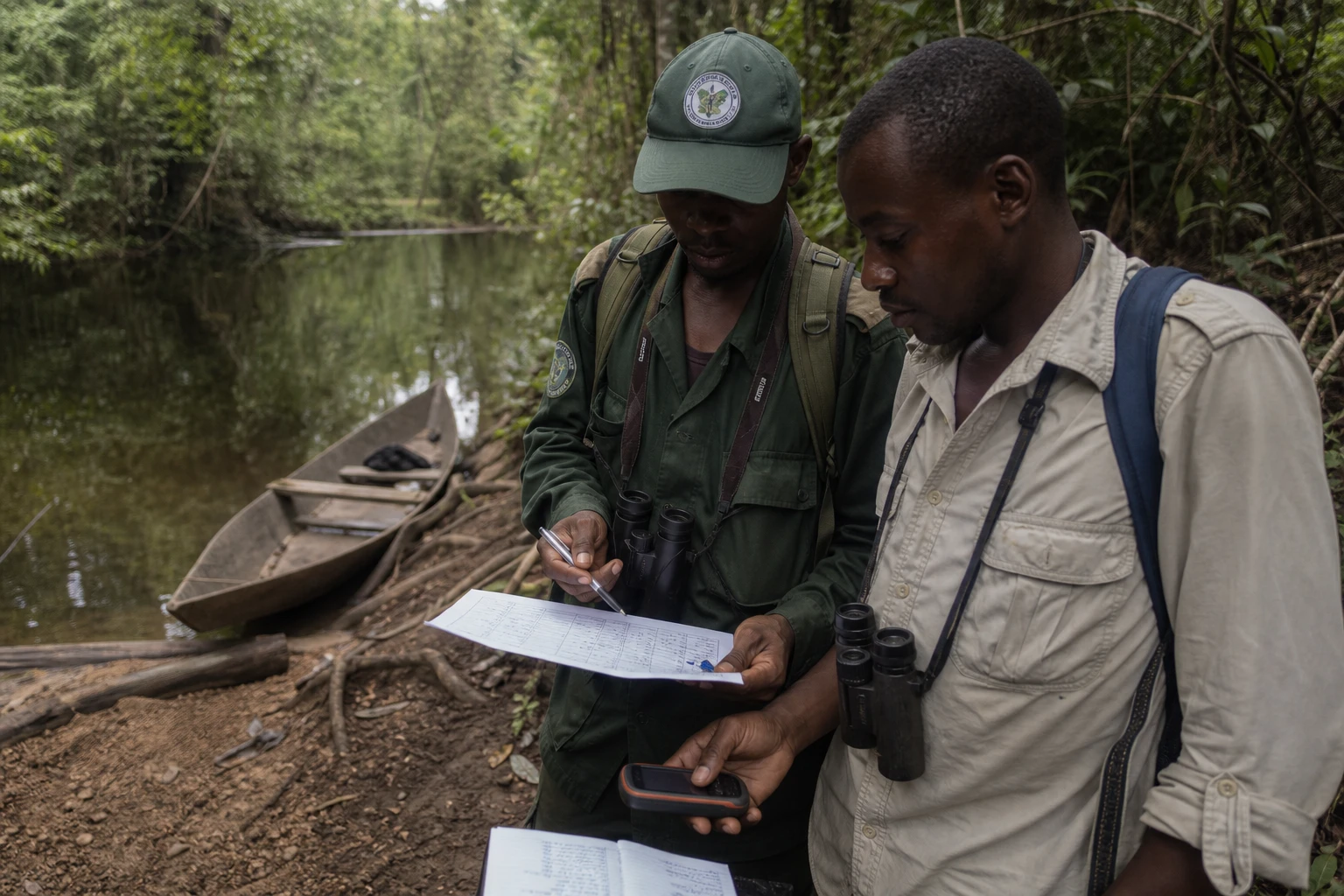
The discovery also underscores the importance of local knowledge. The authors note that residents already knew the animal as Likweli, but that it remained very difficult to observe. According to a report by Actualité.cd, the researchers interviewed communities in 52 villages; only people in eight villages had ever seen the monkey. This detail says much about the species’ biology, but also about how the forest is inhabited, named and understood by those who live there.
What this means for DR Congo
Scientifically, DR Congo has added another piece to an incomplete puzzle. Describing a new African monkey species is not just a laboratory event; it also reveals gaps in natural history knowledge in a region too often reduced to its political tensions or logistical difficulties. Here, the forest is not an empty space. It is a place of observation, movement and multiple forms of knowledge.
The economic and social implications are more tangible. Researchers warn of hunting and habitat change. For communities living nearby, this relates to everyday uses of the forest, bushmeat, mobility needs and the trade-offs between conservation and subsistence. For the Congolese state, it means a protected area cannot be defended on a map alone; it must be better monitored, better understood and better shared with the populations around it.
The chosen scientific name, Colobus congoensis, is significant. It ties the species to the country’s biological identity while reminding us that part of DR Congo’s wealth remains to be documented and protected. In a country where forests help regulate the climate, sustain biodiversity and maintain local balances, the discovery of a rare primate is also a political signal: conservation is not a luxury, but a matter of ecological sovereignty.
A warning for Central Africa
The discovery resonates beyond the borders of DR Congo. The Congo Basin spans several Central African countries and is covered by regional frameworks such as COMIFAC, the Central African Forests Commission, established specifically to co-ordinate the sustainable management of these ecosystems. Every newly described species strengthens the case for protection at landscape scale, not just within an isolated park.
It is also a reminder of a reality that is often underestimated: field science in Central Africa advances when public institutions, African researchers and international partners work together without erasing local knowledge. Here, the result is clear. A species has been named, described and placed in its environment. What happens next will depend on its actual population, which remains poorly known, and on the Congolese authorities’ ability to turn this discovery into lasting protection.