Algeria
 Egypt
 Libya
 Morocco
 Sudan
 Tunisia
 Benin
 Burkina Faso
 Cabo Verde
 Côte d'Ivoire
 Ghana
 Guinea
 Guinea-Bissau
 Liberia
 Mali
 Mauritania
 Niger
 Nigeria
 Senegal
 Sierra Leone
 The Gambia
 Togo
 Cameroon
 Central African Republic
 Chad
 DR Congo
 Equatorial Guinea
 Gabon
 Republic of the Congo
 São Tomé and Príncipe
 Burundi
 Comoros
 Djibouti
 Eritrea
 Ethiopia
 Kenya
 Madagascar
 Malawi
 Mauritius
 Mozambique
 Rwanda
 Seychelles
 Somalia
 South Sudan
 Tanzania
 Angola
 Botswana
 Eswatini
 Lesotho
 Namibia
 South Africa
 Zambia
 Zimbabwe
In Kampala, tax policy walks a tightrope
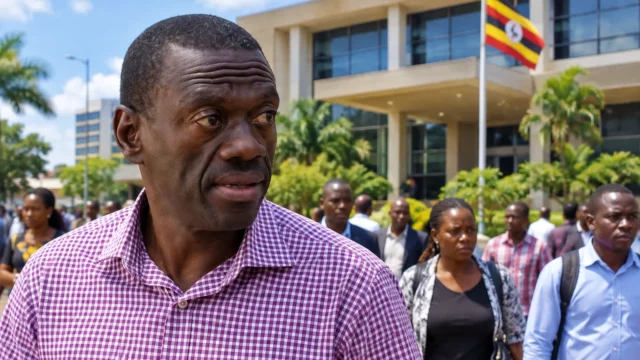
Uganda is under real fiscal pressure. The government wants to raise more revenue without damaging sectors that already account for a significant share of employment, consumption and urban activity. It was in this context that President Yoweri Museveni sent two tax reforms adopted in Kampala back to Parliament, saying some clauses risked distorting competition between businesses, encouraging tax evasion and weighing on the economy.
The issue therefore goes beyond a technical decision. It concerns a central question for a member state of the East African Community (EAC): how to broaden the tax base without undermining competitiveness or fuelling informal activity. This tension is all the more acute as the EAC is pressing its members to improve the harmonisation of taxes and fiscal policies.
What the president sent back to MPs
On 14 July 2026, Uganda’s Parliament confirmed that Museveni had refused to sign the Income Tax (Amendment) Bill, 2026 and the Excise Duty (Amendment) Bill, 2026 into law. According to the House, the president singled out two specific provisions: the introduction of withholding tax on betting and gaming winnings, with an exemption for land-based casinos, and a steep increase in excise duty on single-use plastics.
On gambling, the executive fears unfair competition between operators. The bill retained taxation on betting and gaming winnings while making an exception for land-based casinos licensed under the 2016 Lotteries and Gaming Act. Museveni argues that this different treatment would create scope for tax optimisation and revenue leakage. The logic is clear: if the rules are not the same, activity will move to where the tax burden is lighter.
On plastics, Parliament had approved an increase from 2.5% or $70 per tonne to 25% or $1,500 per tonne, whichever amount was higher. The parliamentary committee had presented the change as a way to better target disposable plastics, curb pollution and bring Uganda into line with stricter regional trends. But the president believes the increase is too abrupt for an industrial sector that, in his view, does not yet have sufficiently viable alternatives.
Gambling, plastics and public revenue: three different balances
The betting issue illustrates the growth of a market that is difficult to regulate. In January 2026, the National Lotteries and Gaming Regulatory Board said stakes had risen from 4.3 trillion Ugandan shillings in 2023/2024 to 8.3 trillion in 2024/2025, alongside an increase in non-tax revenue. The regulator sees this as progress in formalisation. The government also sees it as a source of revenue that could be captured more effectively.
But the issue is not solely about the budget. In urban centres, particularly Kampala, online gambling is reaching more and more households. Poorly calibrated taxation could push some operators towards less visible platforms, making them harder to monitor. Conversely, a tax that is too low leaves the sector with substantial rents without a proportionate contribution to the public budget. Museveni wants to correct this imbalance without freezing the market.
Plastics present a different dilemma. The parliamentary committee itself noted that the reform was aimed mainly at single-use items, often linked to urban waste, blocked drains and flooding in Kampala. The bill also provides for taxing a wide range of products, from bags and straws to lids, cups and plastic films. But in a country where a collection, transport and recycling industry supports thousands of livelihoods, a tax shock that comes too quickly could shift the cost onto small businesses and informal workers.
The Ugandan government is nevertheless seeking to substantially increase its own resources. For the 2026/2027 financial year, it is targeting 45.96 trillion shillings in domestic revenue, including 40.16 trillion shillings in tax revenue. Its stated goal is to raise the tax-to-GDP ratio to 15.5%, from about 13% today, and then higher over the medium term. In this context, every exemption matters. Every gap in the tax framework becomes a political issue.
What this says about Uganda and the region
Sending the bills back to Parliament does not signal a rejection of tax reform as a whole. Rather, it points to an internal balancing act within the government: fund the state, yes, but without damaging sectors deemed strategic or creating stark differences in treatment. This is a delicate line in a country where growth, urban jobs and fiscal discipline are closely tied to the state’s ability to collect taxes without alienating economic players.
The regional implications are significant. In Arusha, EAC finance ministers recently called for better harmonisation of taxes, fiscal frameworks and rules governing goods traded within the Community. Against this backdrop, Uganda’s decision is being closely watched: it shows how far a member state can go in taxing consumer goods without breaking with regional signals of integration and convergence.
For East Africa, the challenge is clear: domestic revenue must rise without stifling job-creating sectors or encouraging evasion strategies. The Ugandan case is a reminder that tax reform is not merely a revenue-raising tool. It is also a test of economic coherence, fairness between operators and institutional credibility. The next point to watch will be the bills’ return to Parliament, with the possibility of amendments on betting and plastics.