Algeria
 Egypt
 Libya
 Morocco
 Sudan
 Tunisia
 Benin
 Burkina Faso
 Cabo Verde
 Côte d'Ivoire
 Ghana
 Guinea
 Guinea-Bissau
 Liberia
 Mali
 Mauritania
 Niger
 Senegal
 Sierra Leone
 The Gambia
 Togo
 Cameroon
 Central African Republic
 Chad
 DR Congo
 Equatorial Guinea
 Gabon
 Republic of the Congo
 São Tomé and Príncipe
 Burundi
 Comoros
 Djibouti
 Eritrea
 Ethiopia
 Kenya
 Madagascar
 Malawi
 Mauritius
 Mozambique
 Rwanda
 Seychelles
 Somalia
 South Sudan
 Tanzania
 Uganda
 Angola
 Botswana
 Eswatini
 Lesotho
 Namibia
 South Africa
 Zambia
 Zimbabwe
A battle over tactics before the battle at the polls
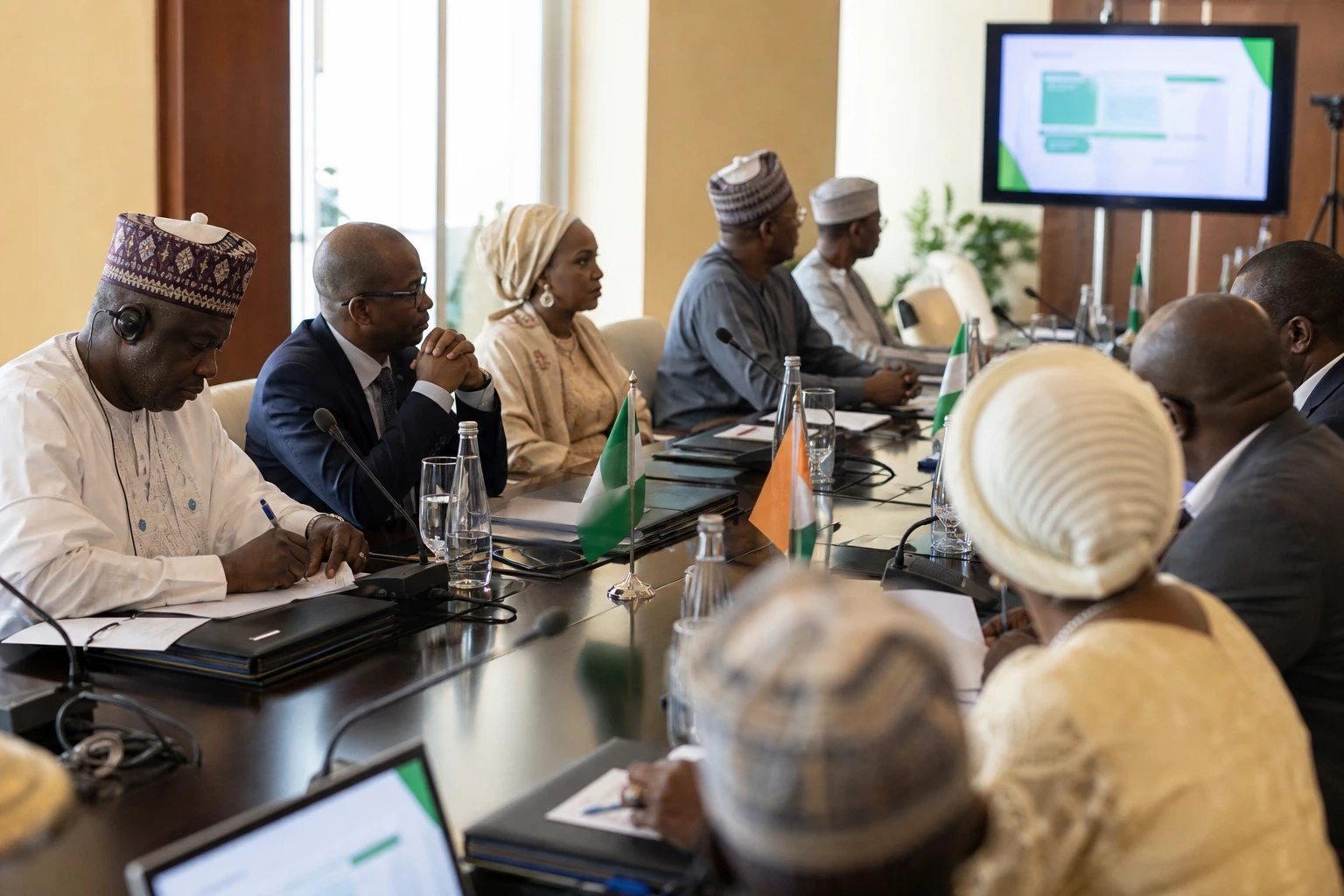
In Abuja, Nigerian politics is already being played on several fronts. On one side, the presidential camp wants to lock down the electoral machinery around Bola Tinubu. On the other, some actors are seeking to broaden support beyond party boundaries, betting on flexible alliances rather than party discipline. In a country where shifts between parties carry considerable weight, this tension says much about the campaign taking shape ahead of the 2027 elections.
Nigeria is not entering this phase on neutral ground. The Independent National Electoral Commission has set the timetable for the 2027 general elections, with the presidential and federal legislative elections on 20 February 2027, followed by governorship and state assembly elections on 6 March 2027. This tightly packed sequence is already making every political position count, especially in a system where governors wield considerable political, logistical and financial clout.
Nyesom Wike’s alliance plan puts the party to the test
At the centre of the controversy is Nyesom Wike, minister of the Federal Capital Territory in Abuja and also a leading figure in the People’s Democratic Party (PDP). He is advocating a “Rainbow Coalition”, a broad-based alliance intended to mobilise support from several camps for Bola Tinubu’s re-election. In recent remarks, he has even argued that this kind of arrangement should not prevent the PDP from fielding its own candidates in other elections.
This position is politically sensitive. Wike remains a heavyweight in the South-South, particularly in the former oil-producing state of Rivers, where his influence remains real despite internal realignments within the PDP. Since Tinubu came to power, he has established himself as one of the president’s most visible supporters, blurring the traditional lines between government and opposition. This ambiguity is a source of his strength, but also of criticism over the coherence of his original camp.
The crux of the conflict is simple. Wike offers a pragmatic reading of the balance of power: support Tinubu in the presidential election while negotiating differently in governorship, legislative and local elections. The APC governors, by contrast, see a risk of dilution. In their view, any parallel alliance could weaken the authority of the president’s party and create competing channels of mobilisation.
APC governors defend the party line
The response came swiftly. The Progressive Governors’ Forum, which brings together governors elected on the platform of the All Progressives Congress, has distanced itself from any alliance that could run counter to the party’s official candidates. The forum’s chairman, Hope Uzodimma, governor of Imo State, recalled that the priority remained Bola Tinubu’s re-election and the defence of APC candidacies at every level.
This reaction is not merely defensive. It highlights the central role of governors in Nigerian politics. In a federal state where territorial networks matter as much as national slogans, state chief executives control resources, local alliances and electoral machinery capable of shaping a campaign. The disagreement with Wike is therefore not just about a political slogan. It concerns who controls the Tinubu project.
Regional voices within the president’s party have also closed ranks. APC officials in the South-East have rejected Wike’s coalition and defended the progressive governors. This protective reflex shows that the issue is not confined to Abuja or Rivers. It resonates in several areas where parties are seeking to consolidate strongholds ahead of legislative and governorship elections, often decisive for the rest of the political cycle.
A wider concern: preventing the presidential vote from splitting
At its heart, this dispute reflects a broader question: how can a presidential candidate win in a fragmented country without fracturing their own base? Wike argues that a candidate can attract cross-party support in the presidential election while leaving each party to manage its contests in other elections. APC governors, by contrast, fear that such an improvised arrangement could pave the way for competing candidacies, legitimacy disputes and a weakening of the party’s national message.
The debate is also unfolding amid a wider period of political realignment. In 2025, an opposition coalition brought together around figures such as Atiku Abubakar and Peter Obi sought to build an alternative to Tinubu, before running into internal divisions. Since then, the opposition landscape has remained fluid, while several figures from other camps continue to negotiate their position in the new balance of power. In this context, Wike is betting on the short term and electoral convergence, while APC governors are banking on party cohesion.
The political calculation also has a tangible effect on voters. In major cities, the arithmetic of alliances is often less clear than in rural states, where local powerbrokers can swing an election. In Abuja and several state capitals, rivalries among elites can spur negotiations. But in areas where voting remains tied to community, party or economic loyalties, mixed messages can also discourage turnout.
What the affair says about Nigeria in 2027 and the continent
For Nigeria, this episode confirms a constant: the road to the presidency rarely runs through a single, unified party. It involves compromises, shifts in influence and trade-offs between the federal centre and the states. The fact that a serving minister, still linked to his original opposition party, can argue for an open coalition around the incumbent president shows just how porous party lines remain.
In West Africa, the Nigerian case is also of interest to ECOWAS, the Economic Community of West African States, because it touches on the strength of pluralism in the continent’s most populous country. In a region already marked by military transitions, disputed elections and fierce competition between central governments and local powerbrokers, Nigeria remains a political laboratory under close scrutiny. If competition there remains open, it sends a useful signal. If it narrows, it fuels the idea that the political arena is being progressively locked down.
The next milestones are already known: the candidate registration period, alliances in key states, and then the elections in February and March 2027. Until then, the question is not just who supports Bola Tinubu. It is what political arrangement can, or cannot, hold together a governing party, powerful governors and actors who have crossed from one camp to another without causing the whole structure to fracture.