Algeria
 Egypt
 Libya
 Morocco
 Sudan
 Tunisia
 Benin
 Burkina Faso
 Cabo Verde
 Côte d'Ivoire
 Ghana
 Guinea
 Guinea-Bissau
 Liberia
 Mali
 Mauritania
 Niger
 Senegal
 Sierra Leone
 The Gambia
 Togo
 Cameroon
 Central African Republic
 Chad
 DR Congo
 Equatorial Guinea
 Gabon
 Republic of the Congo
 São Tomé and Príncipe
 Burundi
 Comoros
 Djibouti
 Eritrea
 Ethiopia
 Kenya
 Madagascar
 Malawi
 Mauritius
 Mozambique
 Rwanda
 Seychelles
 Somalia
 South Sudan
 Tanzania
 Uganda
 Angola
 Botswana
 Eswatini
 Lesotho
 Namibia
 South Africa
 Zambia
 Zimbabwe
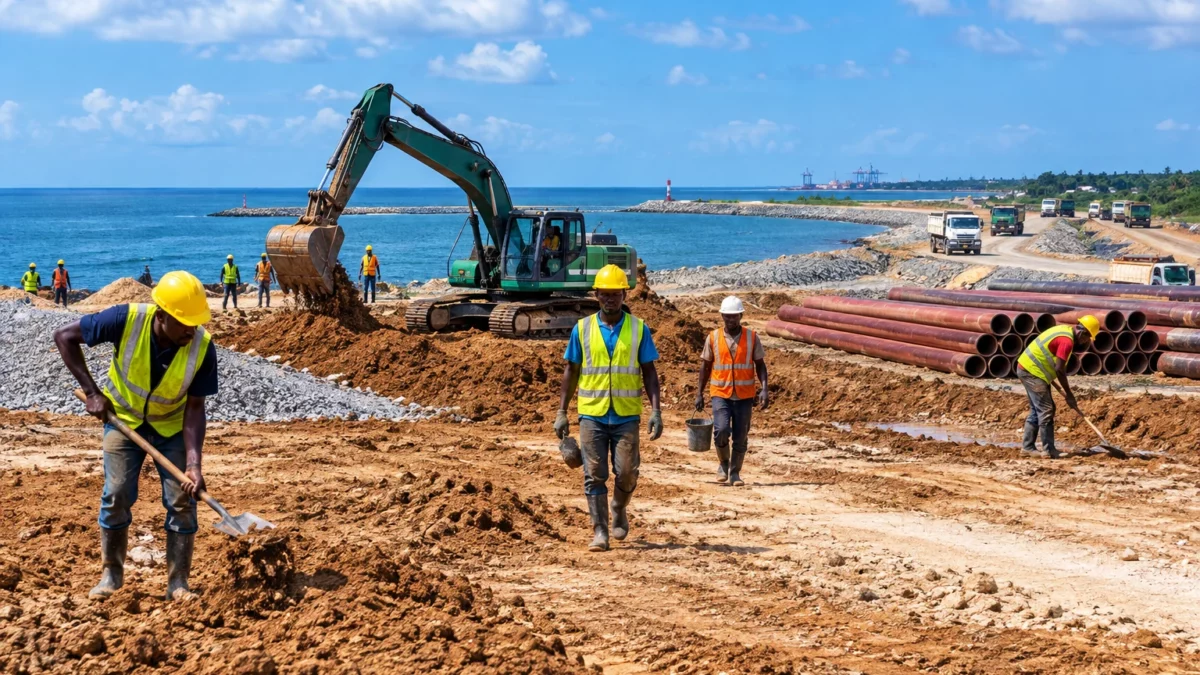
A port can reduce the time ships spend waiting. But on its own, it cannot bring down the price of goods: containers still have to be transported to cities and businesses. That is the central challenge facing the Bakassi project in Nigeria’s Cross River State.
A new maritime gateway in eastern Nigeria
Vice-President Kashim Shettima launched work on the Bakassi deep-water port on 13 November 2026, on behalf of President Bola Tinubu. The facility is designed with a draught of 20 metres, deep enough to accommodate large ships. The announced total cost is $3.5bn.
The project also includes a road corridor intended to connect the port to the country’s interior. Cross River State government documents describe a 275-kilometre toll highway. Other reports of the ceremony cite 260 kilometres: this discrepancy will need to be clarified in the final plans. Nor does the announced overall cost mean that all the funding has already been secured.
The port is being developed as a public-private partnership, a collaboration between the public authorities and private investors. An agreement ratified in February 2025 provides for an 80% stake for Arise IIP and a 20% stake for the Cross River State government. Afreximbank, the African Export-Import Bank, is involved in the financing structure. Public announcements distinguish, however, between the project’s total cost and an initial financing approval valued at $2.27bn.
Bakassi is part of a long-running project that has been revived several times. The shareholders’ agreement marked an institutional milestone, but the start of construction guarantees neither a date for commercial opening nor adherence to the schedule. The government has not yet provided a firm operational deadline.
The challenge goes beyond the quays
Nigeria is seeking to reduce its dependence on the ports of Lagos, notably Apapa and Tin Can Island. According to the authorities, more than 80% of the country’s foreign trade passes through Lagos. Such concentration exposes supply chains to delays and leaves businesses dependent on a handful of road and port access routes.
Problems persist despite the opening of the Lekki deep-water port in 2023. In the first half of 2026, the average time ships spent in Nigerian ports reached 5.3 days, up from 5 days a year earlier, according to Nigerian Ports Authority data reported by BusinessDay. The average rose to 6.1 days at Apapa and 5.1 days at Tin Can Island.
These figures measure the time ships spend in port, not the full time goods wait before delivery. They nevertheless show that adding quays does not automatically resolve delays. Roads, customs procedures, co-ordination between government agencies and the movement of containers to domestic markets will also affect costs.
The planned road is therefore central. It could connect the port facilities to Nigeria’s production and consumption zones. But its financing, construction and maintenance will be decisive. If goods remain stuck on congested routes, the gains made at sea risk being lost on land. Residents of Cross River could benefit from jobs and local economic activity, while the benefits for traders and consumers will depend above all on the actual cost of transport.
A regional ambition to be tested
The project’s promoters present Bakassi as a potential gateway for trade with the West African hinterland and some landlocked countries. This ambition remains to be proven: operators will choose their routes according to journey times, costs, security and the reliability of land links. The port will also have to find its place alongside the maritime hubs already established in the Gulf of Guinea.
For Nigeria, a member of ECOWAS — the Economic Community of West African States —, the stakes go beyond Cross River State. Improved movement of goods could strengthen regional trade and the ambitions of the African Continental Free Trade Area. But these effects will depend on cross-border agreements and compatible customs procedures, not just on the capacity to handle ships.
The next step will therefore be less symbolic: turning the construction site into a functioning facility, connecting the port to markets and making the financial commitments and timetable public. The project could diversify Nigeria’s maritime access points. Its success, however, will be measured by the actual delays and costs borne by businesses and households, in Lagos as well as in regions far from the quays.
Background sources: Cross River State government statement on the launch of construction, Premium Times report, first-half 2026 port data reported by BusinessDay and official project and road corridor details.