Algeria
 Egypt
 Libya
 Morocco
 Sudan
 Tunisia
 Benin
 Burkina Faso
 Cabo Verde
 Côte d'Ivoire
 Ghana
 Guinea
 Guinea-Bissau
 Liberia
 Mali
 Mauritania
 Niger
 Senegal
 Sierra Leone
 The Gambia
 Togo
 Cameroon
 Central African Republic
 Chad
 DR Congo
 Equatorial Guinea
 Gabon
 Republic of the Congo
 São Tomé and Príncipe
 Burundi
 Comoros
 Djibouti
 Eritrea
 Ethiopia
 Kenya
 Madagascar
 Malawi
 Mauritius
 Mozambique
 Rwanda
 Seychelles
 Somalia
 South Sudan
 Tanzania
 Uganda
 Angola
 Botswana
 Eswatini
 Lesotho
 Namibia
 South Africa
 Zambia
 Zimbabwe
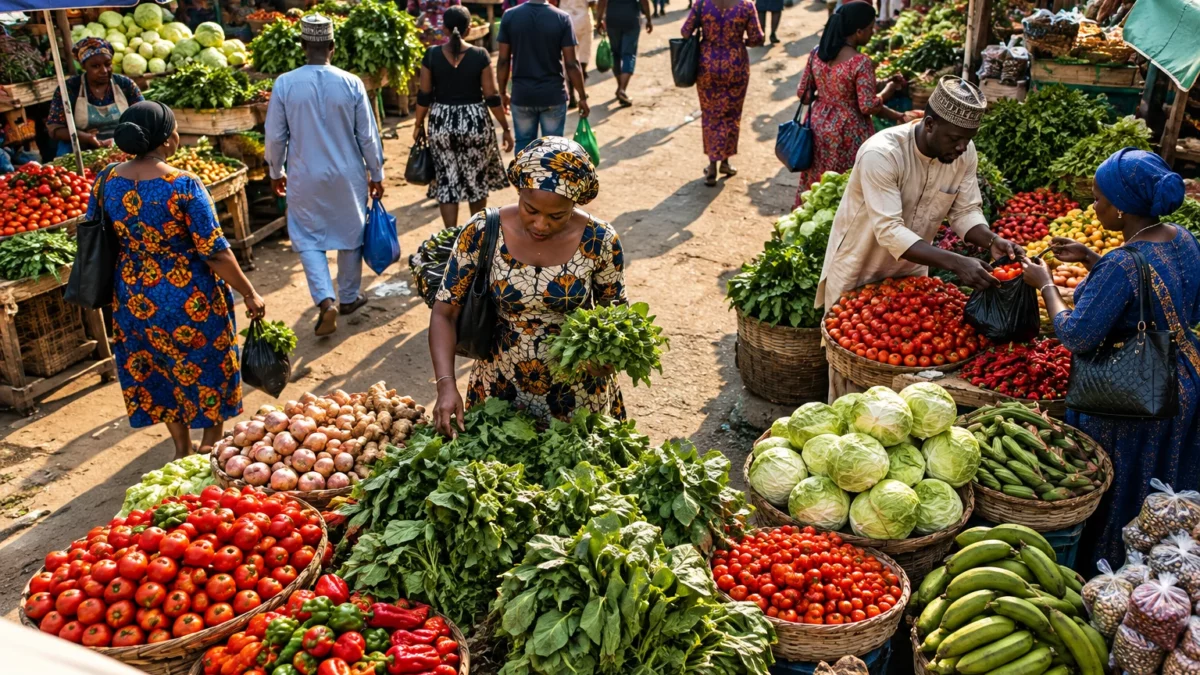
A fall in annual inflation does not mean that prices are falling in Nigeria. It indicates that they are rising more slowly than a year earlier. In October, another indicator even accelerated over the month, reminding us that the cost of living remains a concrete concern for households.
Annual slowdown, but faster monthly price rises
Nigeria’s National Bureau of Statistics (NBS) put annual inflation at 14.06% in October 2026. It stood at 14.63% in September and 18.97% in October 2025. The figures are included in the consumer price index report published on 16 November. Nigerian public broadcaster Voice of Nigeria and independent daily Premium Times reported the same NBS data.
The annual trend is therefore one of moderation. But between September and October, prices rose by 0.43%, compared with 0.06% the previous month. The index thus measures two different realities: over a year, price rises are slowing; over a month, they have accelerated. The fall in the annual rate does not mean that the shopping basket has become cheaper.
Food products, which account for a large share of daily spending, illustrate this contrast. Annual food inflation fell from 19.59% in September to 19.13% in October. By contrast, food prices fell by 0.75% over the month, after a 1.55% decline in September. The fall therefore continued, but at a slower pace.
Reforms whose effects are felt in households
Since taking office in 2023, President Bola Tinubu has introduced major changes: the removal of the fuel subsidy and the easing of foreign-exchange controls. These measures were intended in particular to reduce public-finance imbalances and improve access to foreign currency. They have also raised the cost of essential items, notably transport, energy and imports, with knock-on effects on the prices paid by consumers.
The fall in annual inflation is a sign of moderation, not a complete measure of purchasing power. For a household, the immediate issue remains how much it has to spend on food, transport and housing, as well as how its income is changing. Traders and small businesses, often exposed to transport costs and exchange-rate fluctuations, must also contend with prices that can still rise from one month to the next.
The national average does not describe every local situation. Consumption patterns, supply conditions and transport costs vary between states and between urban and rural areas. National figures alone therefore cannot precisely measure the pressure on each household or informal business.
Central bank adjusts course without declaring victory
The Central Bank of Nigeria (CBN) set its policy rate at 23% at its meeting on 21 and 22 September, after keeping it at 26.5% in July. The policy rate serves as a benchmark for the cost of credit and financial conditions. The bank nevertheless specified that this operational adjustment did not amount to abandoning its restrictive monetary stance.
The CBN places this policy within a transition towards inflation targeting: an approach that involves guiding monetary decisions around a price-inflation objective. The fall in annual inflation may give the central bank more room to manoeuvre, but October’s monthly acceleration and the still-high level of food prices call for caution. A lower policy rate alone does not guarantee a rapid reduction in household spending.
A Nigerian issue with West African repercussions
Nigeria is West Africa’s largest economy and most populous country. Changes in its prices and currency matter to its partners, notably within ECOWAS, the Economic Community of West African States. Cross-border trade, flows of goods and the decisions of regional businesses may be affected by Nigerian costs and economic conditions. This does not mean that countries in the region are following the same trajectory: each retains its own economic dynamics and policies.
In the coming months, indicators to watch will include monthly inflation, food prices, the exchange rate and the CBN’s next decisions. The October report shows an improvement over a year, corroborated by data reported by separate Nigerian media outlets. It also shows why this statistical improvement is not enough to conclude that pressure on household budgets has eased.