Algeria
 Egypt
 Morocco
 Sudan
 Tunisia
 Benin
 Burkina Faso
 Cabo Verde
 Côte d'Ivoire
 Ghana
 Guinea
 Guinea-Bissau
 Liberia
 Mali
 Mauritania
 Niger
 Nigeria
 Senegal
 Sierra Leone
 The Gambia
 Togo
 Cameroon
 Central African Republic
 Chad
 DR Congo
 Equatorial Guinea
 Gabon
 Republic of the Congo
 São Tomé and Príncipe
 Burundi
 Comoros
 Djibouti
 Eritrea
 Ethiopia
 Kenya
 Madagascar
 Malawi
 Mauritius
 Mozambique
 Rwanda
 Seychelles
 Somalia
 South Sudan
 Tanzania
 Uganda
 Angola
 Botswana
 Eswatini
 Lesotho
 Namibia
 South Africa
 Zambia
 Zimbabwe
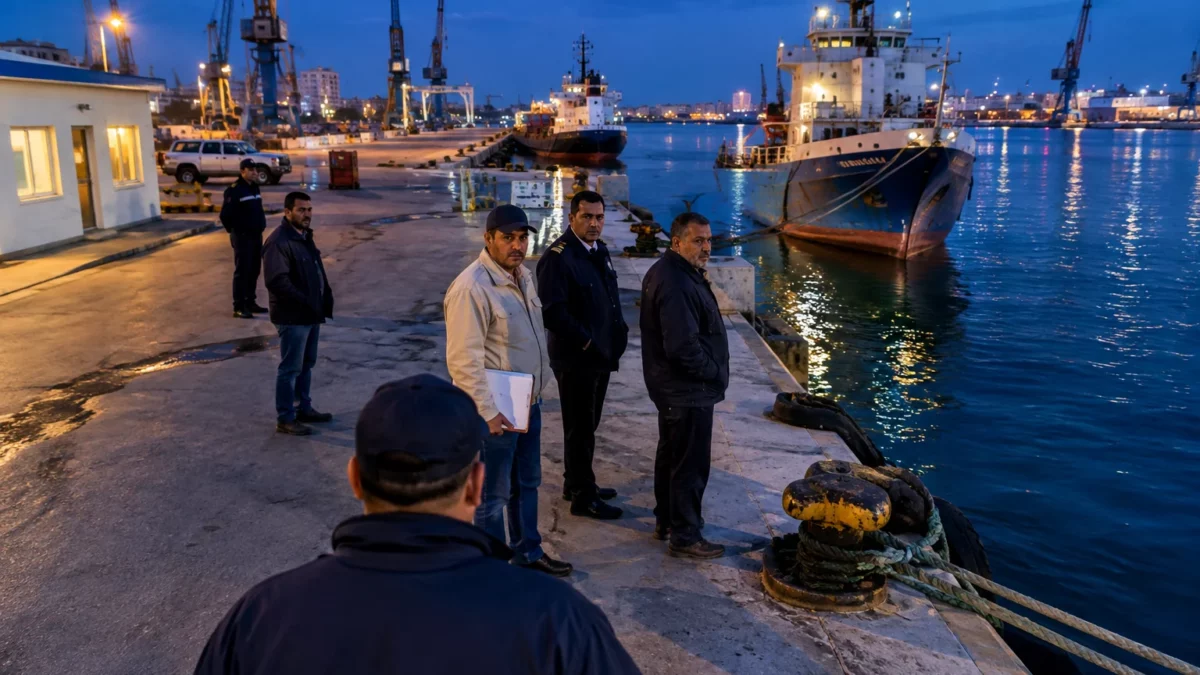
A war being fought thousands of kilometres from Libya has now reached a port in Benghazi. Beyond the vessels hit, the incident poses an immediate question for Libyans: who decides what can take place in their waters and on their territory, while the country remains divided between two rival authorities?
A strike claimed at a Libyan port
On the night of Sunday 22 November 2026, a naval drone operation targeted Russian vessels at the port of Benghazi, in eastern Libya. Ukrainian President Volodymyr Zelensky claimed responsibility for the action. Libyan military officials cited by the Associated Press said the Russian corvette Merkury had been heavily damaged and that a fire had broken out at the naval base.
Kyiv also says it struck the cargo ship Angara, which it describes as a vessel involved in Russian military logistics. Ukrainian authorities say the operation targeted Russian military objectives. However, not all the details put forward by the two sides have been independently verified. Authorities in eastern Libya have announced an investigation into the incident. No confirmed casualties were reported in the first available accounts.
On 24 November, Ukrainian Foreign Ministry spokesman Heorhii Tykhyi invoked Ukraine’s right to defend itself against Russian aggression. Kyiv argues that this right, enshrined in Article 51 of the United Nations Charter, allows it to strike Russian military targets, including outside Ukrainian territory. This is Ukraine’s position: it does not, by itself, settle the question of respect for Libyan sovereignty or the precise status of the vessels targeted.
Two Libyan authorities, one shared concern over sovereignty
The Libyan response reflects a fragmented institutional reality. The Government of National Unity, based in Tripoli and recognised by the UN, condemned the operation and said it had not authorised it. It asked Kyiv for an explanation of its nature and scope. In the east, the rival government based around Benghazi also denounced the strike and called for an international investigation, including into the possible presence of Ukrainian personnel in the west of the country.
These authorities do not form a joint government, and their statements should not be conflated. But the incident confronts them with the same challenge: preventing Libyan territory from becoming a theatre for foreign confrontation without consent recognised by the state. In a country whose political and security institutions remain divided, investigations and accusations can also become instruments of rivalry between east and west.
The division also has a geopolitical dimension. The eastern authorities maintain ties with Moscow, while Libyan forces and institutions remain dispersed among several centres of power. A strike against Russian vessels in an eastern port therefore risks being interpreted through the lens of these alliances, even as Kyiv says it is targeting only Russian military interests. This interpretation does not, in itself, prove that Libyan actors were involved in the operation.
Kyiv’s invocation of the law does not settle the debate
Article 51 of the United Nations Charter recognises the right to self-defence when a state suffers an armed attack. Ukraine invokes this principle to justify its operations against Russian targets. But applying this right to a strike carried out at a port on the territory of another state raises separate questions: where exactly were the vessels, what threat did they pose, and what rules apply to the use of force on the territory or in the waters of a third country?
The publicly available information is insufficient to resolve these points. Kyiv’s description of the vessels as “legitimate military targets” remains Ukraine’s position. For its part, the government based in Tripoli disputes the absence of authorisation. Ukraine’s justification must therefore be distinguished from the facts that remain to be established through an independent investigation.
The eastern government says the Merkury was in Benghazi to refuel and take on supplies before returning to Russia, under maritime cooperation agreements. Ukraine, meanwhile, describes the vessels targeted as part of Russian military logistics. These conflicting accounts concern the vessels’ role and the circumstances of their presence in the port. Verifying them will be crucial to understanding the incident, without prejudging its legal classification.
Repercussions beyond Benghazi
Italy has expressed concern. On 24 November, its Foreign Minister, Antonio Tajani, conveyed his concerns to his Ukrainian counterpart and stressed the need to respect Libyan sovereignty, as well as the risk of the war spreading to the Mediterranean. Rome’s response reflects a concrete regional concern: worsening security in Libya could affect maritime trade and diplomatic efforts across the Mediterranean basin.
For residents, the effects extend beyond diplomatic relations. Rising tensions could undermine security around port facilities, disrupt commercial activity and intensify rivalries between armed forces. The consequences will depend in particular on the ability of the authorities in Tripoli and the east to coordinate their responses, given that they do not have a unified national chain of command.
The UN is working to support a Libyan political process and the reunification of institutions. In August 2026, Libyan actors signed an agreement in Tripoli on steps in the political roadmap, while the UN mission continues its efforts towards elections and more coherent institutions. The Benghazi incident puts these efforts to the test: a credible investigation and exchanges between the authorities could curb mutual accusations, but the available information does not yet make it possible to say what follow-up they will receive.
Across Africa, the case is a reminder that an external conflict can find an extension on the continent when foreign military interests intersect with fragile national institutions. Libya, however, is not merely a theatre for rivalries: its authorities, local actors and the United Nations remain stakeholders in the search for a political solution. The next developments to watch are the findings of the announced investigations, Kyiv’s official response to Libyan requests and any initiative to prevent further military operations on the country’s soil or in its waters.