Algeria
 Egypt
 Libya
 Morocco
 Sudan
 Benin
 Burkina Faso
 Cabo Verde
 Côte d'Ivoire
 Ghana
 Guinea
 Guinea-Bissau
 Liberia
 Mali
 Mauritania
 Niger
 Nigeria
 Senegal
 Sierra Leone
 The Gambia
 Togo
 Cameroon
 Central African Republic
 Chad
 DR Congo
 Equatorial Guinea
 Gabon
 Republic of the Congo
 São Tomé and Príncipe
 Burundi
 Comoros
 Djibouti
 Eritrea
 Ethiopia
 Kenya
 Madagascar
 Malawi
 Mauritius
 Mozambique
 Rwanda
 Seychelles
 Somalia
 South Sudan
 Tanzania
 Uganda
 Angola
 Botswana
 Eswatini
 Lesotho
 Namibia
 South Africa
 Zambia
 Zimbabwe
When water becomes a daily scramble
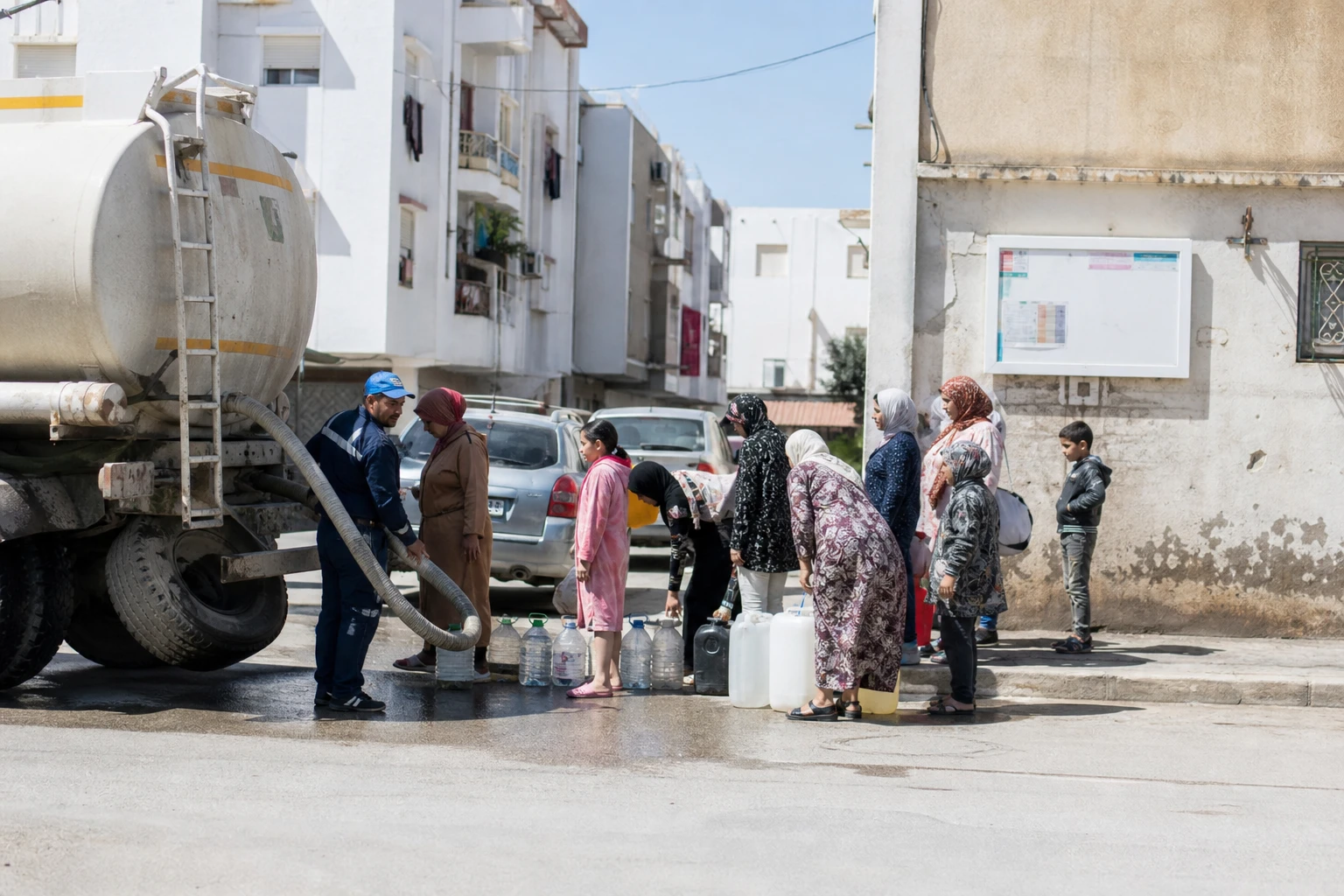
In Tunisia, the heat is more than seasonal discomfort. It weighs on water supplies, travel and everyday life. In several cities, queues outside shops are growing longer. Residents are searching for bottled water, sometimes after lengthy waits, while supply cuts are making the situation even more difficult. The strain is also felt in low-income households, where every litre counts, and in neighbourhoods where domestic water tanks are no longer enough.
The country is enduring a particularly gruelling summer. The National Institute of Meteorology said July 2026 was exceptionally hot, with a national average temperature of 31.7°C, 3.4°C above normal. At the same time, the National Water Exploitation and Distribution Company has pointed out that supplies to Greater Tunis depend largely on water brought to the capital from the north. This makes the capital, Tunis, highly vulnerable to water supply disruptions, especially when demand rises sharply.
Authorities confront a supply crisis
On 28 August, the Tunisian authorities mobilised joint units of the national army, National Guard and civil protection to distribute drinking water by tanker in several regions affected by supply disruptions and water cuts. The measure was announced amid a heatwave that had worsened supply difficulties. The same official source said stocks of bottled water stored in unauthorised locations had been discovered, and ordered their seizure so they could be returned to the market.
On the ground, distribution is not limited to water tankers. Operations to fill and deliver drinking water have been reported in several areas, notably in the governorate of La Manouba and the Tataouine region. In these cases, National Guard and army units have supported local authorities in meeting the most urgent needs. These emergency interventions provide immediate relief, but they are no substitute for a lasting upgrade of the network.
Social tensions extend beyond the weather
Social tensions are not caused by the heat alone. They also stem from a succession of pressures: water cuts, power rationing, insufficient stocks and a sense of institutional silence. Tunisian organisations representing young doctors have condemned the lack of official clarification about deaths linked to heatwaves, while associations defending economic and social rights have warned of a crisis that has become structural. The debate is therefore not solely about health. It concerns trust in the state, equal access to public services and the authorities’ ability to anticipate problems rather than put out fires after the fact.
The figures show the scale of the problem. In July 2026, the Tunisian Observatory of Water recorded 608 reports of supply disruptions, which it described as a critical phase of water emergency. The organisation also noted an increase in water-related protests, from 23 in June to 34 in July. This points to a clear divide between announcements of crisis management and the lived experience of part of the population, in cities and more isolated areas alike.
A warning for Tunisia and its Maghreb neighbours
This episode goes beyond the latest news from Tunisia. It is a reminder that water resilience is becoming a central issue in North Africa, where heat, rainfall variability and urban pressure are reinforcing one another. For Tunisia, a member of the Arab Maghreb Union, the challenge is twofold: secure immediate access to water and accelerate investment in networks, dams, maintenance and loss management. Emergency responses protect households. But they also expose the fragility of a system already under strain.
The next steps will depend on two fronts. First, the authorities’ ability to maintain supplies during heat peaks. Second, the implementation of more structural solutions in water and energy, two closely linked sectors in Tunisia. As long as progress on these issues remains slow, every heatwave risks becoming a test of governance, with a direct cost for households, businesses and public services.