Algeria
 Egypt
 Libya
 Morocco
 Sudan
 Benin
 Burkina Faso
 Cabo Verde
 Côte d'Ivoire
 Ghana
 Guinea
 Guinea-Bissau
 Liberia
 Mali
 Mauritania
 Niger
 Nigeria
 Senegal
 Sierra Leone
 The Gambia
 Togo
 Cameroon
 Central African Republic
 Chad
 DR Congo
 Equatorial Guinea
 Gabon
 Republic of the Congo
 São Tomé and Príncipe
 Burundi
 Comoros
 Djibouti
 Eritrea
 Ethiopia
 Kenya
 Madagascar
 Malawi
 Mauritius
 Mozambique
 Rwanda
 Seychelles
 Somalia
 South Sudan
 Tanzania
 Uganda
 Angola
 Botswana
 Eswatini
 Lesotho
 Namibia
 South Africa
 Zambia
 Zimbabwe
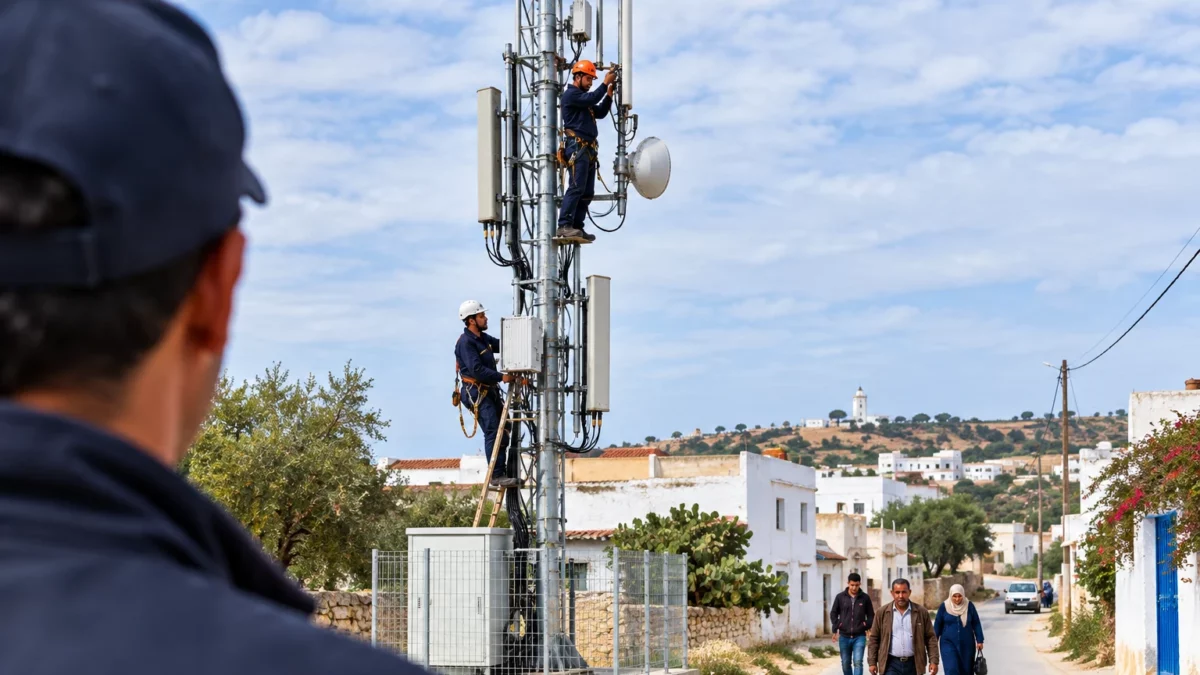
A mobile mast can bring a village closer to public services, markets and loved ones. But in Tunisian regions where people live far apart, commercial returns are not always enough to fund a network. The government is therefore relying on public funds to extend coverage where operators have no contractual obligation to do so.
Public funding for underserved areas
On 19 November 2026, Tunisia’s Minister of Communication Technologies, Sofiène Hemissi, announced a 76 million dinar allocation to improve telecoms coverage. The funding will come from the Communication Technologies Sector Development Fund. The contract has been awarded to Tunisie Télécom and work has begun, the minister told parliamentarians gathered in Tunis to examine his department’s budget.
The programme targets communities that fall outside the coverage commitments of the country’s three operators. The challenges are particularly pronounced in sparsely populated areas and in border, mountainous and desert regions. Installing relay masts or laying fibre there costs more when distances are long and the number of potential subscribers is limited.
So far, the authorities have not specified how many communities and residents will benefit from the project, or when it is due to be completed. The lack of a timeline and public indicators means its practical scale cannot yet be assessed. The minister also noted that local permits and procurement procedures can delay the work.
Previous experience, but results still to be documented
Tunisia has previously used public funding to extend access to telecommunications in sparsely populated areas. A programme linked to “Tunisia Digital 2020” was awarded to Tunisie Télécom from 2017. According to information reported at the time, it targeted 94 areas across 47 delegations and 15 governorates, with goals covering residents, schools and health centres.
An assessment of Tunisia’s digital ecosystem published by USAID in July 2024 provides a reference point for infrastructure progress, but is not sufficient on its own to establish all the detailed results of the earlier programme. The government should therefore publish comparable data for the new project: sites built, villages covered, signal quality and effective internet access. Installing a mast alone does not guarantee an affordable or reliable service.
The choice of a public mechanism reflects a practice found across much of the continent. The GSMA, an international mobile industry association, said in 2023 that 51 of Africa’s 54 countries had established or were preparing a universal service fund. Such funds can finance infrastructure in areas where expected revenues do not cover deployment costs. Their effectiveness, however, depends on transparent tenders, monitoring of works and publication of results.
Coverage, usage and new technologies
Network coverage is only one part of the digital divide. People also need to be able to afford a device and a plan, have access to electricity, know how to use the technology and receive a sufficiently reliable service. For small rural businesses, farmers, pupils and health centres, these conditions determine whether connectivity becomes genuinely useful.
The minister also raised satellite internet as a way to reach hard-to-access areas. The 2027 Finance Bill provides for the exemption of certain satellite connectivity equipment from customs duties. This option could complement terrestrial networks, but the authorities have not yet set out how it will fit with the 76 million dinar allocation or what tariffs users will face.
At the same time, the government plans to phase out the copper network before December 2027 in favour of fibre. The transition requires investment and planning: areas already served by fibre are not necessarily those still waiting for a first connection. Monitoring should therefore distinguish between upgrading existing networks and extending them to communities that remain poorly covered.
A Tunisian issue within a regional divide
The GSMA estimates that in 2026, 122 million people in Africa will live beyond the reach of a mobile broadband network. This figure describes the coverage gap, not the number of people who do not use the internet: some live within signal range but face other barriers, including cost or a lack of digital skills. For Tunisia, the challenge is therefore both to connect areas without coverage and to make the service accessible over the long term.
At the North African level, regional co-operation remains a relevant framework, even though the Arab Maghreb Union does not currently constitute an integrated market comparable to more active economic groupings. Digital networks, online services and cross-border exchanges could nevertheless benefit from better interconnection. At continental level, the African Union also promotes digital integration goals, while disparities in access between capitals and outlying regions remain a shared challenge.
The next step will be to measure the contract’s implementation and verify whether the targeted communities gain a stable connection, rather than merely theoretical coverage. Publishing a timeline, the areas concerned and quality checks will allow residents and elected representatives to assess how the funds are used. Without this information, the announcement sets an ambition but does not yet make it possible to judge its impact on the daily lives of Tunisians.
Tunisia’s TAP news agency on the 76 million dinar allocation reported the minister’s announcement. African Manager also reported on discussions around the 2027 budget and coverage difficulties raised by parliamentarians.