
 Algeria
 Egypt
 Libya
 Morocco
 Sudan
 Tunisia
 Benin
 Burkina Faso
 Cabo Verde
 Côte d'Ivoire
 Ghana
 Guinea
 Guinea-Bissau
 Liberia
 Mali
 Mauritania
 Niger
 Nigeria
 Senegal
 Sierra Leone
 The Gambia
 Togo
 Cameroon
 Central African Republic
 Chad
 Equatorial Guinea
 Gabon
 Republic of the Congo
 São Tomé and Príncipe
 Burundi
 Comoros
 Djibouti
 Eritrea
 Ethiopia
 Kenya
 Madagascar
 Malawi
 Mauritius
 Mozambique
 Rwanda
 Seychelles
 Somalia
 South Sudan
 Tanzania
 Uganda
 Angola
 Botswana
 Eswatini
 Lesotho
 Namibia
 South Africa
 Zambia
 Zimbabwe
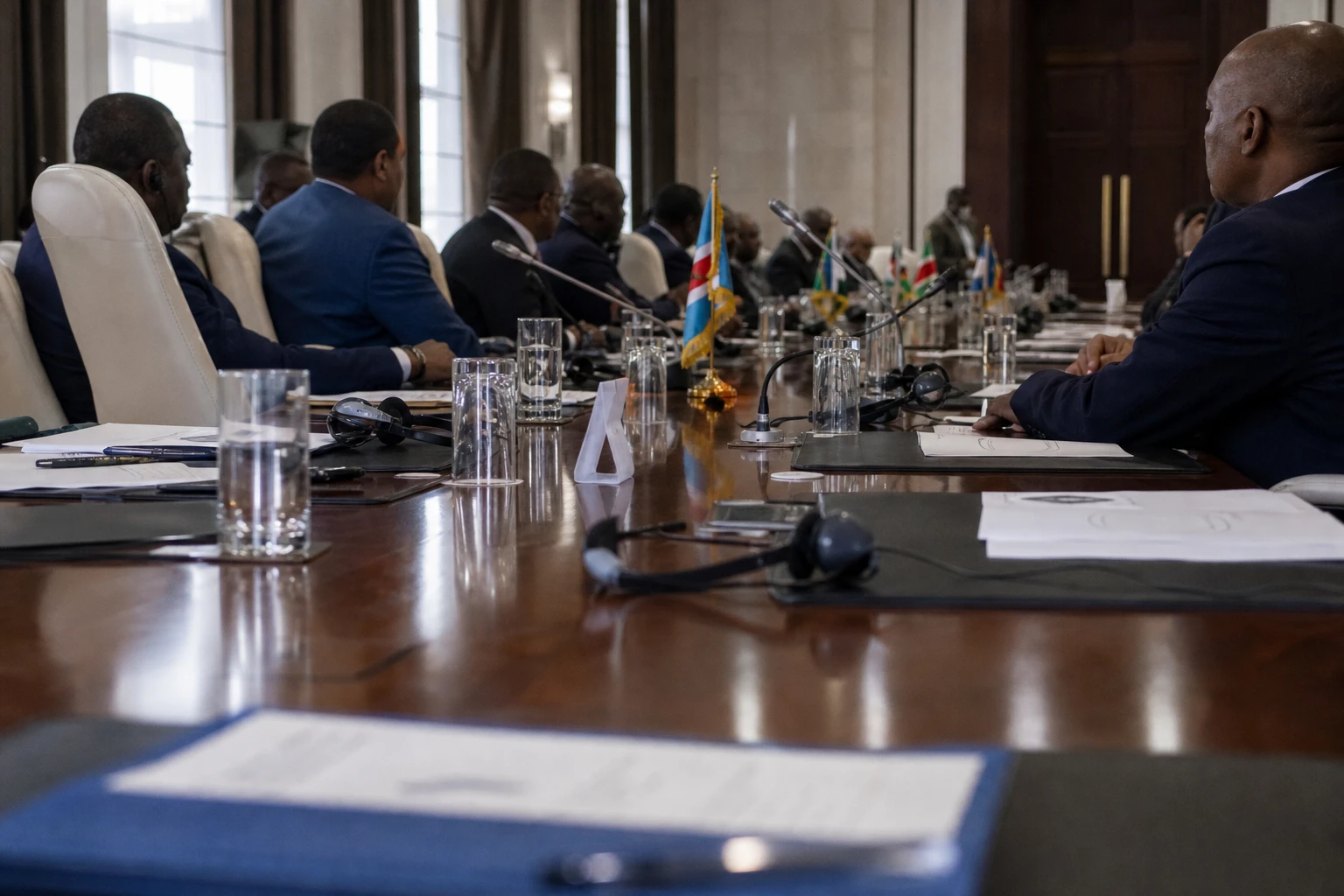
In Kinshasa, the word “dialogue” weighs on more than politics. It also weighs on Congolese memory: they have seen forums, agreements and mediation efforts come and go without the east of the country ceasing to burn. The announcement of 17 July 2026 therefore revives a simple question: is this another framework, or a genuine turning point?
The latest development began at the Cité de l’Union africaine in Kinshasa, during a meeting lasting about two hours between Félix Tshisekedi and representatives of the main religious denominations. Afterwards, Cardinal Fridolin Ambongo said the head of state had chosen the option of an inclusive national dialogue. The Congolese presidency confirmed this direction in a statement published the same day.
The announcement comes in a country where the Democratic Republic of the Congo is pursuing multiple channels to resolve the crisis. At the same time, Kinshasa remains engaged in the Washington and Doha processes on security in the east, while the African Union and regional actors continue to call for a lasting ceasefire. The United Nations also notes that talks involving the AFC/M23 are continuing in a separate framework, with Qatar mediating and other partners providing support.
What has been decided, and what has not
The political principle appears to be settled: the Congolese president wants to convene a dialogue that he intends to lead himself. According to the official statement, a presidential decree must still set out the terms of reference, the method, the venue and the composition of the format. At this stage, there is no indication that a timetable has been set.
The religious denominations are not being presented as decision-makers but as facilitators. CENCO, ECC, the Muslim community and the Platform of Religious Denominations are to continue consultations. Their role resembles that of moral and political support, in a context where the Catholic Church retains a rare degree of influence over public debate in the Congo.
The government is also stressing a sensitive point: this dialogue would replace neither the Washington process nor the one in Doha. Kinshasa is thus seeking to avoid the impression of a single overarching framework that would absorb all discussions. This clarification matters because it shows that the Congolese authorities are seeking to keep several tables in play at once: the domestic table, the security table and the diplomatic table.
An old debate, reopened by the Constitution and the war in the east
The current controversy is not limited to the word “dialogue”. It is linked to debate over a possible constitutional revision. In June 2026, CENCO said there was no need, urgency or opportunity to amend the 2006 Constitution, a position subsequently echoed by several religious and political voices. Cardinal Ambongo himself reaffirmed this stance during the 30 June celebrations.
In response, the presidential majority argues that no national issue should be off limits for discussion. But it now links the debate to a demand for loyalty in the face of what it describes as Rwandan aggression and the crisis in the east. This difference in framing is central: for the authorities, inclusivity requires a clear condemnation of the external enemy; for some in the opposition, it requires first guarantees on civil liberties and political prisoners, and the abandonment of any attempt at constitutional reform seen as an extension of the government’s hold on power.
In Kinshasa, this political standoff has concrete effects. In the capital, it shapes party calculations, the Churches’ caution and the hesitation of a civil society keen to avoid another round of promises that come to nothing. In the east, where fighting and displacement weigh on the market economy as well as local administration, the institutional debate may seem remote but remains decisive: it could accelerate, or conversely delay, the creation of a cohesive domestic front.
The weight of regional mediation
Kinshasa’s announcement cannot be understood without the regional backdrop. Angola continues to occupy a distinct place in efforts to de-escalate tensions around the DRC, as Tshisekedi recalled in Luanda on 16 July 2026. Burundi, for its part, has served as a diplomatic point of contact in this period, as regional consultations on the Congolese crisis multiply.
This regional dimension matters for a simple reason: the Congolese crisis has long spilled beyond national borders. The east of the country remains at the centre of a web in which security, cross-border trade, refugees, strategic minerals and rivalries for influence intersect. SADC has been monitoring the situation for several years, while the African Union is seeking to maintain a common political framework with the other mediators.
In this landscape, the national dialogue sought by Kinshasa could serve two purposes at once. First, to tighten the domestic front. Second, to give Congolese diplomacy more weight in external discussions. But this advantage remains fragile. If the format excludes too many actors, it will be challenged. If it becomes too broad, it risks turning into an arena without decisions. This is where the essential issue lies: the authorities’ ability to produce a framework that is clear, credible and politically useful.
The next step will therefore be crucial. It depends on the announced presidential decree, but also on how the religious consultations incorporate—or not—the opposition’s reservations. For the DRC, the real test will not simply be to convene a dialogue. It will be to show that this dialogue can speak to the entire country without becoming just another moment in the long succession of attempts to resolve the crisis.



