Algeria
 Egypt
 Libya
 Morocco
 Sudan
 Tunisia
 Benin
 Burkina Faso
 Cabo Verde
 Côte d'Ivoire
 Ghana
 Guinea
 Guinea-Bissau
 Liberia
 Mauritania
 Niger
 Nigeria
 Senegal
 Sierra Leone
 The Gambia
 Togo
 Cameroon
 Central African Republic
 Chad
 DR Congo
 Equatorial Guinea
 Gabon
 Republic of the Congo
 São Tomé and Príncipe
 Burundi
 Comoros
 Djibouti
 Eritrea
 Ethiopia
 Kenya
 Madagascar
 Malawi
 Mauritius
 Mozambique
 Rwanda
 Seychelles
 Somalia
 South Sudan
 Tanzania
 Uganda
 Angola
 Botswana
 Eswatini
 Lesotho
 Namibia
 South Africa
 Zambia
 Zimbabwe
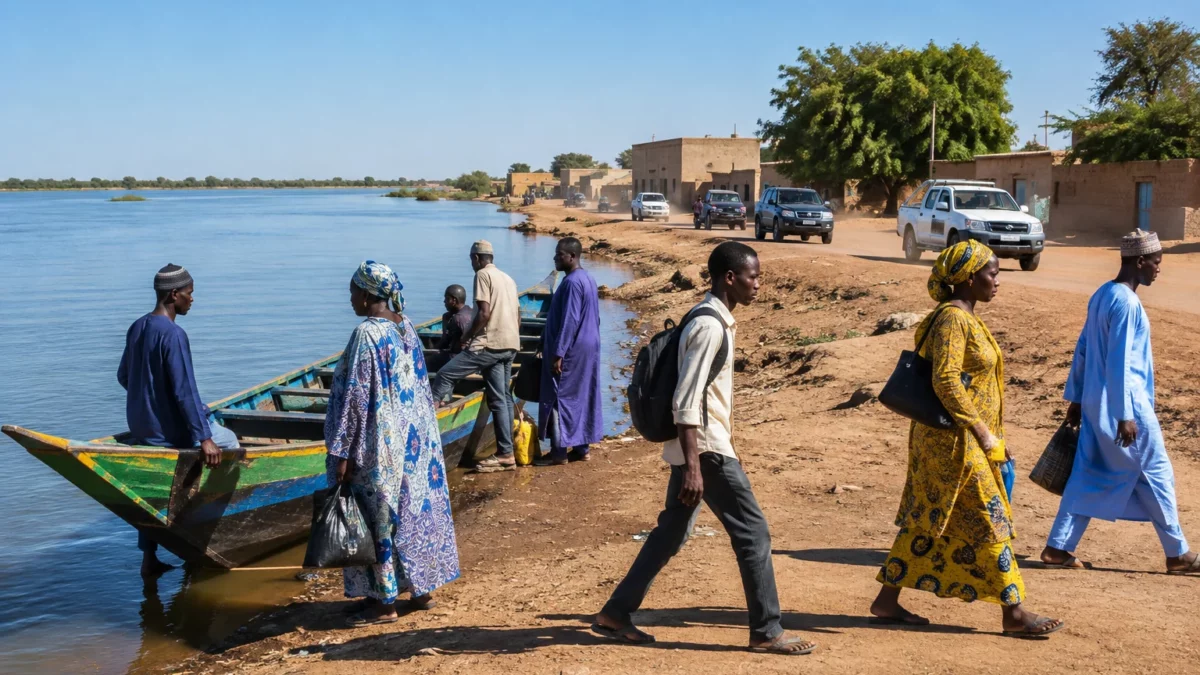
In Tonka, in the Timbuktu region, the presence of soldiers is supposed to reassure residents. It also exposes them to renewed armed pressure. The Group for the Support of Islam and Muslims (JNIM), affiliated with al-Qaeda, is threatening to cut off access to the town unless civilians leave.
A threat targeting movement and trade
In voice messages circulated on Sunday, JNIM reportedly gave residents five days to leave Tonka if they wished to do so. The deadline would expire on Friday 27 November 2026. The group then threatens to prevent vehicles from entering or leaving the town, and canoes from landing there. It says that anyone attempting to cross the blockade would be considered a military target.
These details come from local accounts cited in information available about the ultimatum. The content of the messages and the precise means by which they were circulated have not been publicly confirmed by the Malian authorities. The army and the governorate of Timbuktu did not respond to requests for comment mentioned in these reports. Accordingly, the threat should be reported as a statement attributed to JNIM, not as a blockade already in force.
According to residents quoted in the same reports, a detachment of the Malian Armed Forces (FAMa) and their Russian partners from Africa Corps has been stationed at the entrance to Tonka since late summer. The exact duration of this presence remains uncertain. The deployment follows local calls for the army to maintain a permanent position rather than limit itself to patrols.
A town already marked by threats
The pressure did not begin with this ultimatum. In November 2025, Mariam Cissé, a content creator from Tonka, was abducted and then publicly executed. Accounts reported at the time said she was accused of supporting the army. Human Rights Watch also documented her execution and the attribution of the accusation to suspected JNIM fighters. The armed group had not, however, claimed responsibility for the killing when several media outlets reported it.
Reports published since then describe other targeted killings in Tonka, targeting civilians suspected of collaborating with Malian forces. Each accusation remains an allegation by the suspected perpetrators and is not proof of collaboration. But this pattern creates a risk for residents: being caught between reprisals by an armed group and operations by the forces present in the area.
The regional precedent also shows that threats of forced departure can trigger large-scale displacement. Mali’s National Human Rights Commission reports that a blockade imposed in October 2025 on the Léré-Niono route was accompanied by an ultimatum. The Malian Red Cross reported at the time that thousands of people had been displaced in several localities, including Tonka. This precedent cannot predict the scale of any movement today, but it highlights families’ vulnerability when roads and waterways become uncertain.
Security is not measured by military presence alone
For the authorities, stationing a detachment may respond to a request for protection and strengthen control over access routes. For residents, however, security also depends on being able to travel, reach markets, receive medical care and continue daily activities without being suspected by either side.
A restriction on movement, even if announced but not yet enforced, can disrupt trade. Traders risk losing access to goods and markets. Households reliant on farming, livestock or small businesses have fewer alternatives than an administration or a company with reserves. Travel to neighbouring villages can also make it harder to access essential services, particularly if canoes and roads are targeted at the same time.
At this stage, no mass departures have been reported in the available information. Local sources say the military is urging calm and considers the situation under control. This assurance is not equivalent to independent confirmation that routes are safe or a guarantee against future obstruction. It is therefore important to distinguish between reported instructions, observed facts and announcements by parties to the conflict.
An issue for Mali and the Sahel
Tonka is in the Timbuktu region of northern Mali, where state authority and armed groups are competing for control of roads and towns, and for influence over the population. Since the 2020 coup, the transitional authorities have redirected their security partnerships, notably towards Russia. Africa Corps is now presented as a partner of the Malian forces. This cooperation alone is not enough to establish whether a town is durably protected: access routes, freedom of movement and civilian safety also matter.
At the regional level, Mali is a member of the Alliance of Sahel States, alongside Burkina Faso and Niger, and has left the Economic Community of West African States (ECOWAS), the regional organisation for West African integration. This realignment affects frameworks for cooperation between governments, but does not change the daily reality for people in the north: their movements and trade cross administrative borders and depend on passable roads.
The immediate priority is to establish whether the announced deadline will be followed by actual restrictions, whether residents can travel safely and whether the authorities are issuing verifiable instructions. The case of Tonka is a reminder that a military deployment translates into lasting protection only if civilians do not themselves become targets or instruments of pressure in a conflict.