Algeria
 Egypt
 Libya
 Morocco
 Sudan
 Tunisia
 Benin
 Burkina Faso
 Cabo Verde
 Côte d'Ivoire
 Ghana
 Guinea
 Guinea-Bissau
 Liberia
 Mauritania
 Niger
 Nigeria
 Senegal
 Sierra Leone
 The Gambia
 Togo
 Cameroon
 Central African Republic
 Chad
 DR Congo
 Equatorial Guinea
 Gabon
 Republic of the Congo
 São Tomé and Príncipe
 Burundi
 Comoros
 Djibouti
 Eritrea
 Ethiopia
 Kenya
 Madagascar
 Malawi
 Mauritius
 Mozambique
 Rwanda
 Seychelles
 Somalia
 South Sudan
 Tanzania
 Uganda
 Angola
 Botswana
 Eswatini
 Lesotho
 Namibia
 South Africa
 Zambia
 Zimbabwe
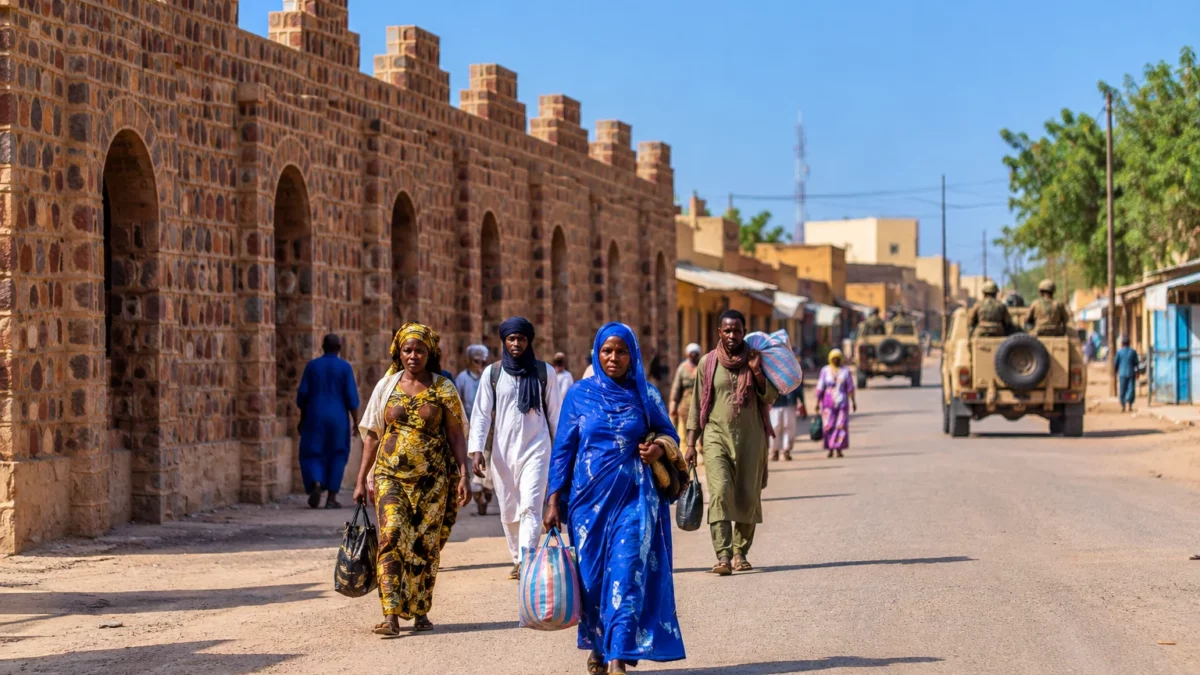
In Bamako, reliance on a Russian military partner has become a pillar of the authorities’ security strategy. But leaked Russian data suggest that this support has itself paid a heavy price in Mali, without preventing the loss of positions in the north.
A toll drawn from leaked records
Between September 2023 and September 2026, 349 Russian citizens died in Mali, according to death certificates from Rosstat, Russia’s national statistics agency, obtained by the hacker groups Cyber Partisans and Silent Crow. The British daily The Guardian analysed the documents and linked most of the deaths to known fighting. The tally has not been independently confirmed publicly by Moscow or Bamako.
The records reportedly attribute 43 Russian deaths to 25 April 2026, the day of coordinated attacks targeting Bamako, Kati, Gao and Kidal, among other places. Six deaths are said to have been recorded in Kidal and one in Aguelhoc, a locality in the Kidal region. Others reportedly occurred in Bamako and Gao. The UN confirms the date, the geographical scale of the attacks and Africa Corps’ subsequent withdrawal from Kidal, but does not validate these figures for Russian losses.
The highest daily toll in the documents, however, concerns 27 July 2024: 70 Russians are said to have died in the Kidal region during the clashes at Tinzaouatène, near the Algerian border. Russian authorities have not published a comparable official tally. At the time, estimates put forward by different actors diverged sharply; the figure from the certificates must therefore remain attributed to the leaked records.
A military partnership put to the test
The Russian presence took hold after the diplomatic and military ruptures that followed the coups of 2020 and 2021. The Wagner Group arrived in Mali in late 2021. Africa Corps, a structure closely linked to Russia’s defence ministry, took over its operations in June 2025. A British estimate cited by The Guardian put its strength in the country at about 2,000 personnel at the time. Compared with that estimate, the 349 deaths would represent more than 10% of the force, but this comparison does not constitute an official casualty rate: neither the exact number of personnel deployed over the entire period nor the composition of the tally has been publicly established.
The events of April 2026 illustrate the limits of this arrangement. The Group for the Support of Islam and Muslims (JNIM), affiliated with al-Qaeda, launched attacks alongside the Azawad Liberation Front (FLA), an independence movement with a predominantly Tuareg base. Two days after the offensive began, Russian fighters withdrew from Kidal. The Malian authorities thus lost control of the northern city, despite their cooperation with Moscow.
The groups do not pursue the same aims. JNIM is waging a jihadist insurgency and seeking to expand its influence. The FLA advocates independence for Azawad. Their coordinated action nevertheless put several military and political centres under pressure. The UN report on West Africa confirms that the 25 April attacks targeted strategic sites and caused civilian and military casualties, including the death of Mali’s defence minister.
Consequences beyond the front line
For the transitional authorities, the issue is as much political as military: the Russian partnership is meant to help defend the territory and protect the institutions. For residents, the consequences extend beyond the fighting. In Gao, Kidal and affected localities, violence and displacement are making access to markets, healthcare and transport more difficult. In Bamako, the UN has also reported pressure on supply routes. Risks and effects therefore vary by region, while the toll among foreign fighters alone does not measure the human cost to Mali’s population.
Human Rights Watch, which gathered testimony and verified images after the events of April, has documented civilian casualties in the clashes and abuses attributed to various armed actors. These findings are a reminder that military tallies, which are often incomplete, describe only part of the situation. Nor do they make it possible to automatically attribute every recorded death to combat: the leaked certificates provide a documentary basis, but the individual circumstances have not all been publicly established.
A weakened regional equation
Mali now operates in a reshaped regional landscape. Its withdrawal from the Economic Community of West African States (ECOWAS), alongside Burkina Faso and Niger, took effect on 29 January 2025. The three countries created the Alliance of Sahel States, which became a confederation. In its June 2026 report, the UN says tensions between the alliance and some ECOWAS members are complicating collective responses to cross-border threats.
For Russia’s partners, these documented losses highlight the cost of an extensive military commitment, but are not enough to measure the overall effectiveness of their presence. For Bamako, they raise a practical question: how far can external support compensate for the persistent challenge to state authority in the north and centre? The next developments to watch include control of routes and towns in the north, the authorities’ ability to secure supplies, and the forms of cooperation between Sahelian countries and their West African neighbours.