Algeria
 Egypt
 Libya
 Morocco
 Sudan
 Tunisia
 Benin
 Burkina Faso
 Cabo Verde
 Côte d'Ivoire
 Ghana
 Guinea
 Guinea-Bissau
 Liberia
 Mali
 Mauritania
 Niger
 Nigeria
 Senegal
 Sierra Leone
 The Gambia
 Togo
 Cameroon
 Central African Republic
 Chad
 DR Congo
 Equatorial Guinea
 Gabon
 Republic of the Congo
 São Tomé and Príncipe
 Burundi
 Comoros
 Djibouti
 Eritrea
 Ethiopia
 Kenya
 Madagascar
 Malawi
 Mauritius
 Mozambique
 Rwanda
 Seychelles
 Somalia
 South Sudan
 Tanzania
 Uganda
 Angola
 Botswana
 Eswatini
 Lesotho
 Namibia
 South Africa
 Zambia
 Zimbabwe
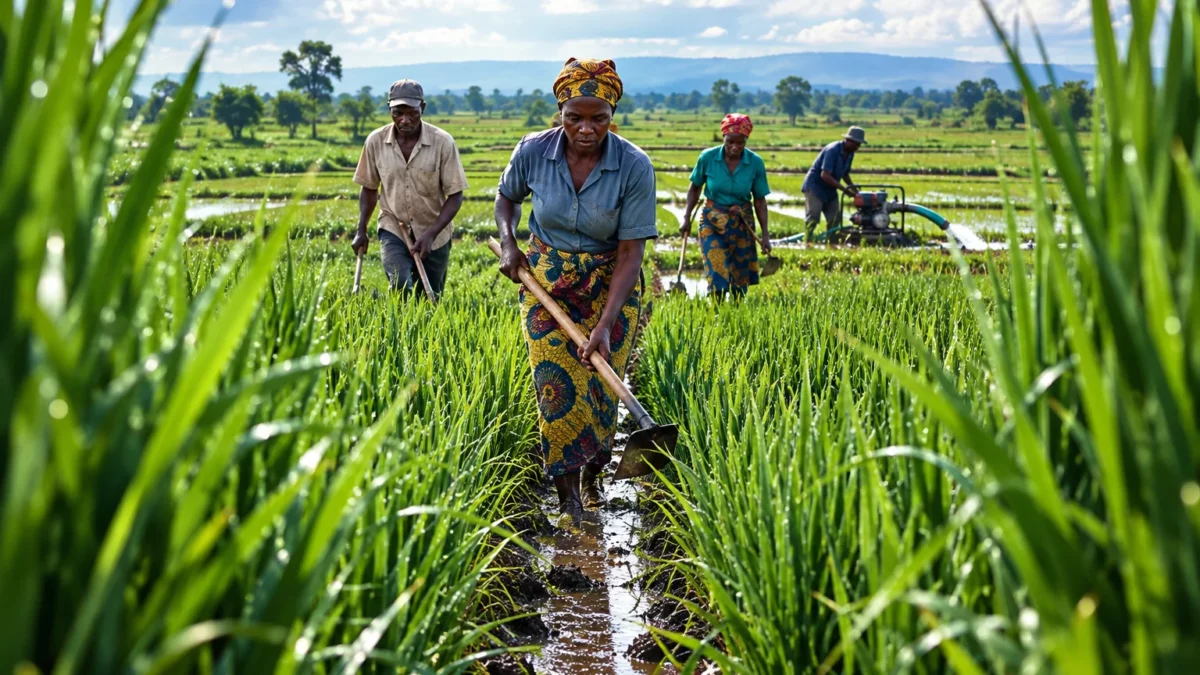
For a Tanzanian business earning revenue in shillings, borrowing in dollars can turn a solar or agricultural project into a risky gamble. Climate finance is therefore not just about finding capital: it must also be accessible, suited to local economies and capable of reaching producers.
From local savings to climate projects
In Tanzania, commercial bank CRDB is seeking to connect financial markets with the needs of businesses and farmers. Its Kijani green bond, whose name means “green” in Swahili, raised 171.8 billion Tanzanian shillings, or about $65.7 million. The issue, launched in 2023, exceeded its initial target and was subsequently admitted to the Luxembourg Stock Exchange. It had also been listed on the Dar es Salaam Stock Exchange.
The figures for the issue are documented by the Luxembourg Stock Exchange and Tanzania’s financial markets regulator, the Capital Markets and Securities Authority. The result shows that a domestic financial institution can mobilise investors beyond the national market. It does not, by itself, prove that small businesses now have easy access to credit.
According to Joseph F. Maji, CRDB’s head of treasury and strategic partnerships, about 62% of the funds were allocated to new financing and 38% to refinancing existing green projects. The bank’s allocation report describes investments in renewable energy and sustainable land management. Target sectors also include climate-smart agriculture, solar irrigation, water and clean transport.
The cost of credit remains an obstacle
A green bond is a loan intended to finance projects that meet environmental criteria. To issue this type of security, a bank must define eligible projects, track how the funds are used and report on their results. This preparation involves costs and requires specialist skills. Large institutions can absorb them more easily than small businesses or banks with fewer resources.
The currency of the loan matters just as much. A Tanzanian business that sells in shillings but repays a debt in dollars is exposed to exchange-rate fluctuations. If the local currency depreciates, its debt can become heavier without any increase in its revenue. Long-term financing in local currency would reduce this mismatch, but requires domestic markets capable of mobilising sufficient savings and capital.
African commercial banks can act as intermediaries, but they can also design products themselves and pool small projects to make them financeable on a larger scale. This role does not absolve governments of the responsibility to provide clear rules, or investors of the need to verify claimed environmental results. International institutions, meanwhile, can provide guarantees and long-term financing, provided their partnerships strengthen local capacity rather than perpetuating lasting dependence on funds from abroad.
Insurance and carbon: promises still to be tested
Climate finance does not come only through bonds. CRDB also cites agricultural insurance, including digital livestock cover, and a partnership with Tanzanian organisation KADERES on carbon-related projects. Insurance can help livestock farmers absorb certain shocks. Carbon markets, in principle, pay for verified emissions reductions or removals, for example through farming practices or ecosystem restoration.
The bank says 243,000 smallholder farmers have been registered in the programme associated with KADERES. But, according to Maji, no payments from carbon credits had yet begun at the time of the interview. The scheme was at the registration, training and data-verification stage. Initial payments therefore depended on the projects being validated and credits actually being issued under the chosen standards.
This distinction is essential: registering farmers in a programme does not mean that credits have already been certified or that farmers have received income. For the scheme to benefit producers, contracts will need to be made easy to understand, the share of revenue they receive specified, and payments made traceable. Measurement and verification costs must also remain proportionate, otherwise intermediaries could capture a substantial share of the value created.
After Antalya, measuring results
The issue arises at regional level. East African economies, like those in other parts of the continent, combine substantial investment needs with financial markets of varying depth. National circumstances nevertheless differ: Tanzania cannot be considered representative of all African countries. The shared challenge is to better connect international climate commitments with businesses and communities, without overlooking the specific conditions of each market.
COP31 was held in Antalya, Türkiye, from 9 to 20 November 2026. It ended on 22 November without general consensus on a final text, according to the United Nations. The outcome highlights the gap that can remain between international negotiations and the practical delivery of finance. For businesses and farmers, announcements are no substitute for affordable credit, suitable insurance or proof that a carbon market is actually paying the promised income.
The partnership announced between CRDB and Tanzania’s National Carbon Monitoring Centre could support carbon-credit-linked financing mechanisms, green credit lines and blended finance schemes, which combine public or concessional capital with private investment. Their impact will depend on data quality, contract transparency and the actual sharing of risks. In Tanzania, as elsewhere, the next indicator to watch is therefore not just the volume of capital mobilised, but the share that reaches projects and communities, at what cost and with what verifiable benefits.