Algeria
 Egypt
 Libya
 Morocco
 Sudan
 Tunisia
 Benin
 Burkina Faso
 Cabo Verde
 Côte d'Ivoire
 Ghana
 Guinea
 Guinea-Bissau
 Liberia
 Mali
 Mauritania
 Niger
 Senegal
 Sierra Leone
 The Gambia
 Togo
 Cameroon
 Central African Republic
 Chad
 DR Congo
 Equatorial Guinea
 Gabon
 Republic of the Congo
 São Tomé and Príncipe
 Burundi
 Comoros
 Djibouti
 Eritrea
 Ethiopia
 Kenya
 Madagascar
 Malawi
 Mauritius
 Mozambique
 Rwanda
 Seychelles
 Somalia
 South Sudan
 Tanzania
 Uganda
 Angola
 Botswana
 Eswatini
 Lesotho
 Namibia
 South Africa
 Zambia
 Zimbabwe
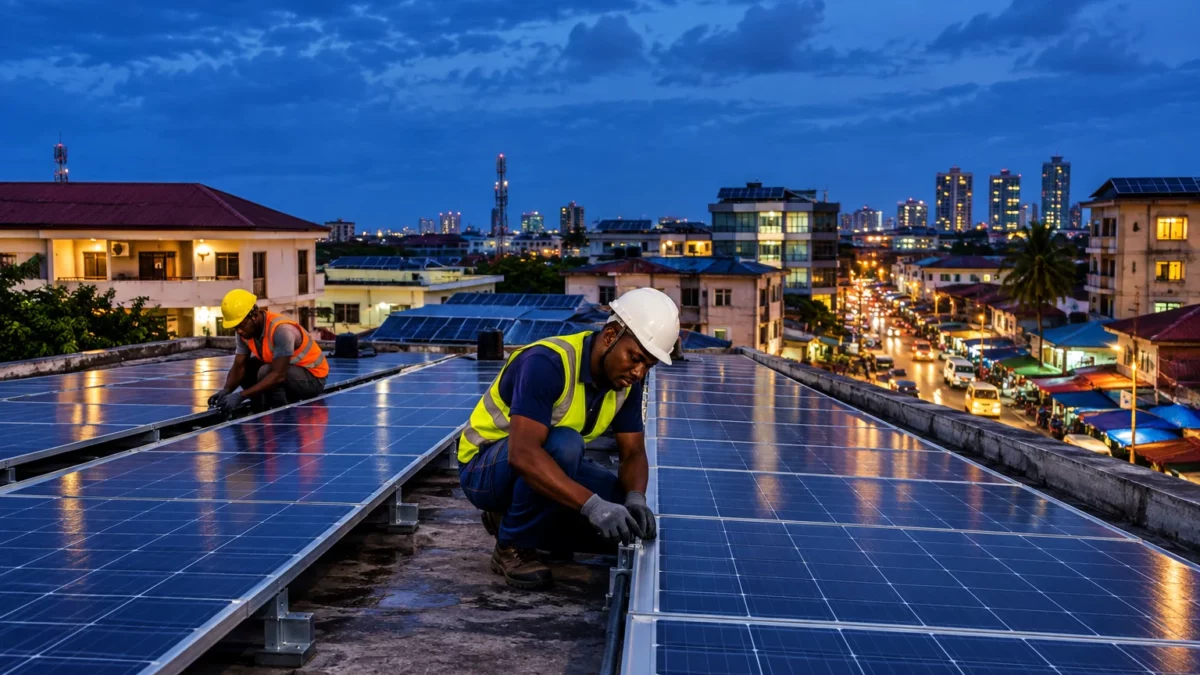
In Lagos, Abuja and industrial areas far from major centres, solar power is becoming a practical way for many Nigerians to secure their electricity supply. New commercial agreements announced in the country reflect this demand. However, they do not in themselves guarantee that panels will be delivered or installed in the planned volumes.
A market driven by households and businesses
In Nigeria, solar’s expansion relies largely on decentralised installations: rooftop panels, batteries and standalone systems for homes, shops and factories. These systems make it possible to generate electricity on site, supplementing or replacing the grid. For businesses, they can also reduce reliance on fuel-powered generators.
This momentum is unfolding against a backdrop in which electricity supply remains a concern for consumers. It does not mean that solar alone can meet the country’s needs. Storage, upfront purchase costs, access to finance and equipment quality remain decisive factors, particularly for low-income households and small businesses.
The trend is evident across West Africa, but markets and regulatory frameworks differ from one country to another. Nigeria is a member of ECOWAS, the Economic Community of West African States. Commercial agreements concluded in the country do not, however, amount to a regional programme or a guarantee of deployment in neighbouring countries.
Four agreements announced, 950 MW of modules
On 25 November 2026 in Lagos, manufacturer AIKO announced two memorandums of understanding with Nigerian companies: 250 MW with Onyxline Distribution and 100 MW with SwitchBox. The African Solar Industry Association (AFSIA) and the organisers of the Renewable Energy Forum Africa also reported the two agreements, totalling 350 MW.
These announcements add to two supply agreements attributed to JinkoSolar in April. The Chinese manufacturer announced a 500 MW framework partnership with Fouani Group, focused on decentralised generation. A second agreement, for 100 MW, involves a Nigerian distributor whose name has not been made public. Specialist outlet PV Tech also reported the two volumes.
Together, the four announcements amount to a nominal 950 MW of modules. These are capacities envisaged under commercial agreements, not confirmation that the panels have already been delivered, connected or commissioned. The financial terms and implementation schedule for AIKO’s memorandums have not been made public. This distinction is essential to assessing the solar fleet’s actual growth.
Local partners play a central role in this supply chain. Onyxline distributes solar equipment, while SwitchBox offers integrated solutions, from design to installation and storage. Fouani Group, for its part, brings a commercial and service network. These partners can help with the sale and maintenance of systems. They do not yet indicate the final price paid by customers or what share of orders will actually be fulfilled.
Growth figures should be treated with caution
The Global Solar Council estimates that Nigeria added 803 MW of photovoltaic capacity in 2025, placing it behind South Africa on the continent for new installations recorded by the organisation. The figure offers an indication of the market’s scale, but does not necessarily capture every panel installed in a household or small business.
Part of the difficulty lies in tracking decentralised installations. They are numerous, dispersed and sometimes absent from administrative statistics. An Ember study, reported by Nigerian outlet Premium Times, estimates that Nigeria could add 1.7 GW of solar in 2026. The projection draws in part on an analysis of Chinese panel exports; it is therefore not a tally of installations already observed on the ground.
Available assessments do not all use the same methods. The Global Solar Council and Ember arrive at different estimates for Africa, reflecting the difficulty of counting off-grid installations. Comparing them without specifying their scope could give a misleading picture of the actual pace of deployment in Nigeria.
The challenge: turning announcements into affordable electricity
In 2026, the Nigerian Electricity Regulatory Commission issued new rules for mini-grids, local networks that supply several customers without relying entirely on the national grid. The framework distinguishes between isolated installations and those connected to the distribution grid. It also sets out authorisation procedures and the conditions for transition if the national grid subsequently reaches the area served.
These rules could help developers plan their projects. But capacity announced in megawatts does not show how many households will be served, where systems will be installed or at what price. Large retailers and businesses often have more resources to finance panels and batteries. For households and small businesses, upfront costs and access to credit can hamper adoption, even as supply grows.
The industrial question also arises. The agreements provide for modules supplied by Chinese groups, while Nigerian companies handle distribution and system integration. This arrangement could build local expertise in installation, maintenance and after-sales service. It does not necessarily mean that panels will be manufactured in Nigeria. The balance between imports, local assembly and jobs created will therefore need to be monitored.
Across the continent, Nigeria’s growth illustrates the increasing importance of decentralised solar generation alongside large power plants. What happens next will depend less on the volumes announced than on their delivery: shipments, financing, connections and consumers’ sustained access to equipment. Future assessments will also need to distinguish more clearly between installed capacity and agreements still awaiting implementation.