Algeria
 Egypt
 Libya
 Sudan
 Tunisia
 Benin
 Burkina Faso
 Cabo Verde
 Côte d'Ivoire
 Ghana
 Guinea
 Guinea-Bissau
 Liberia
 Mali
 Mauritania
 Niger
 Nigeria
 Senegal
 Sierra Leone
 The Gambia
 Togo
 Cameroon
 Central African Republic
 Chad
 DR Congo
 Equatorial Guinea
 Gabon
 Republic of the Congo
 São Tomé and Príncipe
 Burundi
 Comoros
 Djibouti
 Eritrea
 Ethiopia
 Kenya
 Madagascar
 Malawi
 Mauritius
 Mozambique
 Rwanda
 Seychelles
 Somalia
 South Sudan
 Tanzania
 Uganda
 Angola
 Botswana
 Eswatini
 Lesotho
 Namibia
 South Africa
 Zambia
 Zimbabwe
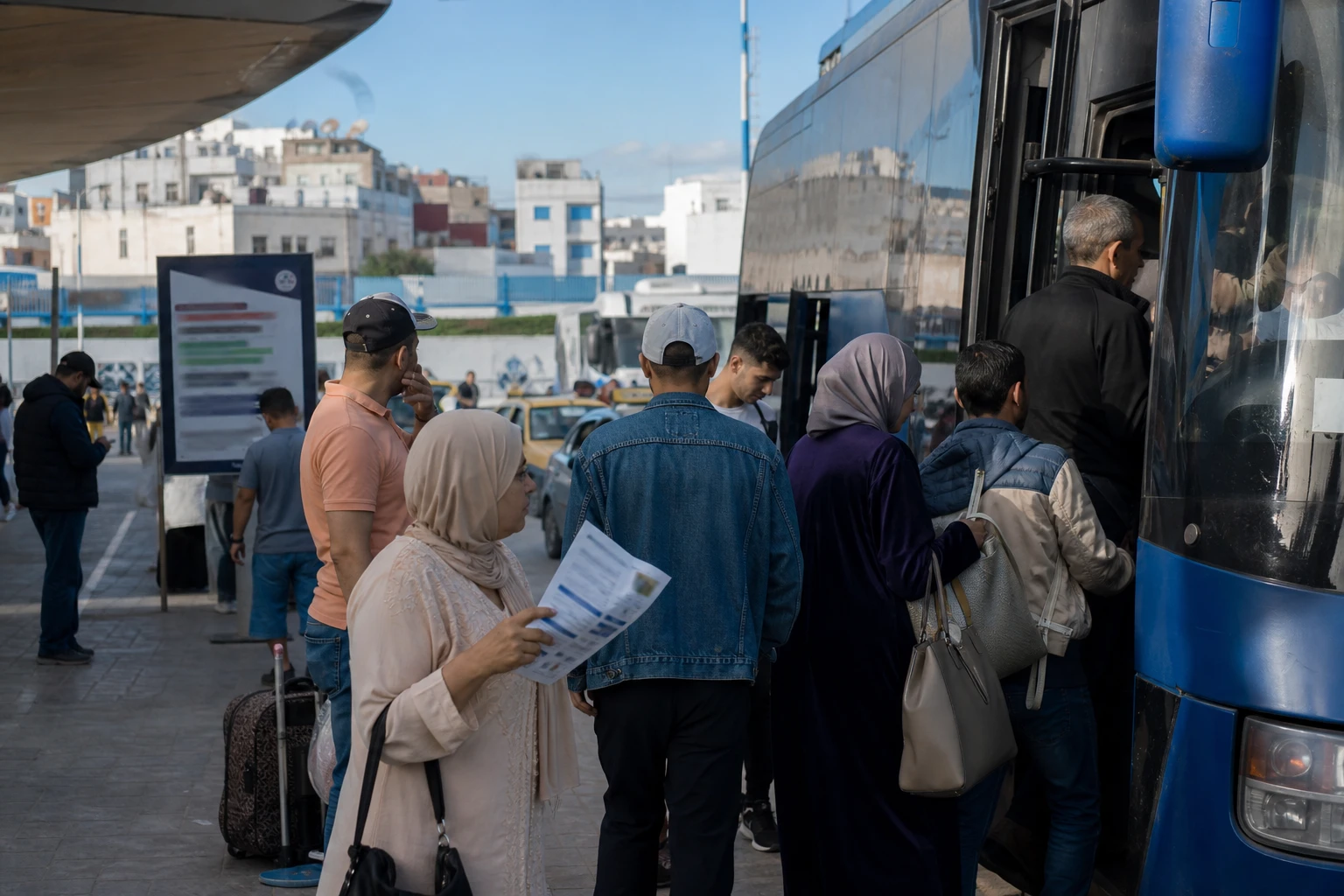
In Tangier, opposition to relations with Israel ran up against an administrative decision, days after parliamentary elections marked by low turnout and the return of the Justice and Development Party (PJD). The episode illustrates a tension now entrenched in Morocco: diplomacy is the preserve of the palace, while the street continues to make Palestine a national political issue.
In Tangier, a protest banned and then dispersed
On Sunday 27 September 2026, the authorities in Tangier banned a demonstration called by the Moroccan Front in Support of Palestine and Against Normalisation with Israel. The decision was justified on public order and traffic grounds, according to a notice carried by the Moroccan press.
Despite the ban, activists tried to gather. The protest was eventually dispersed by security forces that evening. Several arrests were reported, but the exact number and the legal status of those concerned had not yet been established when the first reports came in.
Those named included Hassan Moghbar, a local PJD official, Hassan Nektar, president of the Tangier branch of the Moroccan Association for Human Rights (AMDH), and activist Mohamed Lamrabet. These reports should be treated with caution until independent or official confirmation is published.
The ban was announced by Tangier’s territorial and security authorities, who cited their regulatory powers over public space and traffic. The restriction notice carried by a Moroccan media outlet does not, however, establish the full number of arrests on its own.
A street mobilised for several months
The scene in Tangier is not an isolated episode. Since the start of the war in Gaza, rallies have been held regularly in several Moroccan cities. Protesters are calling, in particular, for an end to normalisation with Israel and reaffirming their support for the rights of the Palestinian people.
Further demonstrations were reported on Friday 25 and Saturday 26 September in several localities. In Marrakech, a rally drew a large number of participants under a dual slogan: support for Al-Aqsa Mosque and rejection of rapprochement with Israel. The precise scale of these gatherings varies by source and should therefore be distinguished from estimates by activists.
In Tangier, the authorities have previously banned or dispersed other actions related to this issue. Activists had notably sought to protest against the presence of an Israeli delegation at a nautical competition held near the port. These previous incidents have helped make the city a flashpoint between civil society groups, political parties and local authorities.
This protest movement is also part of a broader debate about civil liberties. During the election period, the AMDH reported arrests, detentions or restrictions targeting activists from Annahj Addimocrati, a party that supported boycotting the vote. Reported cases involved Beni Mellal, Kenitra, Casablanca, Salé, Tangier and Al Hoceima.
The PJD’s electoral comeback does not shift the centre of power
The Tangier demonstration took place four days after the parliamentary elections of 23 September 2026. The Authenticity and Modernity Party (PAM) came first with 97 of the 395 seats. It was ahead of the National Rally of Independents (RNI), which won 66 seats, and Istiqlal, with 65.
The PJD made the most dramatic gains. After falling to 13 seats in the previous election, it won 54 this time. National turnout stood at 38.02% when polling stations closed, then at 38.08% in provisional results announced by the Interior Ministry. Official Moroccan data on the election confirm the low turnout.
The PJD’s result marks a parliamentary comeback, but not a takeover of the state apparatus. The party made the Palestinian cause and opposition to normalisation important themes of its campaign. However, Moroccan foreign policy remains a central prerogative of King Mohammed VI. Parliament can debate and vote, but it does not set the kingdom’s broad diplomatic direction on its own.
This arrangement limits the immediate impact of the PJD’s electoral success. The party can voice opposition in parliament and in the public sphere. It does not, however, have the institutional means to unilaterally annul the agreements Rabat has concluded with Tel Aviv.
Diplomatic rapprochement advances despite opposition
On 16 September 2026, Morocco, Israel and the United States announced in New York that they had agreed to upgrade their diplomatic missions to embassy status and exchange ambassadors. The declaration also provides for direct flights between the two countries to resume soon.
This step deepens the process begun in December 2020, when Rabat and Tel Aviv restored official relations under an agreement backed by Washington. Rapprochement has developed across several sectors, including trade, tourism, security co-operation and defence.
The presence of the Moroccan delegation in the United Nations General Assembly hall during Israeli Prime Minister Benjamin Netanyahu’s speech on 24 September was also seen as a sign of diplomatic continuity. It does not, however, mean that the Moroccan authorities are abandoning their official support for Palestinian rights.
Rabat continues to publicly defend the creation of a Palestinian state and Jerusalem’s special status. This position coexists with the continuation of relations with Israel. It is precisely this coexistence that solidarity movements oppose, arguing that political statements do not make up for the maintenance of diplomatic, economic and security ties.
An issue that extends beyond Morocco’s borders
The events in Tangier highlight a gap between the Moroccan state’s international strategy and the expectations of part of society. For the authorities, co-operation with Israel is part of a policy of alliances and defending national interests. For protesters, the situation in Gaza makes this partnership politically and morally unacceptable.
The contrast also affects the political parties. The PJD can capitalise on popular sympathy for the Palestinian cause, but its return to the House of Representatives does not alter the constitutional balance of power. Meanwhile, the parties expected to form a majority will have to contend with public opinion that does not treat the Palestinian issue as merely a foreign policy concern.
In the short term, two issues will be watched in Morocco: the formation of the next government around the PAM and the actual opening of the embassies announced on 16 September. The way the authorities handle demonstrations in Tangier, Rabat, Casablanca and Marrakech will also show whether the protest remains confined to the street or gains a stronger foothold in parliamentary debate.
Across North Africa, Morocco thus confirms its distinctive position. The kingdom is deepening its relations with Israel while maintaining official rhetoric in support of the Palestinian cause. This two-tier diplomacy may preserve room for manoeuvre internationally. It nevertheless sustains lasting tensions with part of Moroccan society, for whom Palestine remains a central political and popular touchstone.