Algeria
 Egypt
 Libya
 Morocco
 Tunisia
 Benin
 Burkina Faso
 Cabo Verde
 Côte d'Ivoire
 Ghana
 Guinea
 Guinea-Bissau
 Liberia
 Mali
 Mauritania
 Niger
 Nigeria
 Senegal
 Sierra Leone
 The Gambia
 Togo
 Cameroon
 Central African Republic
 Chad
 DR Congo
 Equatorial Guinea
 Gabon
 Republic of the Congo
 São Tomé and Príncipe
 Burundi
 Comoros
 Djibouti
 Eritrea
 Ethiopia
 Kenya
 Madagascar
 Malawi
 Mauritius
 Mozambique
 Rwanda
 Seychelles
 Somalia
 South Sudan
 Tanzania
 Uganda
 Angola
 Botswana
 Eswatini
 Lesotho
 Namibia
 South Africa
 Zambia
 Zimbabwe
A ball in a city still on edge
In Khartoum, the war has fractured journeys, families and playing fields. Yet a group of Sudanese footballers continues to meet for training, with few resources and plenty of determination. Their goal is not merely symbolic: they want to represent Sudan in Morocco at the second edition of the World Cup of Dwarf Football, scheduled for 20 to 30 November 2026.
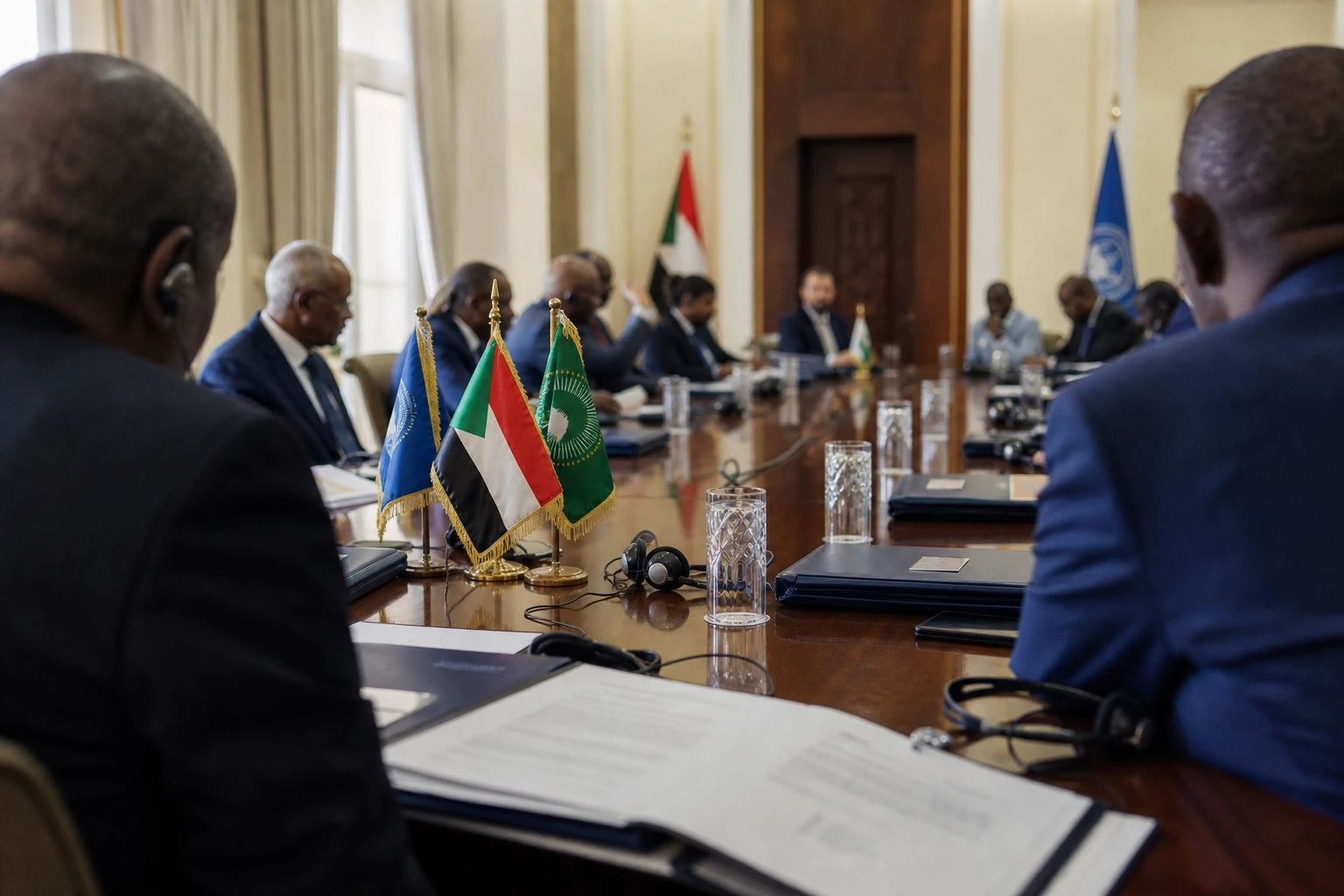
The contrast says much about Sudan today. The country remains gripped by armed conflict that has caused one of the world’s largest displacement crises, according to a joint statement by the UN and the African Union published in April 2026. In this context, the presence of a national team, even one in adapted sport, carries far greater significance than a simple sporting event.
Khartoum, sport and the survival of institutions
Sudan is a member of IGAD, the regional organisation for the Horn of Africa, while the African Union is closely monitoring the conflict and calling for an inclusive political process. In February 2026, the AU Peace and Security Council reiterated its commitment to the country’s unity and territorial integrity. In June, the AU Commission again condemned the escalation of violence.
This broader context matters, because Sudanese sport is no longer just about performance. It is also about maintaining a minimum of collective organisation in a country where public structures have been profoundly disrupted by the war. The small-stature players’ team has existed since 2020, thanks to the initiative of volunteers and sports journalists, and has since received official recognition.
The Moroccan tournament is itself a sign of the growing organisation of adapted sport on the continent. SNRT News says the competition will bring together 24 teams. Maroc World News reports the same line-up and notes that Sudan is among the participating teams. Morocco, which has already made football a tool of regional influence, is thus becoming an anchor for a discipline that remains little known.
The facts: qualification prepared in adversity
In Khartoum, the players train regularly despite security and transport constraints. An image published by Reuters on 19 August 2026 shows a training session dated 17 August in the Sudanese capital, indicating that preparations are a long-term effort rather than a one-off event. Sudanese outlet Al Jazeera Net, for its part, devoted a report to the team on 16 August, confirming the intensity of the work involved in putting it together.
The team’s officials describe an operation built from very little. One of them, Mohammed Nour Kasha, president of the Sudanese Federation of Persons of Small Stature, said the group came from different parts of the country and that travel made it difficult to assemble the squad. Another member of the management team recalled that the team had already missed a previous edition for lack of sufficient funding and because of logistical difficulties. These details have been reported by Arabic-language media and confirmed by Reuters’ accounts.
The November tournament will be the team’s first international appearance, according to Reuters. The cup will bring together 24 teams, with Argentina as defending champions — a detail that also illustrates the gap between nations already established in this sporting niche and those still seeking to make their mark on the circuit.
What this team says about Sudan today
The significance of this qualification extends far beyond the pitch. For the players, the stakes are first and foremost personal: to take part in a sporting setting where their height has often been used as a pretext for exclusion. For the country, the team offers a rare story of continuity. It shows that amid internal displacement, administrative disruption and economic hardship, Sudanese groups continue to organise collective activities, training sessions and national teams.
This is important for understanding Sudan without reducing it to war. On the one hand, regional and continental authorities are making repeated calls for a ceasefire, dialogue and the protection of civilians. On the other, local actors are trying to maintain spaces for social life, however small. Adapted football thus becomes evidence of civic resistance, but also an indicator: when a country can still bring players together from different regions to prepare for an international competition, networks, solidarity and institutional links remain to be preserved.
The contrast is also social. In the capital, where facilities remain limited, the effort depends on very practical resources: available pitches, transport, equipment and administrative support. In the regions, the war has disrupted travel and made it harder for players to attend. This imbalance sums up a broader reality of contemporary Sudan: what still works often does so through local initiative, resourcefulness and attachment to the idea of national representation.
An African resonance beyond Morocco
At continental level, this story is part of a broader movement: Africa is seeking to give greater prominence to lesser-covered disciplines, marginalised athletes and sporting formats that do not always feature in major commercial circuits. Morocco, already at the heart of African football with AFCON 2025 and a co-host of the 2030 World Cup, is further strengthening its position as a regional sporting hub. Hosting this World Cup of Dwarf Football fits into that strategy of welcome and visibility.
For Sudan, the date to watch is clear: late November 2026 in Morocco. For the AU and IGAD, the signal is different. As long as sporting and civic institutions continue to exist, even in a limited form, they provide footholds for future reconstruction. The match is therefore not played only on the pitch. It is also being played in the ability of Sudanese people to preserve forms of shared life while the guns have yet to fall silent.