Algeria
 Egypt
 Libya
 Morocco
 Tunisia
 Benin
 Burkina Faso
 Cabo Verde
 Côte d'Ivoire
 Ghana
 Guinea
 Guinea-Bissau
 Liberia
 Mali
 Mauritania
 Niger
 Nigeria
 Senegal
 Sierra Leone
 The Gambia
 Togo
 Cameroon
 Central African Republic
 Chad
 DR Congo
 Equatorial Guinea
 Gabon
 Republic of the Congo
 São Tomé and Príncipe
 Burundi
 Comoros
 Djibouti
 Eritrea
 Ethiopia
 Kenya
 Madagascar
 Malawi
 Mauritius
 Mozambique
 Rwanda
 Seychelles
 Somalia
 South Sudan
 Tanzania
 Uganda
 Angola
 Botswana
 Eswatini
 Lesotho
 Namibia
 South Africa
 Zambia
 Zimbabwe
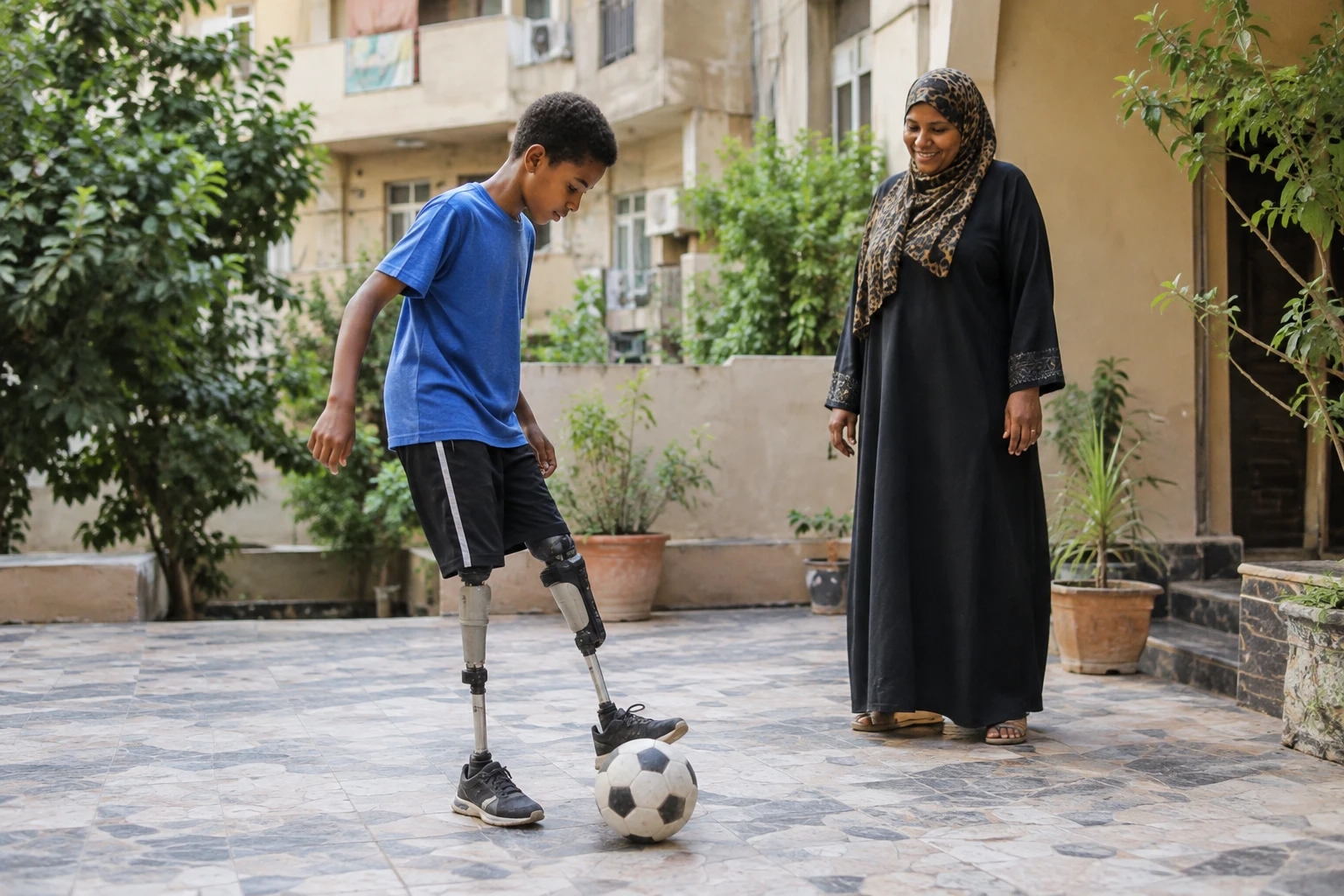
For Zaher, football is no longer just a memory of a life interrupted by war. At 13, the young Sudanese boy is walking again with prostheses and dreams of returning to the ball. A video from his idol, Vinícius Júnior, has given him a new perspective: the Real Madrid winger has invited him to attend a match and spend a day with him.
A message that opens a door
The long-distance meeting took place in Cairo, where Zaher and his mother, Habibah, lived for nearly a year. In the message, delivered in Arabic, the Brazilian player says he has learned about Zaher’s story and encourages him to use his new prostheses, return to football and seek happiness. He also offers him the chance to come and see Real Madrid. Spain’s EFE news agency also reported the invitation on 11 November 2026.
Zaher first left the room, overwhelmed with emotion, then returned wearing a shirt bearing the name of his favourite player. “Tell Vinícius I love him,” he replied. He hopes he will be able to obtain a visa and accept the invitation. It therefore remains a possibility, not a trip that has yet been arranged.
The news puts a face to a reality less visible than the front lines: for injured children, care does not end with surgery. They also need prostheses that fit, rehabilitation, psychological support and follow-up as their bodies grow. Without these steps, a prosthesis can become unusable or cause further difficulties.
From Khartoum to Cairo, a journey of care
In 2024, Zaher and his mother were selling lentils on the street in Khartoum, where fighting had severely disrupted daily life and services. A drone strike left him seriously injured and he lost both his legs. His mother said she saw her son bleeding, unable to answer his questions about what had happened to him. The precise circumstances of the strike are reported by the family.
The war broke out in April 2023 between the Sudanese army and the Rapid Support Forces (RSF), a paramilitary force. Khartoum became a battlefield. For Zaher, staying there also meant living with inadequate access to the specialist care he needed. Leaving the country was not straightforward, however: according to the family’s account, identity documents had been destroyed and preparing to leave took several months.
A fundraiser launched with the help of Dena Latif, a Sudanese-born lawyer living in the UK, raised £45,000, or about $60,000 according to the reported figures. The money helped pay for his care. In Cairo, Zaher underwent surgery, learned to use his prostheses and attended physiotherapy sessions. He also received psychological support. Dr Bintelmuna Eltayeb, who treated him, describes a boy who has regained his smile and confidence.
His journey shows the importance of ties between families, healthcare professionals and transnational solidarity networks. It does not, however, replace an accessible healthcare system in his country of origin. The possibility of returning to Khartoum also depends on the availability of services, security and the ability to adjust the prostheses regularly for an adolescent who is still growing.
A capital recovering, needs that persist
Zaher’s story places his return to his family and friends in Khartoum at a time when the army had retaken control of the capital. But returning does not mean that pre-war conditions have been restored. Buildings remain damaged, and health, education and protection needs extend far beyond the case of a single family.
The figures convey the scale of the emergency, without summing up individual experiences. In its mid-year 2026 humanitarian report, UNICEF estimates that 17.3 million children in Sudan need assistance. The agency also says that more than 4,300 children have been killed or maimed since the conflict began, among the violations it has been able to verify. This documented toll may be lower than the actual number, particularly because insecurity makes monitoring difficult.
Food security remains a major concern. The Integrated Food Security Phase Classification (IPC), a system that classifies the severity of food insecurity, estimates that about 19.5 million people, or 41% of the population, faced high levels of acute food insecurity between February and May 2026. These figures were published by the IPC and reproduced in a summary by the US news agency AP.
The consequences vary depending on location and resources. Residents returning to the capital may find their homes, only to discover that public services have been weakened. In areas that remain difficult to reach, delivering specialist care and humanitarian aid is particularly challenging. And for low-income families, the cost of travel, treatment or medical equipment can remain an obstacle, even when one-off support is mobilised.
Beyond the gesture, the question of follow-up
Sudan is a member of the Intergovernmental Authority on Development (IGAD), a regional organisation in the Horn of Africa. The war has caused displacement within the country and to neighbouring states, including Egypt. Zaher’s journey thus illustrates a regional dimension of the conflict: when care is unavailable close to home, families sometimes have to seek treatment across borders.
At continental level, his case is also a reminder that protecting children in wartime is not just about preventing injuries. It involves long-term care, schooling, mental health and the chance to grow up without every step depending on a fundraiser or an exceptional invitation. The African Union and IGAD are monitoring the Sudan crisis, while humanitarian needs continue to weigh on host countries and displaced communities.
For Zaher, the next challenge is practical: continuing his rehabilitation and having his prostheses adjusted as he grows. For other injured children, the challenge is wider: accessing care despite fighting, blocked roads and limited resources. Vinícius’s message gave him a moment of joy. Continuity of care will determine what he can build after that moment.
EFE’s report on Vinícius Júnior’s invitation, UNICEF’s 2026 humanitarian report on Sudan and the IPC’s analysis of food security in Sudan help place this journey in the context of the national crisis.