
 Algeria
 Egypt
 Libya
 Morocco
 Sudan
 Tunisia
 Benin
 Burkina Faso
 Cabo Verde
 Côte d'Ivoire
 Ghana
 Guinea
 Guinea-Bissau
 Liberia
 Mali
 Mauritania
 Niger
 Nigeria
 Senegal
 Sierra Leone
 The Gambia
 Togo
 Cameroon
 Central African Republic
 Chad
 DR Congo
 Equatorial Guinea
 Gabon
 Republic of the Congo
 São Tomé and Príncipe
 Burundi
 Comoros
 Djibouti
 Eritrea
 Ethiopia
 Kenya
 Madagascar
 Malawi
 Mauritius
 Mozambique
 Rwanda
 Seychelles
 Somalia
 South Sudan
 Tanzania
 Uganda
 Angola
 Botswana
 Eswatini
 Lesotho
 Namibia
 Zambia
 Zimbabwe
When a drought undermines water reserves, or a flood damages roads and homes, climate adaptation is measured in everyday life. In South Africa, the government estimates that $15.6bn in investment will be needed to strengthen protection by 2035.
A national plan that must reach local communities
The figure was presented by David Maynier, South Africa’s Minister of Forestry, Fisheries and the Environment, at COP31 in Antalya. In a statement published on 18 November 2026, he estimated that more than 250 billion rand, or around $15.6bn, in funding would be required to carry out priority adaptation measures between 2026 and 2035. The figure also appears in the country’s climate transparency report, published in the Government Gazette on 6 November. South Africa’s official statement at COP31 and the report thus give the same order of magnitude.
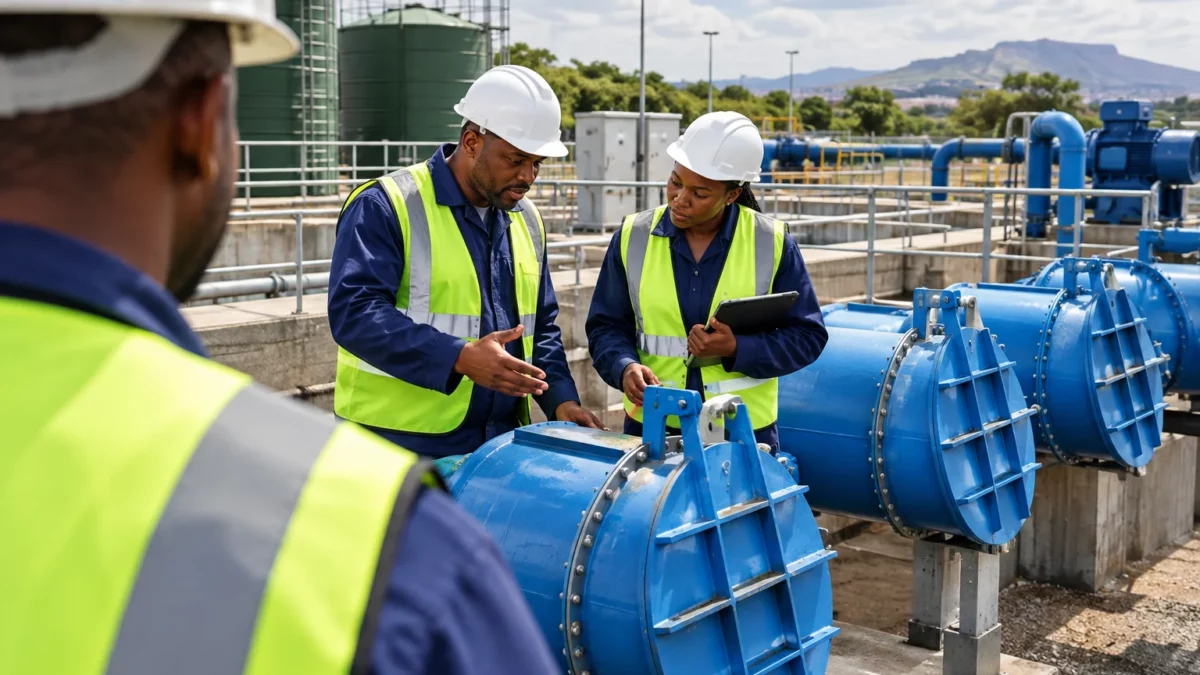
These needs span several sectors: water resources, agriculture and food security, health, infrastructure, human settlements and coastal areas. The task is not simply to repair damage after a disaster. It is also to reduce risks before they strike, for example by strengthening water networks and exposed public facilities.
The legal framework is already in place. South Africa’s Climate Change Act, adopted in 2024, came into force on 17 March 2025. It organises the country’s response around emissions reduction and adaptation, with a role for the different levels of government. The national adaptation strategy, meanwhile, guides priorities and sectoral planning. The government confirmed the date the Act came into force.
Needs that go beyond adaptation
The $15.6bn covers only part of South Africa’s climate challenge. The country must also cut emissions and transform its energy system. Its second transparency report estimates that around 3,470 billion rand in investment will be needed for mitigation — that is, emissions reduction — over the 2026-2035 period. The two funding envelopes serve different purposes and should not be confused. The report published in the Government Gazette sets out these estimates.
The challenge is also a budgetary one. The OECD estimates that climate finance flows tracked in South Africa — public and private, domestic and international — averaged 188 billion rand a year in 2022 and 2023. This figure covers both adaptation and mitigation, so it is not a sum directly available for adaptation projects alone. It nevertheless illustrates the gap between the resources mobilised and the stated needs. The OECD’s analysis of climate investment in South Africa also highlights difficulties in preparing projects at municipal level.
This distinction matters for communities. Municipalities must translate national strategies into practical works: protecting sanitation networks, securing water supplies or adapting health facilities. But a funding envelope announced at national level does not guarantee that the money will be disbursed, that it will take the form of grants or that it will reach the areas most exposed to risk.
The South African government is calling on COP31 to advance a goal of tripling adaptation finance by 2035. The minister is also urging predictable contributions to multilateral climate funds. Behind this demand lies a question of terms: loans, guarantees and private investment are not equivalent to grants. They can support projects, but their cost, eligibility criteria and timing influence national choices.
An energy transition that must be aligned with resilience
South Africa remains heavily dependent on coal. The 2025 Integrated Resource Plan states that coal-fired power stations provide more than 75 per cent of electricity generation. This dependence makes the transformation complex: emissions must be reduced without undermining security of supply, economic activity or jobs in mining regions. South Africa’s official energy plan documents coal’s share.
A just transition — a term for an energy transformation accompanied by measures for affected workers and communities — therefore involves several fronts. Networks must be able to accommodate more renewable electricity, while coal regions need economic prospects. At the same time, adaptation investment must protect people from climate impacts. Funding for decarbonisation does not replace what is needed for water, health or resilient infrastructure.
A shared challenge in Southern Africa
The issue extends beyond South Africa’s borders. Within SADC, the Southern African Development Community, countries share climate risks and interconnected water resources. The regional organisation highlights the role of water management in adaptation and the need to better prepare the region for droughts and floods. SADC’s adaptation strategy places this co-operation within a regional framework.
What happens next will depend on two steps: translating South Africa’s plans into projects accessible to provinces and municipalities, and the ability of climate negotiations to make international funding more predictable. For Pretoria, the challenge is to turn a national estimate into concrete protection. For the region, it is to bring adaptation, energy security and shared water management together without shifting the cost of the transition on to households and communities with the fewest resources.



