Algeria
 Egypt
 Libya
 Morocco
 Sudan
 Tunisia
 Benin
 Burkina Faso
 Cabo Verde
 Côte d'Ivoire
 Ghana
 Guinea
 Guinea-Bissau
 Liberia
 Mali
 Mauritania
 Niger
 Nigeria
 Senegal
 The Gambia
 Togo
 Cameroon
 Central African Republic
 Chad
 DR Congo
 Equatorial Guinea
 Gabon
 Republic of the Congo
 São Tomé and Príncipe
 Burundi
 Comoros
 Djibouti
 Eritrea
 Ethiopia
 Kenya
 Madagascar
 Malawi
 Mauritius
 Mozambique
 Rwanda
 Seychelles
 Somalia
 South Sudan
 Tanzania
 Uganda
 Angola
 Botswana
 Eswatini
 Lesotho
 Namibia
 South Africa
 Zambia
 Zimbabwe
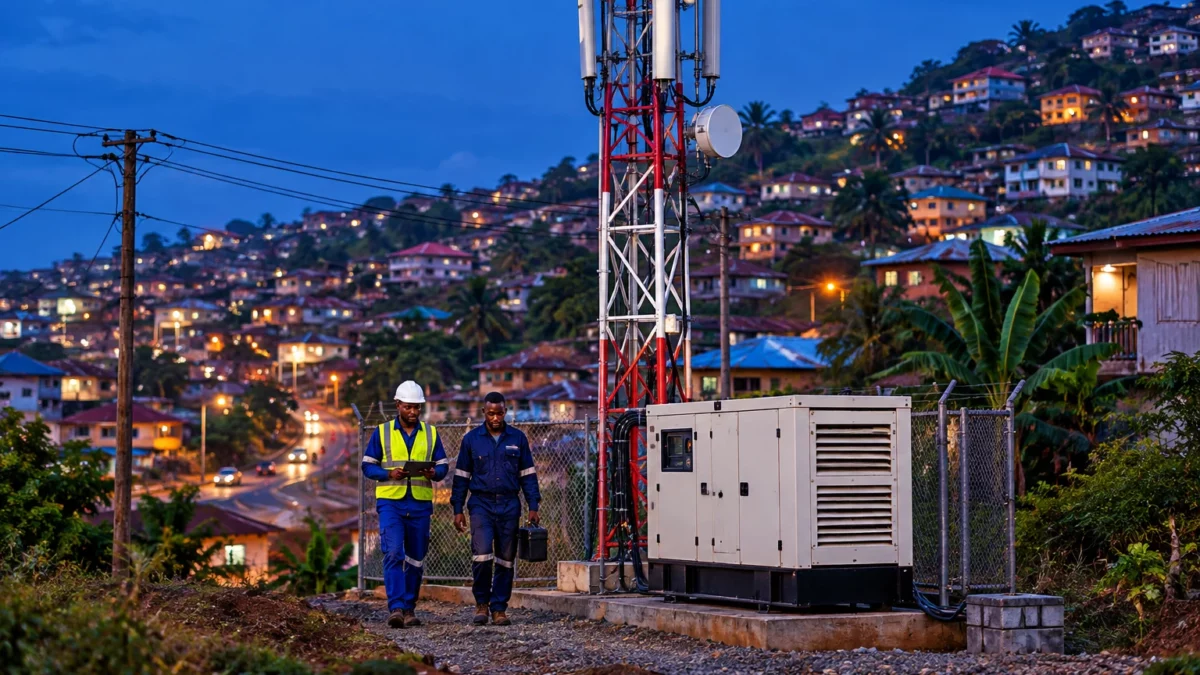
For a phone call or mobile payment to work, more than an antenna is needed: it also needs electricity. In Sierra Leone, where power remains limited and unreliable, operators often have to generate some of the energy their networks require themselves. A new agreement aims to bring telecoms and electricity planning closer together. Its effectiveness, however, will depend on one essential factor: the grid’s ability to provide reliable power.
A joint plan for two essential networks
On 20 November 2026, Sierra Leone’s Ministry of Communication, Technology and Innovation announced the signing of a memorandum of understanding with the Ministry of Energy and Aton Path LLC. The announcement was made on the sidelines of the West Africa Integration and Investment Summit (WAIIS), a summit focused on integration and investment in West Africa. Aton Path is acting through its Accessible Energy Bank platform.
The partners plan to develop a master plan bringing together electricity, telecoms and digital infrastructure. The first announced step is to assess existing facilities and conduct feasibility studies. These are intended to identify telecoms sites that could be connected to the national grid, and then specify the work and funding required. The memorandum opens a study phase; it does not, by itself, guarantee that connections will be made.
The government presents this coordination as a way to reduce operators’ reliance on diesel generators and contain their costs. In turn, mobile sites could become regular customers of electricity suppliers. This additional source of demand could contribute to energy-sector revenues, provided supply is stable enough to meet operators’ needs.
Grid connections cannot replace network reform
The constraints are considerable. Sierra Leone’s National Energy Compact, developed with support from the World Bank, estimates installed capacity at about 271 megawatts, but available capacity at just over 140 megawatts. The document puts the electricity access rate at 36%. These national figures mask significant disparities between urban and rural areas, as well as between households connected to the grid and those relying on decentralised solutions.
In other words, connecting more telecoms sites will not be enough if the grid cannot provide a regular supply. Outages, reported particularly during the dry season, could undermine the services the partnership aims to support. Operators may therefore keep their generators as a backup even after being connected. The final cost will depend as much on the reliability of the electricity supply as on the connection price.
Sierra Leone is not taking on this challenge in isolation. The country is part of the West African Power Pool, the regional framework that organises electricity exchanges between West African states. Interconnections can diversify supply, but they do not remove the need to strengthen generation, transmission and distribution nationally. For residents, particularly outside Freetown, the stakes go beyond uninterrupted calls: a lasting improvement in electricity supply can also support businesses, public services and digital activities.
Solar power and batteries offer another route
Connecting to the grid is not the only option. In March 2026, the International Finance Corporation (IFC) announced an investment to support IPT PowerTech in modernising and operating 2,235 telecoms sites in Sierra Leone, Liberia and Ethiopia. More than 90% of these sites are in off-grid or underserved areas. The programme includes solar panels and batteries, as well as more efficient generators where they remain necessary.
According to estimates published by the IFC, optimising power supply could reduce operators’ energy costs in Sierra Leone by up to 26%. This is a projection linked to the programme, not a saving already recorded across the sector as a whole. Stand-alone systems can be particularly suitable for remote sites, where extending the grid is costly. However, they require investment, maintenance and sufficient storage capacity.
The GSMA, the global association of mobile operators, notes in its November 2024 study that energy is a major challenge for operating networks in Africa, especially in rural areas where revenue per site is lower. Across the continent, fuel costs and its transport can weigh heavily on operators’ expenses. But conditions vary from country to country: these regional estimates do not automatically reflect the specific situation in Sierra Leone.
Results will be measured on the ground
For operators, more affordable power can reduce operating expenses and limit service interruptions. For their customers, the benefits will be real only if these savings help improve coverage, network quality or the cost of services. The memorandum does not yet specify which sites will be prioritised, how much the work will cost or the timetable for investment.
For electricity suppliers, mobile sites would represent additional commercial demand. But connecting new customers without strengthening supply could increase pressure on an already constrained grid. The allocation of costs will also be crucial: it will be necessary to establish who will fund the lines, equipment and any adaptations, and how risks will be shared between the state, operators and investors.
The next announced steps — technical assessments, feasibility studies and financing plans — will show whether this coordination leads to concrete projects. Across West Africa, the case illustrates a shared question for ECOWAS countries, members of the Economic Community of West African States: how to expand digital services without making their power supply too costly or too vulnerable. For Sierra Leone, the test will be twofold: to keep mobile sites running more consistently and to improve, over time, the capacity of the electricity system that powers them.
Background sources: announcement by Sierra Leone’s Ministry of Communication, Sierra Leone’s National Energy Compact, IFC programme with IPT PowerTech and GSMA study on energy and telecoms in Africa.