Algeria
 Egypt
 Libya
 Morocco
 Sudan
 Tunisia
 Benin
 Burkina Faso
 Cabo Verde
 Côte d'Ivoire
 Ghana
 Guinea
 Guinea-Bissau
 Liberia
 Mali
 Mauritania
 Niger
 Nigeria
 Senegal
 The Gambia
 Togo
 Cameroon
 Central African Republic
 Chad
 DR Congo
 Equatorial Guinea
 Gabon
 Republic of the Congo
 São Tomé and Príncipe
 Burundi
 Comoros
 Djibouti
 Eritrea
 Ethiopia
 Kenya
 Madagascar
 Malawi
 Mauritius
 Mozambique
 Rwanda
 Seychelles
 Somalia
 South Sudan
 Tanzania
 Uganda
 Angola
 Botswana
 Eswatini
 Lesotho
 Namibia
 South Africa
 Zambia
 Zimbabwe
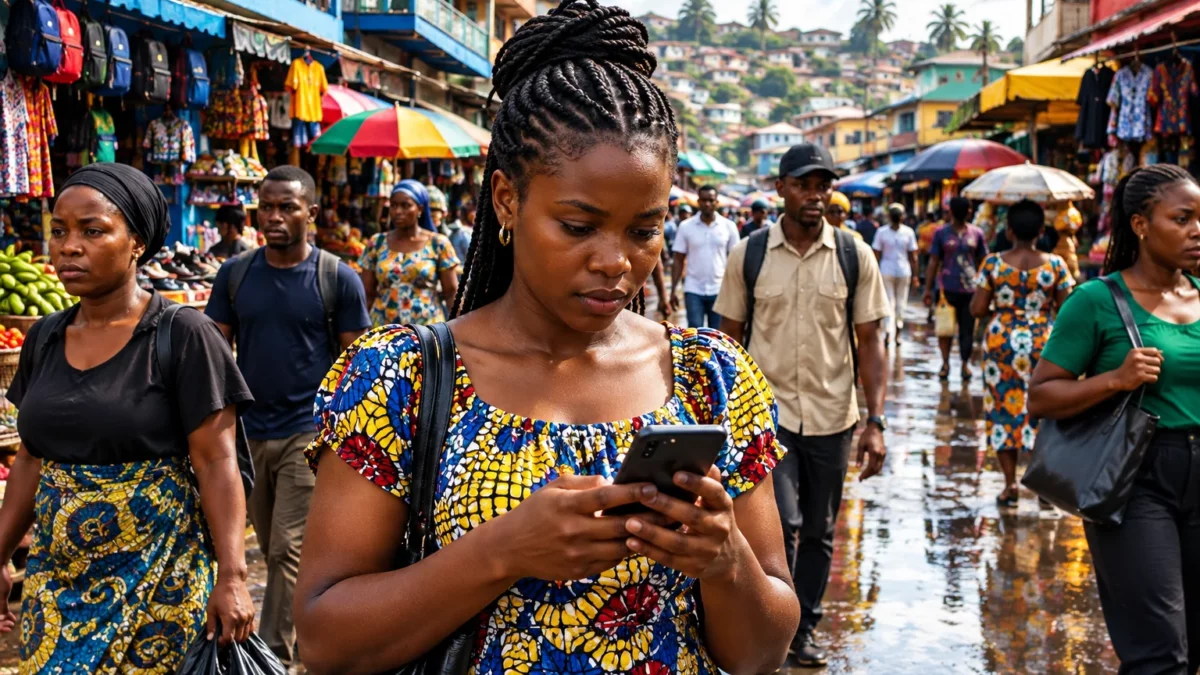
A 4G mast can cover a community without its residents being able to use the internet. In Sierra Leone, the price of a phone remains a tangible obstacle. A local assembly project aims to bring devices, skills and jobs closer to people. The question is whether this ambition will translate into genuinely affordable smartphones.
Coverage alone is not enough to connect people
The digital divide is not measured solely by the presence of a network. People must also be able to buy a device, pay for data and have a reliable enough connection to use it. In 2024, 4G networks covered about 82% of Sierra Leone’s population, but only one in four people used the internet, according to a World Bank diagnostic. In the same year, 28.53% of people aged 15 and over owned a smartphone, according to figures cited by national authorities and reported by the local press.
This gap gives the project a significance beyond industry. A connected phone can be used to communicate, study, access public services or develop a business. But local assembly alone will not solve the cost of data plans, electricity shortages or disparities between Freetown and less well-served areas.
Across West Africa, the issue also concerns regional economic co-operation. Sierra Leone is a member of ECOWAS, an organisation that works, among other things, to integrate its member states’ markets. Training technicians and developing local suppliers could therefore, in time, be of interest to other countries in the region. That will depend, however, on the project’s ability to produce consistently and meet the standards applicable to devices.
Agreement to study an assembly plant
On 19 November 2026, Sierra Leone’s Ministry of Communication, Technology and Innovation signed a memorandum of understanding with Unique Group Company Ltd, a Gambian business. The signing took place on the sidelines of the West Africa Integration and Investment Summit, held in Lungi from 16 to 18 November. The announced investment is indicative: $21.9 million. The agreement covers the exploration of a facility for assembling mobile phones and electronic equipment, not a plant that is already operational. The authorities have yet to specify the timetable, the exact location of the site or the terms on which the devices will be sold. Sierra Leone’s ministry outlines the agreement with Unique Group.
The proposed first phase would include device assembly and configuration, quality checks, maintenance and repairs. A technical training centre is also planned. It could equip Sierra Leoneans with skills in electronics and maintenance, beyond production roles alone. The project also refers to initiatives involving digital learning, connecting schools and solar-powered equipment, without providing a detailed timetable at this stage.
This caution about the project’s status is essential. A memorandum of understanding expresses a shared intention, but does not guarantee that the funds will be secured or work will begin. The announced amount also does not, by itself, make it possible to estimate the number of jobs, production capacity or final price of the smartphones.
The final price will be the real test
The upfront cost remains high for some households in the region. In its report published in November 2025, the GSMA, an international mobile operators’ association, estimated that an entry-level smartphone cost an average of $38.91 in sub-Saharan Africa in 2024, or about 26% of average monthly income per person. This share rose to 64% for the poorest 40% and 87% for the poorest 20%. The burden was also heavier for women than for men. The GSMA report on smartphone prices and adoption thus highlights how the average price conceals wide disparities in purchasing power.
Assembling phones in the country does not necessarily mean they will be cheaper to buy. Components may still be imported, while energy, logistics and financing add to costs. The project will therefore need to clarify its supply chain and business model. If the devices are too expensive, underpowered or difficult to repair, their local origin alone will not persuade buyers.
Kenya offers a point of comparison, though not a blueprint to be copied mechanically. In January 2026, Kenyan authorities announced that five million smartphones had been assembled in the country, with prices ranging from 6,000 to 8,000 Kenyan shillings. These figures are a government announcement reported by the media, and do not in themselves measure sales or actual use. A GSMA analysis of the Kenyan market also notes that perceptions of quality, brand awareness and consumer preferences influence device choices. Figures announced in Kenya for locally assembled devices.
Measuring the impact beyond the factory
For workers and young people in training, the challenge will be access to transferable skills, not just jobs on an assembly line. For consumers, particularly outside the capital, the decisive factor will be the total cost: the price of the phone, mobile data, repairs and the availability of parts. For businesses, consistent production could open up regional markets, provided it meets standards and demand.
The next step is therefore less an announcement of expansion than a series of concrete decisions: confirmed financing, a site, a timetable, a product range, prices and access to spare parts. The ministry presents the agreement as a way to make digital technology a driver of jobs and skills. Its effectiveness will be judged above all by the number of affordable devices brought to market and how residents use them. In Sierra Leone, as across the rest of ECOWAS, closing the gap between coverage and actual connectivity requires addressing devices, networks and the cost of services together.