Algeria
 Egypt
 Libya
 Morocco
 Sudan
 Tunisia
 Benin
 Burkina Faso
 Cabo Verde
 Côte d'Ivoire
 Ghana
 Guinea
 Guinea-Bissau
 Liberia
 Mali
 Mauritania
 Niger
 Nigeria
 Sierra Leone
 The Gambia
 Togo
 Cameroon
 Central African Republic
 Chad
 DR Congo
 Equatorial Guinea
 Gabon
 Republic of the Congo
 São Tomé and Príncipe
 Burundi
 Comoros
 Djibouti
 Eritrea
 Ethiopia
 Kenya
 Madagascar
 Malawi
 Mauritius
 Mozambique
 Rwanda
 Seychelles
 Somalia
 South Sudan
 Tanzania
 Uganda
 Angola
 Botswana
 Eswatini
 Lesotho
 Namibia
 South Africa
 Zambia
 Zimbabwe
A railway beyond Dakar, and a promise that matters for Thiès
In Senegal, the train is no longer just a commuter service between Dakar and its suburbs. It is becoming a tool for regional development in a country where urban pressure, distances and transport costs weigh on everyday life as much as on the economy. The extension of the Regional Express Train (TER) to Thiès fits this approach: bringing employment centres closer, easing congestion in the capital region and preparing a broader network across the country.
Thiès is not a peripheral city in any limited sense. It is one of the major hubs of western Senegal, a crossroads city on the Dakar–interior route. The issue therefore concerns not only commuting but also logistics competitiveness, the distribution of economic activity and the place of medium-sized cities in national strategy. Senegal’s presidency itself recently asked the government to ensure the efficient operation of the TER, Senegal Railways and Senegal’s Grand Trains as part of a multimodal approach.
What the funding covers and why it matters
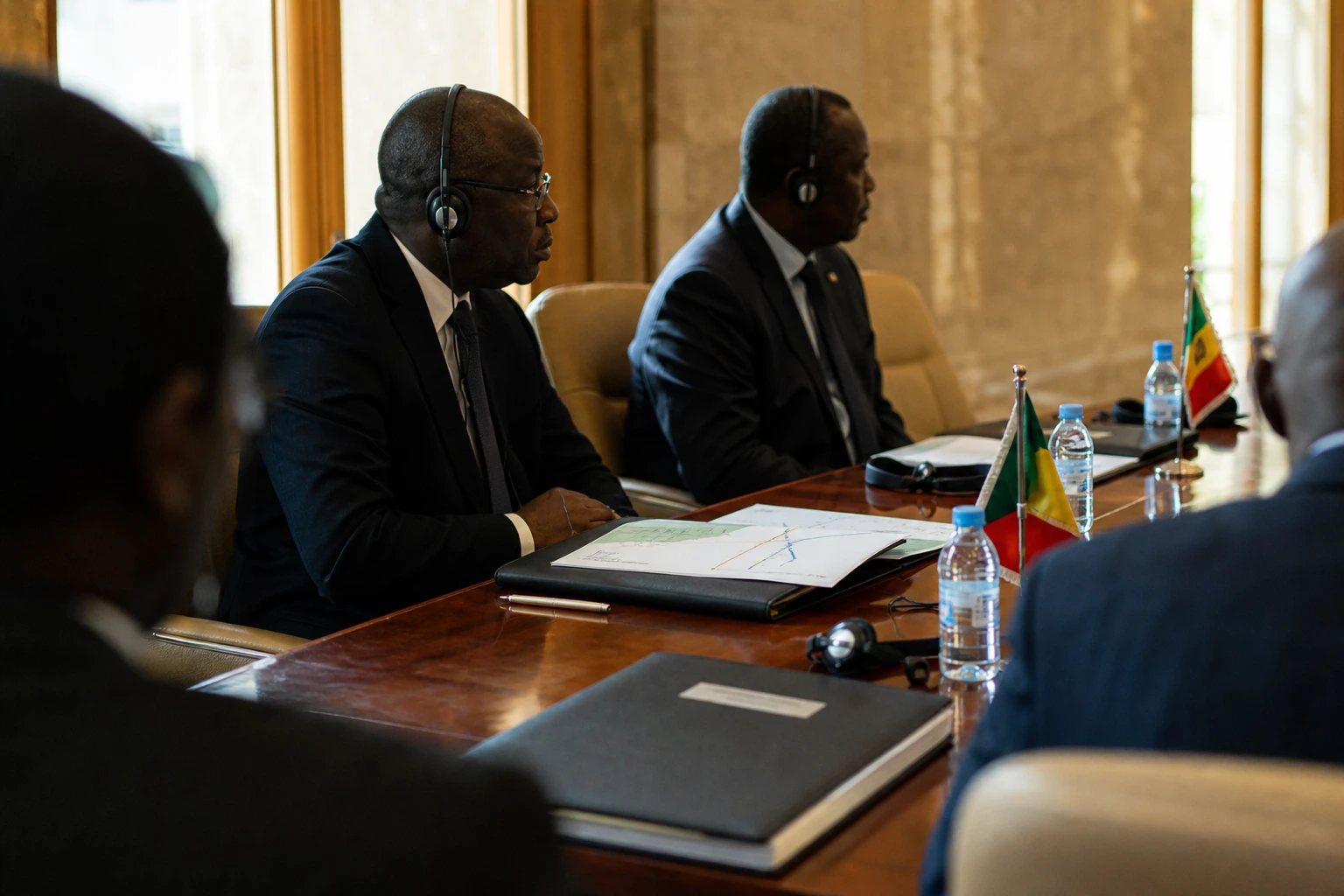
On 24 July 2026, Senegal’s Ministry of Land and Air Transport, the National Company for the Management of Regional Express Train Assets (Senter), the French Development Agency and the European Union signed a memorandum of understanding to fund preliminary studies for extending the TER to Thiès. The announced funding amounts to €10 million. It is to cover the technical, economic, social and environmental studies required before any construction work can begin.
This step did not come out of nowhere. As early as 3 March 2026, Senegalese authorities had announced the €10 million allocation for feasibility studies for Phase 3, jointly funded by the European Union and AFD. The signing on 24 July 2026 therefore formalises a preparatory stage that had already been announced, as Senegal’s government seeks to place rail at the heart of the Senegal 2050 National Transformation Agenda.
This study phase is significant. In transport infrastructure, the quality of preliminary design determines how robust the final construction project will be. In Dakar and its outskirts, where travel is often marked by congestion, the challenge is not simply to extend a line. It is to assess operating profitability, environmental impact, climate resilience and integration with other modes of transport.
A mobility issue, but also a matter of economic balance
In Thiès, the return of the train has a practical dimension: saving time, reducing the strain of the journey and widening the employment catchment area accessible from Dakar. It is also a question of territorial redistribution. When transport networks remain centred on the capital, opportunities are concentrated there. When they are extended, secondary cities can attract more activity, services and labour flows. AFD also notes that the Dakar–Thiès corridor is seen as a first step towards a broader network.
The Senegalese government sees the project as a lever for more balanced growth. In his address to the nation on 3 April 2026, President Bassirou Diomaye Diakhar Faye reminded the country that it needed to anticipate pressures on supply chains, transport costs and energy prices. Rail addresses precisely this kind of structural constraint: it can ease pressure on roads, improve the movement of people and, in time, support trade between Dakar, Thiès and the country’s interior.
The issue is also a budgetary one. The announcement comes as the Senegalese state seeks to balance economic recovery, financial sustainability and the funding of major infrastructure projects. Choosing to begin with studies reflects a cautious approach. It allows costs, routes, land requirements and the integration of the future extension into the existing network to be assessed more rigorously.
Regional significance for West Africa
At regional level, the project goes beyond Senegal alone. The country wants to pursue a corridor-based approach compatible with the ambitions of ECOWAS and WAEMU, as well as with a broader view of African flows. The “Senegal 2050” document also refers to rail and road links connecting with neighbouring countries, including Mali and The Gambia. From this perspective, Thiès is not simply a destination: it is a useful node for a future, denser network.
The political significance is just as clear. By moving forward with European partners on an urban and interurban project, Dakar is showing that it wants to retain control of its infrastructure development while diversifying its support. The TER, already described by AFD as a flagship mobility project for the Dakar region, is thus becoming a test of consistency for the transformation policy announced by the Senegalese state. The next test will therefore lie less in the announcement than in the ability to turn these studies into a credible route, complete financing and a well-managed construction project.