Algeria
 Egypt
 Libya
 Morocco
 Sudan
 Tunisia
 Benin
 Burkina Faso
 Cabo Verde
 Côte d'Ivoire
 Ghana
 Guinea
 Guinea-Bissau
 Liberia
 Mali
 Mauritania
 Niger
 Nigeria
 Sierra Leone
 The Gambia
 Togo
 Cameroon
 Central African Republic
 Chad
 DR Congo
 Equatorial Guinea
 Gabon
 Republic of the Congo
 São Tomé and Príncipe
 Burundi
 Comoros
 Djibouti
 Eritrea
 Ethiopia
 Kenya
 Madagascar
 Malawi
 Mauritius
 Mozambique
 Rwanda
 Seychelles
 Somalia
 South Sudan
 Tanzania
 Uganda
 Angola
 Botswana
 Eswatini
 Lesotho
 Namibia
 South Africa
 Zambia
 Zimbabwe
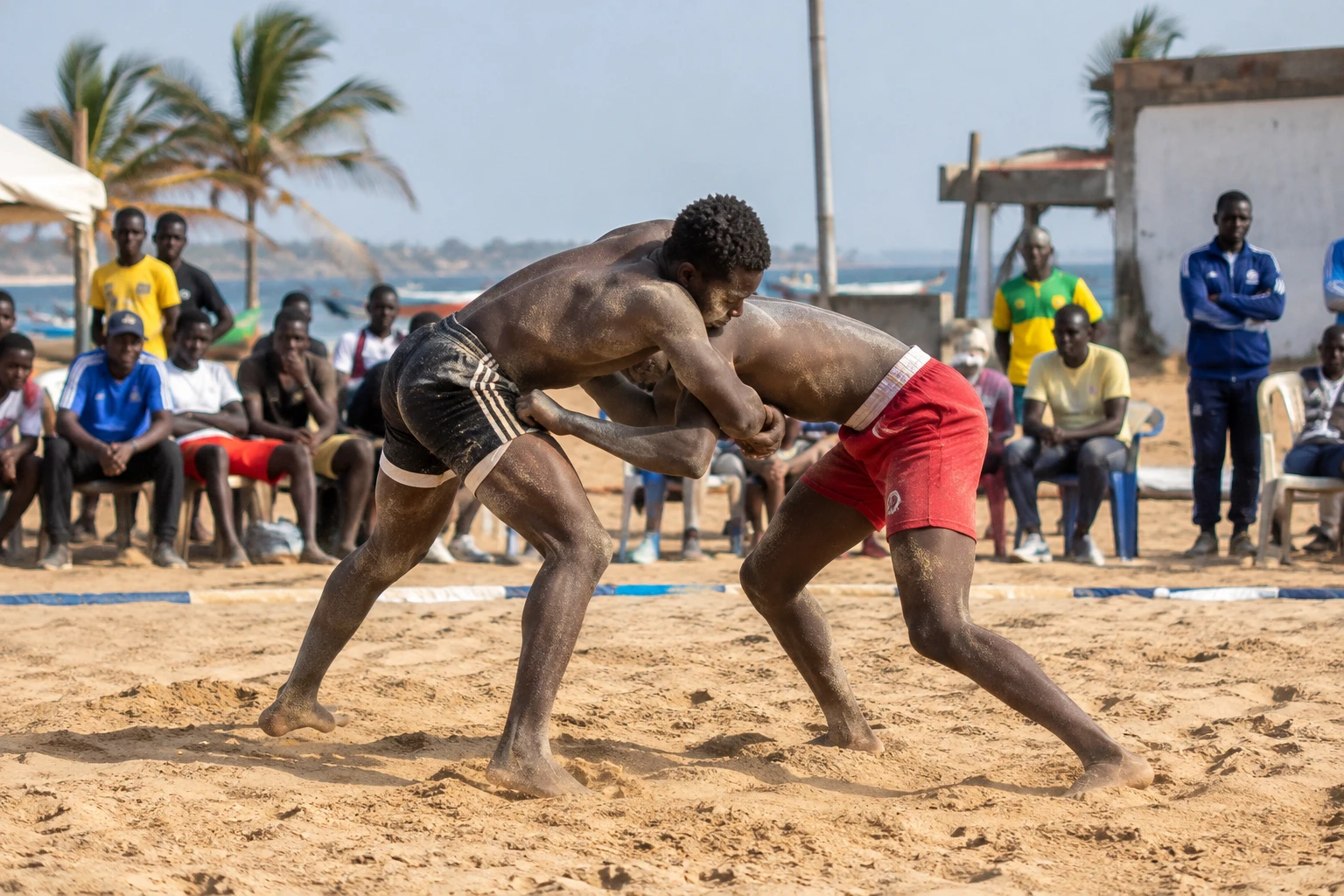
At Saly, Senegal’s first titles at the Youth Olympic Games did not come in a sport long considered marginal on the Olympic stage. They were won on the sand, in a sport deeply rooted in the country’s life. In two days, beach wrestling put young Senegalese women and men at the centre of the competition.
At Saly, wrestling brings Senegal into its Games
Senegal is hosting the Youth Olympic Games from 31 October to 13 November 2026. Dakar, Diamniadio and Saly are sharing the events. It is the first Olympic sporting event to be held on the African continent. For the host country, the stakes therefore go beyond the medal table: the challenge is also to bring the Games to life beyond the competition venues and show Senegal’s ability to organise an international event.
The beach wrestling competition is taking place in Saly, in the Thiès region, about 80 kilometres from Dakar. The discipline, contested on a sand surface, is making its debut at the Youth Olympic Games in Dakar. It is not, however, foreign to Senegalese traditions: wrestling, particularly laamb, has an important place in the country’s sporting culture. The rules of beach wrestling nevertheless differ from those of traditional Senegalese wrestling, as the national coaching team has pointed out.
The Games bring together about 2,700 young athletes across 25 sports and 153 medal events. Senegal is hosting them with an Olympic history still marked by an individual podium finish at the Summer Games: Amadou Dia Ba’s silver in the 400 metres hurdles in 1988. Saly’s successes therefore carry particular resonance, without in themselves summing up the performances of other delegations or Senegal’s results in events still under way.
Three golds and a bronze
On Saturday 7 November, Élisabeth Diatta won gold in the under-55kg category. The Senegalese wrestler beat Japan’s Reisa Kojima in the final. On the same day, Maguette Diop won the men’s 80kg category, beating Azerbaijan’s Nihad Suleymanli. The Senegalese Press Agency and the International Olympic Committee confirmed the first two titles.
The following day, Ndèye Khady Anna Diatta added a third gold medal in the 45kg category. She won her final against Mexico’s Karen Rios Silva, after beating Colombia’s Valery Edith Rubio Torres in the semi-final. Abdoulaye Diouf completed Senegal’s beach wrestling tally with bronze in the under-90kg category, after a 4-1 win over Brazil’s Allan Smith de Sousa Bezerra.
Senegal’s result in the discipline was therefore three gold medals and one bronze. This should be distinguished from the country’s provisional total at the Youth Olympic Games: by the evening of 8 November, Senegal had three golds and two bronzes, with the second bronze coming from judoka Matar Diop. The overall tally could still change before the Games close.
Journeys built over time, not a one-off success
The finals tell individual stories, but also of teamwork. Before the Games, the Senegalese delegation had entered eight wrestlers in the event. The medals should not obscure the athletes who were eliminated or fell just short of the podium. They took part in a competition where the international rules of beach wrestling set different benchmarks from those of laamb.
Maguette Diop’s case illustrates this transition between disciplines. According to the APS, he had faced several of his opponents at the under-17 world championships, held in Baku in August. Coach Abdoulaye Thiam said adapting to the rules had made preparation more difficult. The title thus reflects both familiarity with elite competition and the ability to adjust technique to a different format.
Ndèye Khady Anna Diatta’s success also carries representational significance. Her place among Senegal’s flag-bearers at the opening ceremony had already put her in the spotlight. Wrestling is often associated with men in the sporting imagination. Yet the performances of young women wrestlers show that Senegalese women are also claiming their place in the discipline, on the national stage and in international competitions.
Isabelle Sambou, a former champion and member of the coaching team, is supporting this generation. Her career links Saly’s titles to continuity in the sport: experience of international competition, passing knowledge on to young people and women’s presence in coaching. To turn this success into lasting progress, needs extend beyond preparing for a handful of finals. They include access to facilities, coaches, competitions and long-term support for young athletes.
An African event, a legacy to assess
These victories are giving beach wrestling and its athletes new visibility. On their own, they do not prove that hosting the Youth Olympic Games will leave behind lasting facilities or funding. That legacy will depend on decisions made after the ceremonies: maintaining venues, giving clubs access to facilities and supporting less publicised sports. The benefits must also reach athletes who live far from Dakar and major training centres.
The significance of the Games extends beyond Senegal. For African countries, Dakar 2026 is a first experience of hosting an Olympic event. The success of this edition will be judged by the competition, but also by how its venues and investments serve local communities after the delegations leave. For now, the Youth Olympic Games continue until 13 November. Senegal’s results in other sports remain to be seen, so the competition should not be reduced to Saly’s medal haul alone.
The wrestling medals also show that a locally rooted discipline can find a place in an international sporting framework, provided its rules are mastered and athletes are prepared. For the young champions and their coaches, the next step will be to carry this momentum beyond the Games. For Senegal, the challenge will be to use these titles as a foundation for training and participation, rather than as an isolated memory of its Olympic event.