Algeria
 Egypt
 Libya
 Morocco
 Sudan
 Tunisia
 Benin
 Burkina Faso
 Cabo Verde
 Côte d'Ivoire
 Ghana
 Guinea
 Guinea-Bissau
 Liberia
 Mali
 Mauritania
 Niger
 Nigeria
 Sierra Leone
 The Gambia
 Togo
 Cameroon
 Central African Republic
 Chad
 DR Congo
 Equatorial Guinea
 Gabon
 Republic of the Congo
 São Tomé and Príncipe
 Burundi
 Comoros
 Djibouti
 Eritrea
 Ethiopia
 Kenya
 Madagascar
 Malawi
 Mauritius
 Mozambique
 Rwanda
 Seychelles
 Somalia
 South Sudan
 Tanzania
 Uganda
 Angola
 Botswana
 Eswatini
 Lesotho
 Namibia
 South Africa
 Zambia
 Zimbabwe
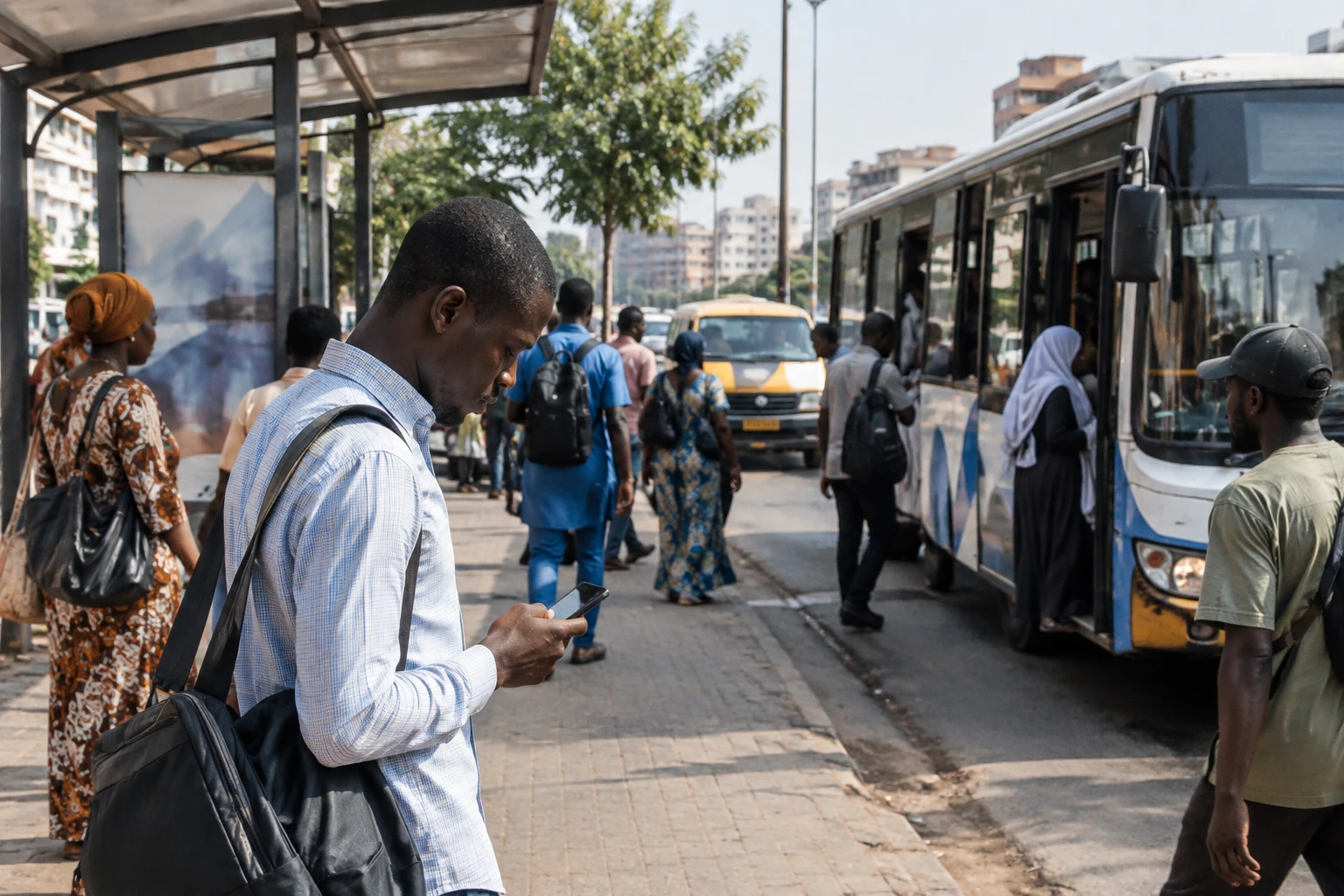
In Senegal, mobile coverage is expanding faster than people’s actual access to digital services. For some households, the obstacle is no longer just the network: it is also the price of a phone capable of connecting to it. The issue has now entered cooperation discussions between Dakar and Riyadh.
A gap between network availability and use
Senegal has significantly developed its mobile infrastructure. According to estimates by the GSMA, an international organisation representing the mobile industry, 4G covers 97% of the population and 5G, 39%. Yet 8.16 million people use mobile internet, or about 43% of the population. These indicators do not measure the same thing: coverage means a network is accessible in an area, while the number of users measures the people who use it. The GSMA’s data on mobile access in Senegal therefore highlight a significant usage gap.
This challenge forms part of a broader national digital trajectory. Senegal has made digital transformation a public policy priority, notably through the New Deal Technologique, which runs to 2034. But ambitions for digital public services, education and economic activity also depend on people’s ability to acquire devices and use these services.
At regional level, Senegal belongs to ECOWAS, the Economic Community of West African States, and WAEMU, the monetary and economic union of several countries in the region. Cross-border exchanges and digital services are expanding, but incomes, infrastructure and tax rules vary from one country to another. Senegal’s results should therefore be viewed in this West African context, without presenting them as representative of the entire continent.
Riyadh discussions, details still unknown
On the sidelines of the International Telecommunication Union (ITU) Plenipotentiary Conference, held in Doha from 9 to 27 November 2026, Senegal’s Minister of Telecommunications and Digital Affairs, Samba Diouf, met his Saudi counterpart, Abdullah Alswaha. According to a statement from Senegal’s ministry, discussions covered access to digital equipment, infrastructure, the sharing of expertise and the digitisation of public services.
The ITU conference brings together member states to set the direction of the United Nations agency dedicated to telecommunications. The meeting between the two ministers therefore took place in an international forum where connectivity, investment and technological cooperation are key issues. The ITU confirms that the conference is taking place in Doha, but the publicly available information does not yet specify the content of a bilateral agreement on smartphones.
So far, no announcement has provided details of a timetable, funding, the devices involved or potential beneficiaries. This is therefore a possible area of cooperation raised by officials, not a programme whose implementation has already been confirmed. The distinction matters: a statement of intent guarantees neither lower prices nor the actual distribution of phones.
Prices weigh more heavily on poorer households
The cost of an entry-level smartphone can represent a significant expense for a household on a limited income. In its analysis of Senegal, the GSMA estimates that an internet-enabled device costs, on average, the equivalent of 19% of monthly income per capita. For the 40% of the population on the lowest incomes, that share rises to 42%. These ratios give an indication of the burden of the purchase, but do not by themselves describe the income and spending of each family.
However, devices are only one of the obstacles. Digital skills, the relevance of the services on offer, connection quality and trust in digital use also influence adoption. A cheaper phone can make access easier, but on its own it is not enough to bring about a lasting increase in internet use. The GSMA also notes that more than half of the population lives in an area with coverage but does not use mobile internet. Its report on Senegal’s digital transformation emphasises these combined barriers.
Geographical and social disparities also matter. A programme targeting underserved localities will have a different impact from a national tax measure. In cities and rural areas alike, needs differ according to economic activity, network availability and purchasing power. Women and workers in the informal economy, in particular, may face greater difficulties in accessing conventional credit.
Public and private measures still to be defined
Senegal already has several options. The Telecommunications Universal Service Development Fund (FDSUT), which supports access to services in underserved areas and among underserved groups, plans to distribute 10,000 smartphones through its universal access programme, at a rate of 2,000 devices a year, according to information released about the scheme. Operators also offer entry-level phones, while refurbished devices can provide a cheaper option. However, these initiatives do not have the same target groups or reach.
The GSMA recommends targeted assistance, financing suited to irregular incomes and packages combining the purchase of a phone with communications credit. It also recommends reviewing taxes on the cheapest devices. Any tax cut should be assessed in terms of its actual effect on the price paid by consumers, as well as its impact on public revenue and sales channels.
In practice, the central question will be the mechanism: who would fund the devices, according to what criteria, and how would it be verified that any price reduction benefits buyers? Useful cooperation could also cover training, maintenance or the development of accessible digital services, rather than focusing solely on supplying devices.
A West African challenge, with results to be measured
For Senegal’s authorities, the challenge is to turn already extensive network coverage into tangible access. People could benefit in areas such as administrative procedures, payments and learning, provided services are affordable and suitable. For the public finances, subsidies and tax exemptions raise another question: how can support be targeted at the households most in need without creating a costly or difficult-to-monitor scheme?
What happens next will therefore depend on verifiable announcements: a formal agreement, budget, timetable and allocation criteria. Coverage and usage figures will also need to be tracked over time. Across West Africa, Senegal’s case illustrates a shared difficulty: expanding infrastructure is not enough if device costs, skills and patterns of use continue to keep part of the population at a distance from the digital world.