Algeria
 Egypt
 Libya
 Morocco
 Sudan
 Tunisia
 Benin
 Burkina Faso
 Cabo Verde
 Côte d'Ivoire
 Ghana
 Guinea
 Guinea-Bissau
 Liberia
 Mali
 Mauritania
 Niger
 Nigeria
 Sierra Leone
 The Gambia
 Togo
 Cameroon
 Central African Republic
 Chad
 DR Congo
 Equatorial Guinea
 Gabon
 Republic of the Congo
 São Tomé and Príncipe
 Burundi
 Comoros
 Djibouti
 Eritrea
 Ethiopia
 Kenya
 Madagascar
 Malawi
 Mauritius
 Mozambique
 Rwanda
 Seychelles
 Somalia
 South Sudan
 Tanzania
 Uganda
 Angola
 Botswana
 Eswatini
 Lesotho
 Namibia
 South Africa
 Zambia
 Zimbabwe
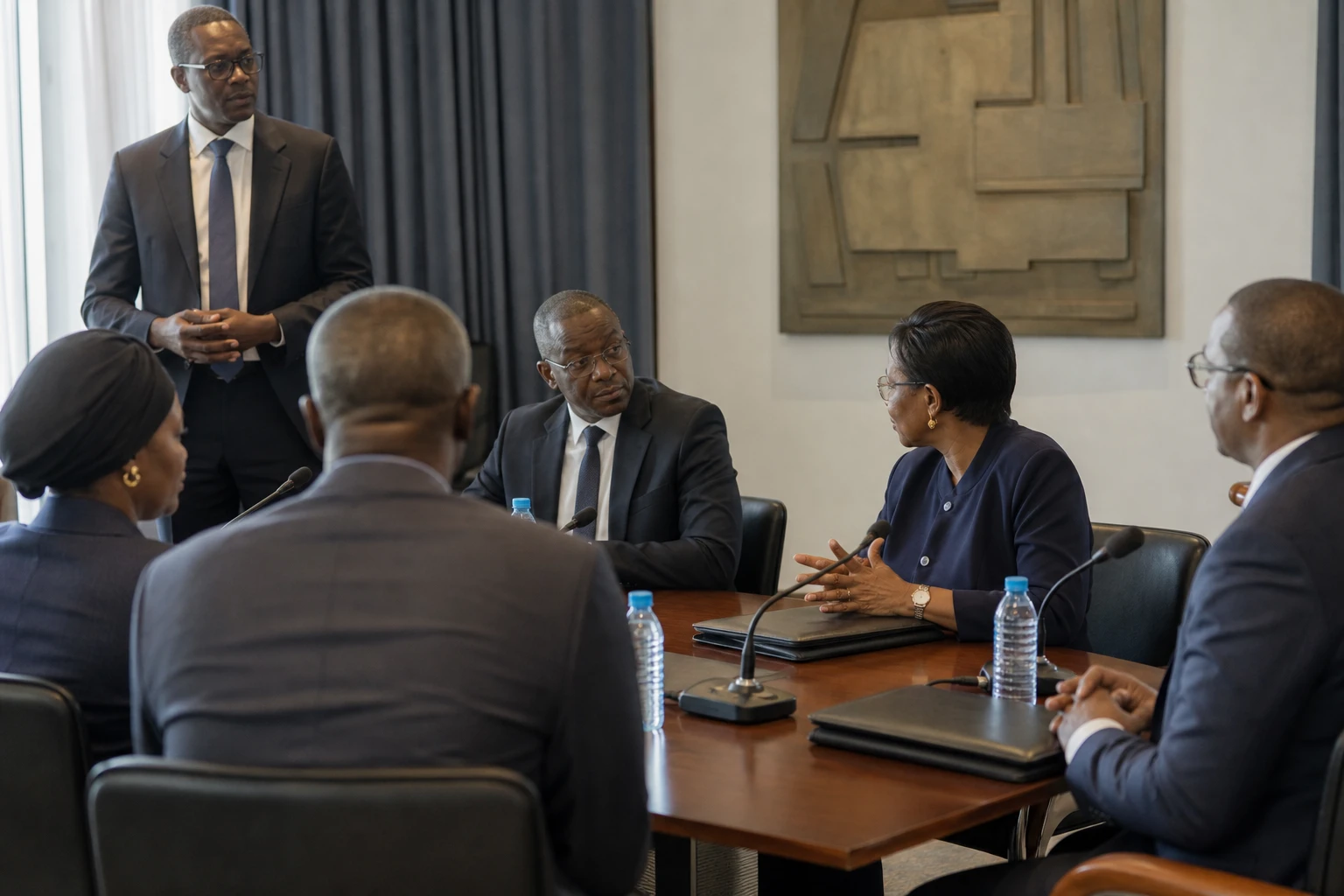
A deal that brings relief, but does not close the file
In Dakar, the figures are as reassuring as they are troubling. The technical agreement reached with the International Monetary Fund opens up a financing window of $2.2 billion, but above all it brings a more sensitive question back to the fore: who will pay for the adjustment, and at what pace?
In a country where public debt has been reassessed in depth following the Court of Auditors’ audit, the debate is no longer just about the volume of resources, but about how to restore confidence without putting households under strain. Senegal remains in a phase of budgetary repair, with the state seeking to refinance itself while preserving its social spending capacity.
What the agreement says and what the state is seeking
On 1 September 2026, IMF staff and the Senegalese authorities reached agreement on the broad outlines of a 36-month programme under the Extended Credit Facility. The amount under discussion is about $2.2 billion, or 1,537.1 million SDRs and 475% of Senegal’s quota. But the agreement remains subject to several steps: formal approval by the IMF Executive Board, the implementation of corrective measures linked to the misreporting case, and the securing of financing assurances from the country’s partners.
The state’s position emphasises debt sustainability and budget transparency. The Ministry of the Economy, Finance and Planning has launched a Senegal Debt Treatment Plan, presented as a sovereign response to the deterioration in the country’s risk profile and the gradual loss of access to international markets. The official document also specifies that debt denominated in CFA francs will remain outside the plan’s scope, with most of the effort targeting claims considered to place the greatest burden on the budget.
On the same day, Cheikh Diba announced a reform of energy subsidies. According to APS, the government wants to protect vulnerable households while reducing the cost of electricity by nearly 30%. The minister also defended more precise targeting of aid, explaining that a universal subsidy benefits the biggest consumers too much.
Why civil society is calling for greater clarity
The response in Dakar was immediate. Civil society organisations called for the state’s commitments to be published and voiced fears of indirect austerity through energy tariffs, cuts to some spending and tighter budgetary discipline for households. They want the contents of the debt treatment plan made public without delay, so citizens know what has been negotiated on their behalf.
This demand is not new, but it carries particular weight in the Senegalese context. Following the Court of Auditors’ audit published in 2025, which reconstructed the debt stock at 18,558.91 billion CFA francs as at 31 December 2023, or 99.67% of GDP, accountability has become central to public debate. The IMF, for its part, acknowledged that the Senegal case required corrective measures before any further support.
The Legs Africa think tank, meanwhile, stresses one practical point: restoring the public finances must not come at the expense of health, education and productive investment. This view reflects a concern widely shared in West African societies, where budget adjustment is often judged by its effects on essential services far more than by its accounting balances.
An issue for Senegal, but also for West Africa
The issue goes well beyond Senegal alone. The government says it intends to use the G20 Common Framework, a mechanism for coordinating creditors, and to pursue debt treatment in consultation with its partners. At the same time, Dakar is relying on the regional market of the West African Economic and Monetary Union, showing that the budgetary response also involves regional instruments, not just Washington or bilateral lenders.
For ECOWAS, of which Senegal remains an important economic and political player, the challenge is clear: how can macroeconomic stability be maintained without closing off social space? The Senegalese case is a reminder that financial discipline in the region is not limited to a deficit table. It also affects electricity prices, the role of subsidies, the state’s ability to pay its arrears and the confidence of businesses awaiting payment.
The government says the plan should create new room for social sectors and investment. Critics, for their part, are calling for written guarantees, parliamentary oversight mechanisms and citizen monitoring. Between these two demands, a point of convergence is emerging: transparency will not be an image-enhancing extra, but a political condition for the programme’s acceptance.
The next steps will come quickly. The programme still has to be reviewed by IMF management and then by the Executive Board, while the Senegalese government has announced regular updates on what comes next. That will show whether the agreement merely serves to reopen access to financing or genuinely helps rebuild sustainable public finances without further breaking the social contract.