Algeria
 Egypt
 Libya
 Morocco
 Sudan
 Tunisia
 Benin
 Burkina Faso
 Cabo Verde
 Côte d'Ivoire
 Ghana
 Guinea
 Guinea-Bissau
 Liberia
 Mali
 Mauritania
 Niger
 Nigeria
 Sierra Leone
 The Gambia
 Togo
 Cameroon
 Central African Republic
 Chad
 DR Congo
 Equatorial Guinea
 Gabon
 Republic of the Congo
 São Tomé and Príncipe
 Burundi
 Comoros
 Djibouti
 Eritrea
 Ethiopia
 Kenya
 Madagascar
 Malawi
 Mauritius
 Mozambique
 Rwanda
 Seychelles
 Somalia
 South Sudan
 Tanzania
 Uganda
 Angola
 Botswana
 Eswatini
 Lesotho
 Namibia
 South Africa
 Zambia
 Zimbabwe
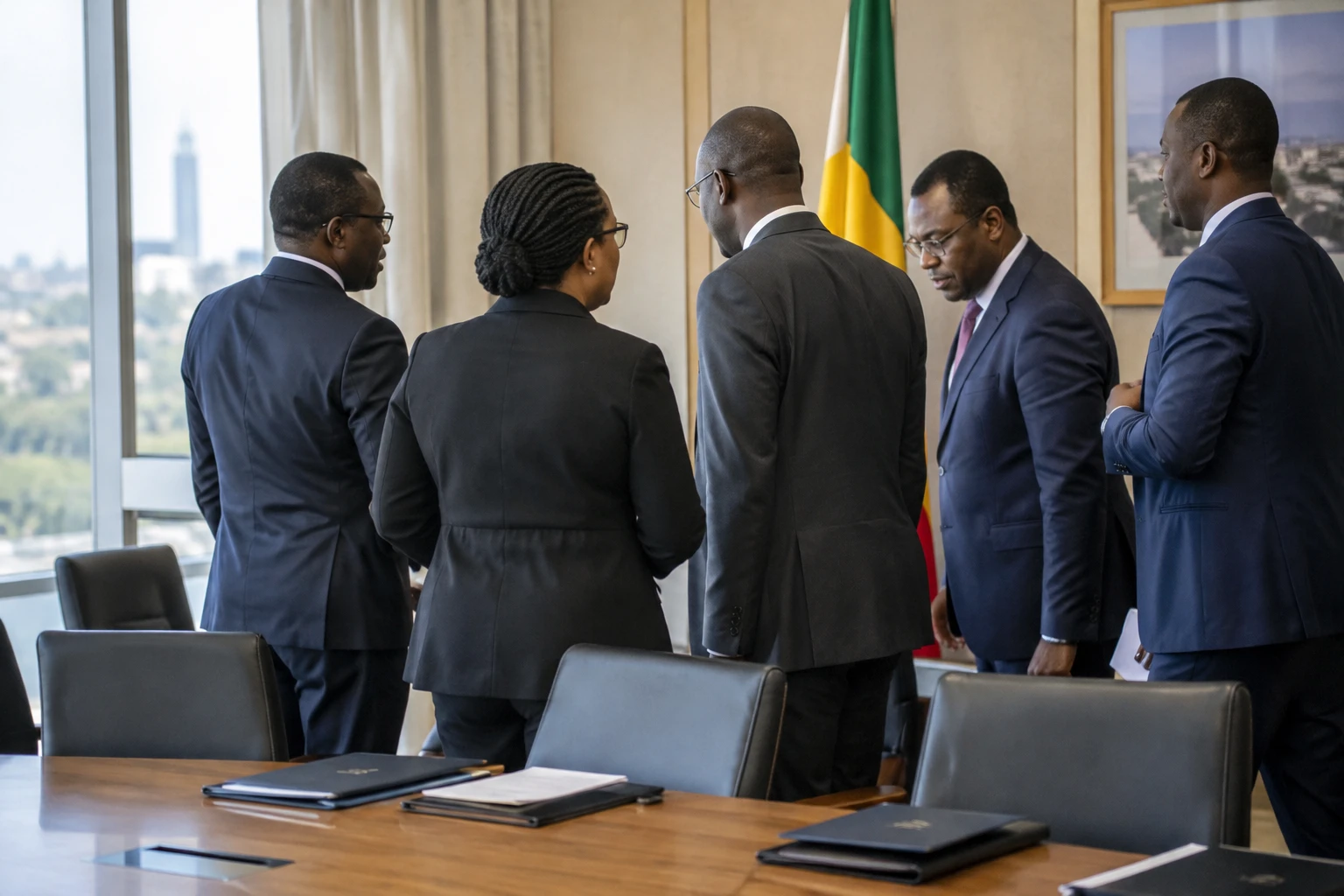
For Senegal, accelerating debt treatment does not simply mean saving time in negotiations. It also means preserving public resources, restoring access to financing and limiting the cost of adjustment for households and businesses.
The timetable suggested by Washington sets an ambition, not a deadline already accepted by all creditors. And speed alone will not show whether the resulting agreement genuinely eases the country’s budgetary constraints.
Debt reassessed, negotiations under way
The current crisis has its roots in the review of public accounts launched after the political changeover in 2024. The checks uncovered loans and commitments that had not been properly declared. Debt was consequently reassessed at about 132% of gross domestic product at the end of 2024, according to estimates cited by the International Monetary Fund (IMF). This ratio depends on the scope used and on statistical revisions.
The issue goes beyond the accounting figures. The greater the share of revenue allocated to repayments, the less room the budget has to fund public services, investment and social programmes. The effects may vary across regions: urban households are particularly affected by changes in prices and taxation, while regions also depend on the continuity of investment and infrastructure projects.
Senegal is also part of the West African Economic and Monetary Union (WAEMU), sharing the CFA franc and a central bank with several neighbouring countries. Debt negotiations remain a national matter, but their terms can affect regional financing, shared bond markets and investor confidence in West Africa.
Washington sets a goal, not an agreement
On 14 October 2026, on the sidelines of the annual meetings of the IMF and the World Bank, US official Erin Browne said she hoped Senegal’s process would be completed in less than a year. She called for swift and transparent discussions. However, no binding timetable was announced for the different parties.
Washington presents the case as a test for the G20 Common Framework. Established in 2020, the mechanism aims to co-ordinate discussions between an indebted state and bilateral and private creditors in order to make debt sustainable. Its operation has been criticised for the length of negotiations, notably in the cases of Ghana and Zambia.
Senegal has requested debt treatment under the mechanism, according to information reported at the meeting of the Global Sovereign Debt Roundtable. The forum brings together the IMF, the World Bank and representatives of creditors and borrowing countries. The request opens a process; it does not prejudge either the outcome or the final sharing of the burden.
Creditors do not form a single bloc. Lender states, bondholders, commercial banks and regional institutions do not have the same contracts or interests. Co-ordination may therefore shorten exchanges, but it does not remove the need to negotiate amounts, maturities or guarantees.
The IMF programme and the cost to the public
On 1 September 2026, IMF staff and the Senegalese authorities announced a staff-level agreement in principle on a new financing programme of about $2.2bn. It must still go through the necessary institutional steps. The Fund says the programme aims, among other things, to restore macroeconomic stability and debt sustainability.
This technical agreement should be distinguished from the outcome of debt treatment. IMF financing is not, by itself, a restructuring: it is support tied to economic policies, while treatment involves discussions with creditors about existing obligations. The Senegalese government has also presented a debt treatment plan. The precise terms and their effects remain to be established.
For the authorities, a swift agreement could reduce uncertainty and help mobilise financing. But the conditions will matter as much as the timetable. If adjustment relies mainly on tax rises, spending cuts or reductions in certain subsidies, its effects will vary according to income, sector and region. Conversely, treatment that is too limited could leave the budget under heavy pressure.
Transparency will therefore be crucial: publishing the commitments covered, explaining the choices made and monitoring the impact on public spending. Correcting past information is a matter of trust for financial partners. It also concerns Senegalese people, who should be able to understand how decisions are made about repayments and national priorities.
A precedent watched across West Africa
The timetable sought by Washington resonates beyond Senegal. The G20 Common Framework applies to several African states facing debt difficulties, but each situation depends on its creditor structure and political choices. A swift outcome in Dakar could show that co-ordination procedures are making progress; it would not guarantee that the same model would work elsewhere.
The co-chairs’ report of the Global Sovereign Debt Roundtable, published in October, notes progress in several earlier cases while also reporting that commercial discussions are still under way. The next indicator to watch will therefore be tangible: progress in exchanges with creditor groups, followed by the publication of sufficiently precise terms to assess the relief secured.
For Senegalese people, the issue is not simply meeting a deadline of less than 12 months. Success will be judged by the ability to reduce debt pressure durably without undermining essential services or investment. For the G20 and its partners, the case will show whether the mechanism can combine speed, transparency and fair treatment of creditors.
US statements on the timetable for Senegal’s debt · Updates on discussions at the IMF meetings · The agreement in principle between the IMF and Senegal · The Senegalese government’s presentation of its treatment plan · The 2026 report of the Global Sovereign Debt Roundtable