Algeria
 Egypt
 Libya
 Morocco
 Sudan
 Tunisia
 Benin
 Burkina Faso
 Cabo Verde
 Côte d'Ivoire
 Ghana
 Guinea
 Guinea-Bissau
 Liberia
 Mali
 Mauritania
 Niger
 Nigeria
 Sierra Leone
 The Gambia
 Togo
 Cameroon
 Central African Republic
 Chad
 DR Congo
 Equatorial Guinea
 Gabon
 Republic of the Congo
 São Tomé and Príncipe
 Burundi
 Comoros
 Djibouti
 Eritrea
 Ethiopia
 Kenya
 Madagascar
 Malawi
 Mauritius
 Mozambique
 Rwanda
 Seychelles
 Somalia
 South Sudan
 Tanzania
 Uganda
 Angola
 Botswana
 Eswatini
 Lesotho
 Namibia
 South Africa
 Zambia
 Zimbabwe
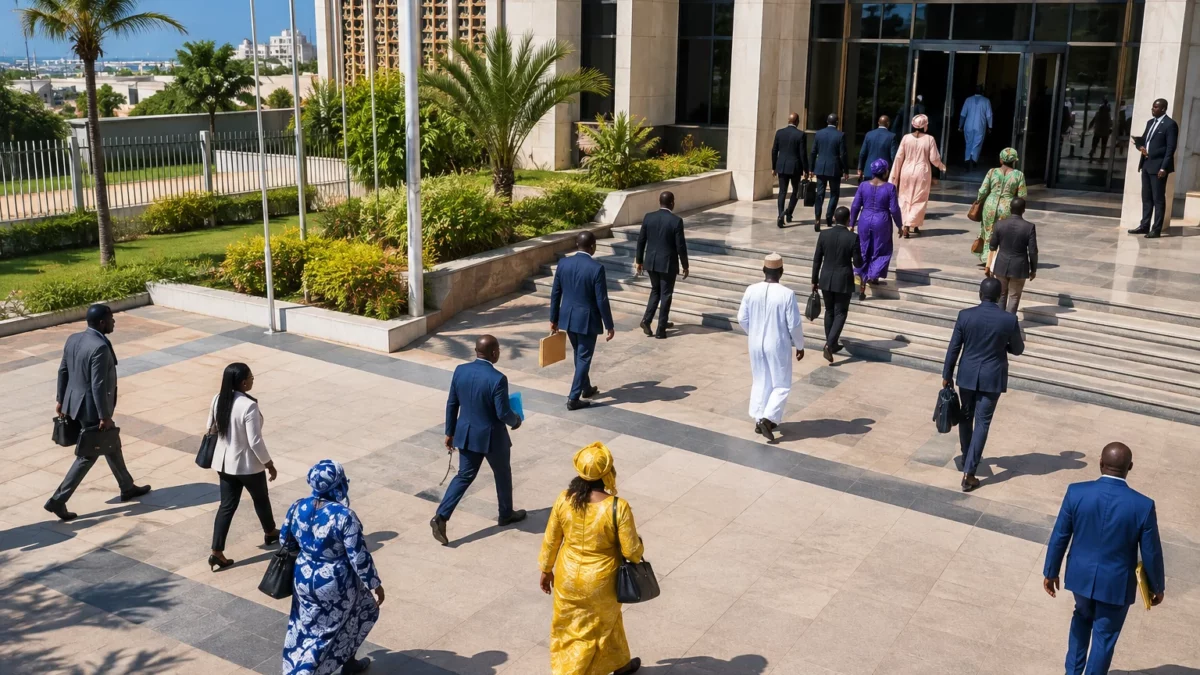
In Senegal, the clash over the budget is no longer just about revenue and spending forecasts. It raises a direct institutional question: how far can the executive go when MPs have rejected a budget text? For Senegalese people, the stakes are concrete: these decisions affect public investment, services and support for households.
A dispute spilling beyond Parliament
Senegal already had a budget for 2026, adopted in December 2025. The supplementary finance bill (LFR) was intended to amend revenue and spending during the year. It comes amid pressure on public finances and negotiations with the International Monetary Fund (IMF), the institution that lends to states and monitors their economic commitments.
The conflict took shape during parliamentary scrutiny. The bill was rejected in committee, then referred back for further discussions at the government’s request. The National Assembly ultimately rejected it on 3 November. According to the vote report cited by the Senegalese press, the motion to end consideration of the bill received 126 votes after proxy votes were verified. This procedure ends consideration of the text without a vote on each article.
The disagreements are not only procedural. Debates have focused in particular on the announced reduction in public investment, energy subsidies and allocations for households. The bill provides for CFA francs 7,251.9 billion in payment appropriations for the general budget. Total revenue is estimated at CFA francs 5,516.7 billion. These are projections included in the bill; they do not, on their own, constitute an account of revenue actually collected.
The decree and its disputed legal basis
On 19 November, President Bassirou Diomaye Faye signed decree No. 2026-2416, bringing the supplementary finance bill into force. The Presidency cites Article 68 of the Constitution, which provides for a finance bill to be brought into force by decree if it has not been “finally voted on” within 60 days. The bill was tabled on 18 September; the deadline expired on 17 November.
The executive’s position is that parliamentary rejection does not amount to final adoption. Under this interpretation, since the text had not been adopted by the end of the deadline, the constitutional mechanism could be applied. The explanatory note published by Senegalese Radio and Television (RTS) also invokes the organic law on finance bills and the rules of the West African Economic and Monetary Union (WAEMU), which harmonises some budget rules among its member states.
But this justification has not ended the debate. A critical reading points out that the Assembly took a formal decision on 3 November: it rejected the bill rather than letting the 60-day period expire without taking a position. The question, then, is whether Article 68 applies only when no decision has been taken by the deadline, or also covers a text rejected before that date. For now, the opposing interpretations have been set out publicly; the mere existence of the decree is not enough to establish that the legal controversy is over.
Choices affecting services and the economy
The supplementary budget sets out the state’s spending authorisations. It can therefore affect investment in infrastructure, water, health and education, as well as transfers and assistance that support purchasing power. The effects will not be the same everywhere: urban households are particularly affected by energy and transport prices, while people in the regions also depend on continued investment and public services. Businesses, especially those working with the administration, need clear budget rules to plan their activities and payments.
The bill also provides for a net change in outstanding debt of CFA francs 2,258 billion. This is a budget authorisation provided for in the text, not an independent measure of Senegal’s total debt. Amid high levels of debt and discussions with the IMF, how these figures are implemented will matter as much as their adoption. External financing can support the state’s needs, but it generally comes with management and monitoring commitments.
In September 2026, a technical agreement with the IMF was announced for a 36-month, $2.2bn programme. Approval by the institution’s executive board could be delayed if the authorities and MPs fail to reach a compromise, a French Treasury economic note said at the time. This technical agreement should be distinguished from financing that has been definitively approved and disbursed.
A test for institutions and the region
The developments come as relations between the president and the camp of his former political ally Ousmane Sonko have become strained. The budget dispute thus exposes a governance challenge: a parliamentary majority can belong to the same political camp as the executive without backing its choices. For the institutions, the challenge is to preserve both the continuity of public services and the National Assembly’s oversight role.
The implications extend beyond Dakar. WAEMU sets common benchmarks for budget management, while the Economic Community of West African States (ECOWAS) provides a broader framework for regional co-operation. The Senegalese controversy is a reminder that common rules do not replace national constitutional procedures. The next steps to watch are the publication and implementation of the decree, the response of MPs and oversight institutions, and consideration of the 2027 budget. They will show how the disagreement between budgetary continuity and parliamentary decision-making is resolved.
Sources consulted: RTS explanatory note on the decree ; 2026 supplementary finance bill ; Council of Ministers statement reported by APS ; analysis of the parliamentary debate ; economic note on the supplementary finance bill and discussions with the IMF ; analysis of the legal arguments surrounding the decree.