Algeria
 Egypt
 Libya
 Morocco
 Sudan
 Tunisia
 Benin
 Burkina Faso
 Cabo Verde
 Côte d'Ivoire
 Ghana
 Guinea
 Guinea-Bissau
 Liberia
 Mali
 Mauritania
 Niger
 Nigeria
 Sierra Leone
 The Gambia
 Togo
 Cameroon
 Central African Republic
 Chad
 DR Congo
 Equatorial Guinea
 Gabon
 Republic of the Congo
 São Tomé and Príncipe
 Burundi
 Comoros
 Djibouti
 Eritrea
 Ethiopia
 Kenya
 Madagascar
 Malawi
 Mauritius
 Mozambique
 Rwanda
 Seychelles
 Somalia
 South Sudan
 Tanzania
 Uganda
 Angola
 Botswana
 Eswatini
 Lesotho
 Namibia
 South Africa
 Zambia
 Zimbabwe
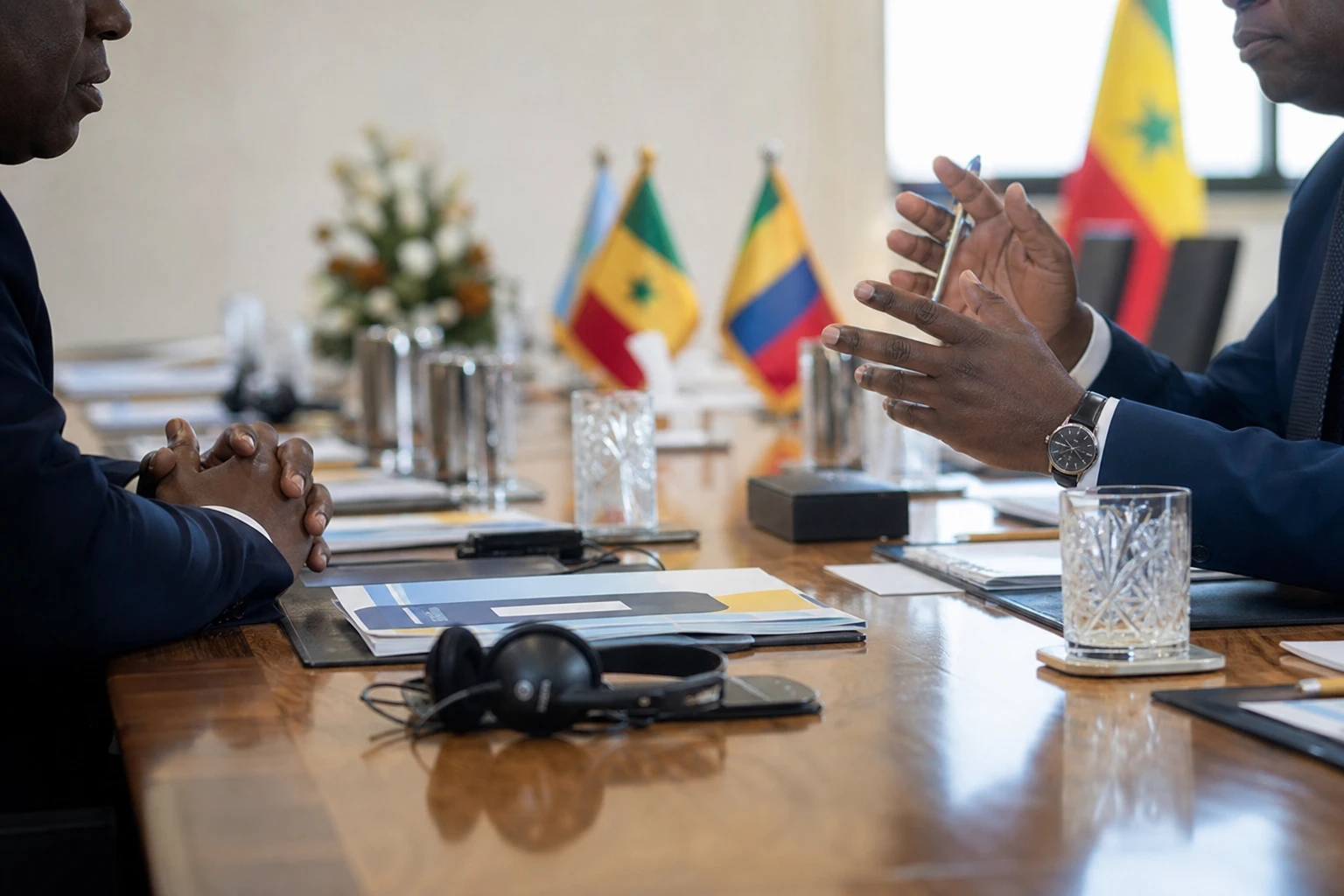
In Dakar, transparency is no longer a slogan but a political test
In Senegal, the question is no longer simply who governs. It is now how far those who govern are willing to be scrutinised. Amid strong expectations of a break with the past, the president’s asset declaration has become a concrete marker of institutional credibility.
This comes as Dakar has put Parliament back at the centre of the political arena. The National Assembly, dominated by the Pastef majority, has opened an extraordinary session to consider several bills over a few days, including measures on public transparency, special funds and two major social reforms. The timetable shows a determination to move quickly. It also shows that the battle is less about announcements than about the precise wording of the rules.
What the bill provides for, and why it is straining relations within the majority
The issue concerns Article 37 of the Constitution, which governs, among other things, the swearing-in of the president before the Constitutional Council. The principle of an asset declaration is already included: the newly elected president must submit a written declaration of assets, filed with the Constitutional Council and made public. The reform under discussion in the Assembly seeks to go further, requiring a second declaration at the end of the term.
Under the version put forward by MPs, the obligation would no longer apply only to the president. It would also be extended to the prime minister and the president of the National Assembly. This extension was brought back after an initial passage through Parliament in late June, followed by the Constitutional Council’s rejection of the revised text. The debate is therefore not new. It is now more institutionally charged because it touches on the heart of the balance between the executive, Parliament and the constitutional court.
On 24 July 2026, the Bureau of the National Assembly declared several transparency-related bills admissible, including one amending Article 37 and another on the oversight of special funds, the allocations made to the presidency and the prime minister’s office. At the same time, the Assembly president and the relevant authorities were asked to provide opinions within the statutory deadlines. This confirms that the issue is being treated as a coherent political package: assets, opaque funds and parliamentary oversight are moving forward together.
A standoff over transparency, but also over the pace of reform
The substance of the debate is straightforward. Senegal’s government has promised more transparent governance. In practice, however, every step towards that promise raises questions: who oversees, who declares, who publishes, and when? OFNAC, the national anti-corruption office, has reminded those required to declare their assets that they must regularise their situation before 31 July 2026 or face sanctions. This deadline gives administrative force to a reform often treated as a symbol.
The government has already changed the framework. Law No. 2025-13 on asset declarations was adopted, and an implementing decree was published in November 2025. This means Senegal already has a recent legal foundation. The latest parliamentary initiative is therefore aimed less at creating a system than at broadening its scope and strengthening its political reach.
For the Pastef majority, the stakes are twofold. First, it wants to prove that it is not abandoning the break with the past it promised voters. Second, it wants to show that Parliament can do more than mechanically support the executive. Ayib Daffé, head of the parliamentary group, has already accused the president of holding back transparency reforms. This tension points to a broader issue: in Senegal after the change of power, the clarity of the rules matters as much as the balance of power.
The risk of legal challenges remains the sensitive point. A new appeal to the Constitutional Council is possible, as is the prospect of a referendum if the parliamentary route encounters obstacles. The precedent set in June 2026 showed that the constitutional court could strike down a poorly drafted reform. The majority must therefore produce a robust bill, or risk turning a promise of transparency into a period of legal instability.
What this means for the Senegalese state and the region
If the reform is passed, it will not concern only a handful of senior officials in Dakar. It will redefine accountability standards across the state apparatus. For citizens, this means greater visibility into the assets of those who hold the highest offices. For institutions, it means stricter, clearer and potentially more binding procedures. For businesses, especially those working with public procurement, it is a signal that compliance rules are being tightened.
The debate over special funds points in the same direction. These allocations, often presented as flexible tools for government action, also attract criticism whenever they escape clear oversight. Parliament is seeking to regain control of grey areas that have long fuelled distrust. The issue directly affects the quality of public spending, as well as perceptions of power in a country where demand for accountability remains high.
At regional level, Senegal is sending a message to ECOWAS, the West African organisation of which it is a member: transparency is not only a matter of good governance; it is also a condition for political stability. In a sub-region marked by military transitions and electoral disputes, a credible framework for overseeing leaders can carry considerable weight. Senegal is thus seeking to remain a point of balance, not through posturing but through institutional proof.
The next step is clear: consideration of the bills during the extraordinary session, followed by monitoring whether they are referred for constitutional review. That is where the next phase will be decided. Not through grand words, but through a very concrete detail: who must declare, when, to whom, and subject to what penalty. In this battle, Dakar is looking as much at its own institutions as at the image they project across West Africa.