Algeria
 Egypt
 Libya
 Morocco
 Sudan
 Tunisia
 Benin
 Burkina Faso
 Cabo Verde
 Côte d'Ivoire
 Ghana
 Guinea
 Guinea-Bissau
 Liberia
 Mali
 Mauritania
 Niger
 Nigeria
 Sierra Leone
 The Gambia
 Togo
 Cameroon
 Central African Republic
 Chad
 DR Congo
 Equatorial Guinea
 Gabon
 Republic of the Congo
 São Tomé and Príncipe
 Burundi
 Comoros
 Djibouti
 Eritrea
 Ethiopia
 Kenya
 Madagascar
 Malawi
 Mauritius
 Mozambique
 Rwanda
 Seychelles
 Somalia
 South Sudan
 Tanzania
 Uganda
 Angola
 Botswana
 Eswatini
 Lesotho
 Namibia
 South Africa
 Zambia
 Zimbabwe
In Dakar, the question is no longer simply whether Bassirou Diomaye Faye has a parliamentary majority. It now concerns the timing of a possible new vote and the balance of power that could emerge from it.
For several months, Senegal’s executive has been operating in a tense institutional environment. The president and the National Assembly no longer always share the same view of the balance of powers. This situation has fuelled speculation about another dissolution, less than two years after the previous snap legislative election.
A government facing an increasingly influential Assembly
The debate is part of the trajectory set in motion by Bassirou Diomaye Faye’s election on 24 March 2024. After taking office at the presidential palace, the head of state quickly sought a parliamentary majority able to support his programme of political and economic transformation.
The National Assembly was dissolved in September 2024. The snap legislative election held on 17 November that year gave the president’s camp a commanding presence. Since then, however, the way power functions has changed. Ousmane Sonko, the former prime minister and a central figure in Pastef, has become president of the National Assembly, while relations between the two poles of the executive and the majority have grown more complex.
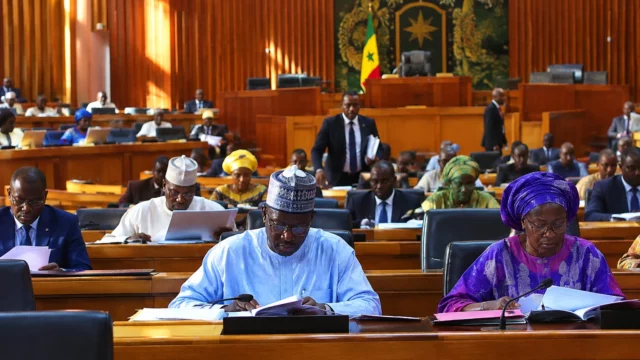
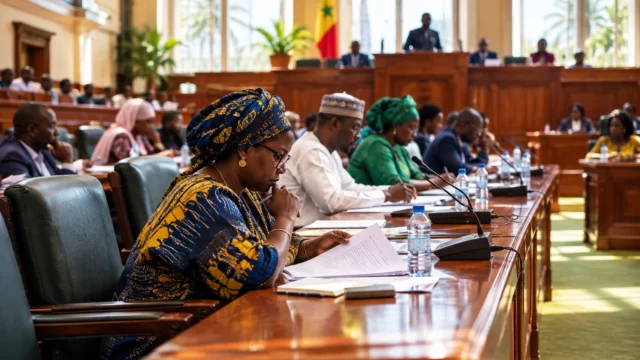
This change has come amid institutional reform. In June 2026, MPs adopted a reform strengthening several of Parliament’s prerogatives and placing greater limits on certain presidential powers. The text drew criticism from the opposition and civil society, which denounced what they considered an overly sensitive alteration to the constitutional balance.
The Constitutional Council was subsequently asked to rule on the reform. This step is a reminder that the parliamentary question is not merely a matter of electoral calculation. It also concerns the separation of powers and the interpretation of the Senegalese Constitution.
What the president actually said
On the sidelines of the 81st session of the United Nations General Assembly in New York, Bassirou Diomaye Faye gave a joint interview to RFI and France 24 on Thursday 24 September 2026. The dissolution of the National Assembly was among the topics discussed, alongside the timetable for local elections and talks with the International Monetary Fund.
Asked about the possibility of a dissolution from 2 December 2026, the Senegalese president did not rule it out. However, he stopped short of announcing a firm decision. In other words, no dissolution had been declared as of 24 September 2026.
This distinction matters. A possible presidential decision would not be a mere political formality. It would usher in a new electoral period, with direct consequences for the government’s work, the budget vote and the implementation of announced reforms.
The Senegalese Constitution allows the president to dissolve the National Assembly after consulting the prime minister and the president of the parliamentary institution. In the event of a dissolution, elections must be held within a maximum of 90 days after publication of the decree, according to the interpretation adopted by the Constitutional Council in 2024.
A political choice with very real consequences
For the executive, a dissolution could help clarify the majority and reduce institutional deadlock. It would nonetheless carry risks. The outcome of a new election would not be guaranteed, particularly in a political landscape where Pastef retains a strong capacity to mobilise and the internal balance within the majority has changed.
For Ousmane Sonko and the MPs close to him, the challenge would be to defend the legitimacy of an Assembly that has become a more assertive decision-making centre. The strengthening of parliamentary powers gives MPs greater means to scrutinise the government’s actions, examine agreements relating to natural resources and conduct inquiries.
For Senegalese people, the consequences would be practical first and foremost. An election campaign could slow the examination of some bills, shift budget priorities and prolong uncertainty over economic reforms. Those working in the informal economy, who are numerous in Dakar and across the regions, would be particularly sensitive to changes in the administrative timetable and any tax measures that might follow.
The effects would not be the same everywhere. The capital would be the focus of political debate, demonstrations and statements by the parties. In rural areas, attention would be more focused on prices, access to public services, agriculture, infrastructure and the tangible impact of national policies. An election campaign alone would therefore not capture the country’s expectations.
The 2024 precedent still looms large
The last dissolution was decided by Bassirou Diomaye Faye on 12 September 2024, ahead of the 17 November legislative election. At the time, the president was seeking to break a deadlock with an Assembly drawn from the former majority and secure the institutional means needed to pursue his programme.
The situation in 2026 is different. The president’s camp is no longer facing the same Parliament, but a majority riven by political and institutional tensions. The debate is therefore not solely about the opposition between the government and its adversaries. It also concerns the relationship between two leaders who emerged from the same political movement: Bassirou Diomaye Faye and Ousmane Sonko.
This situation makes the coming weeks decisive. The government will have to continue its work as MPs wield greater influence and the head of state retains the possibility, subject to conditions, of calling new elections.
A period being watched beyond Senegal
Senegal holds a distinctive position in West Africa. A member of the Economic Community of West African States (ECOWAS), it continues to be seen as an important actor in regional institutional stability, at a time when several neighbouring countries are undergoing military transitions or breaking with the regional organisation.
A new political crisis in Dakar would therefore have implications beyond relations between the president and the National Assembly. It could affect perceptions of Senegal’s democratic strength, its relations with ECOWAS partners and investor confidence in a country facing sensitive economic choices.
The next key date is now 2 December 2026, when the president is expected to gain the right to dissolve the National Assembly. Until then, Senegalese people will be watching exchanges between the executive and Parliament, decisions by the Constitutional Council and the evolution of relations between Bassirou Diomaye Faye and Ousmane Sonko. For now, one certainty remains: the parliamentary question has become the main test of Senegal’s new political architecture.