Algeria
 Egypt
 Libya
 Morocco
 Sudan
 Tunisia
 Benin
 Burkina Faso
 Cabo Verde
 Côte d'Ivoire
 Ghana
 Guinea
 Guinea-Bissau
 Liberia
 Mali
 Mauritania
 Niger
 Nigeria
 Senegal
 Sierra Leone
 The Gambia
 Togo
 Cameroon
 Central African Republic
 Chad
 DR Congo
 Equatorial Guinea
 Gabon
 Republic of the Congo
 São Tomé and Príncipe
 Burundi
 Comoros
 Djibouti
 Eritrea
 Ethiopia
 Kenya
 Madagascar
 Malawi
 Mauritius
 Mozambique
 Seychelles
 Somalia
 South Sudan
 Tanzania
 Uganda
 Angola
 Botswana
 Eswatini
 Lesotho
 Namibia
 South Africa
 Zambia
 Zimbabwe
A visit driven as much by economics as geopolitics
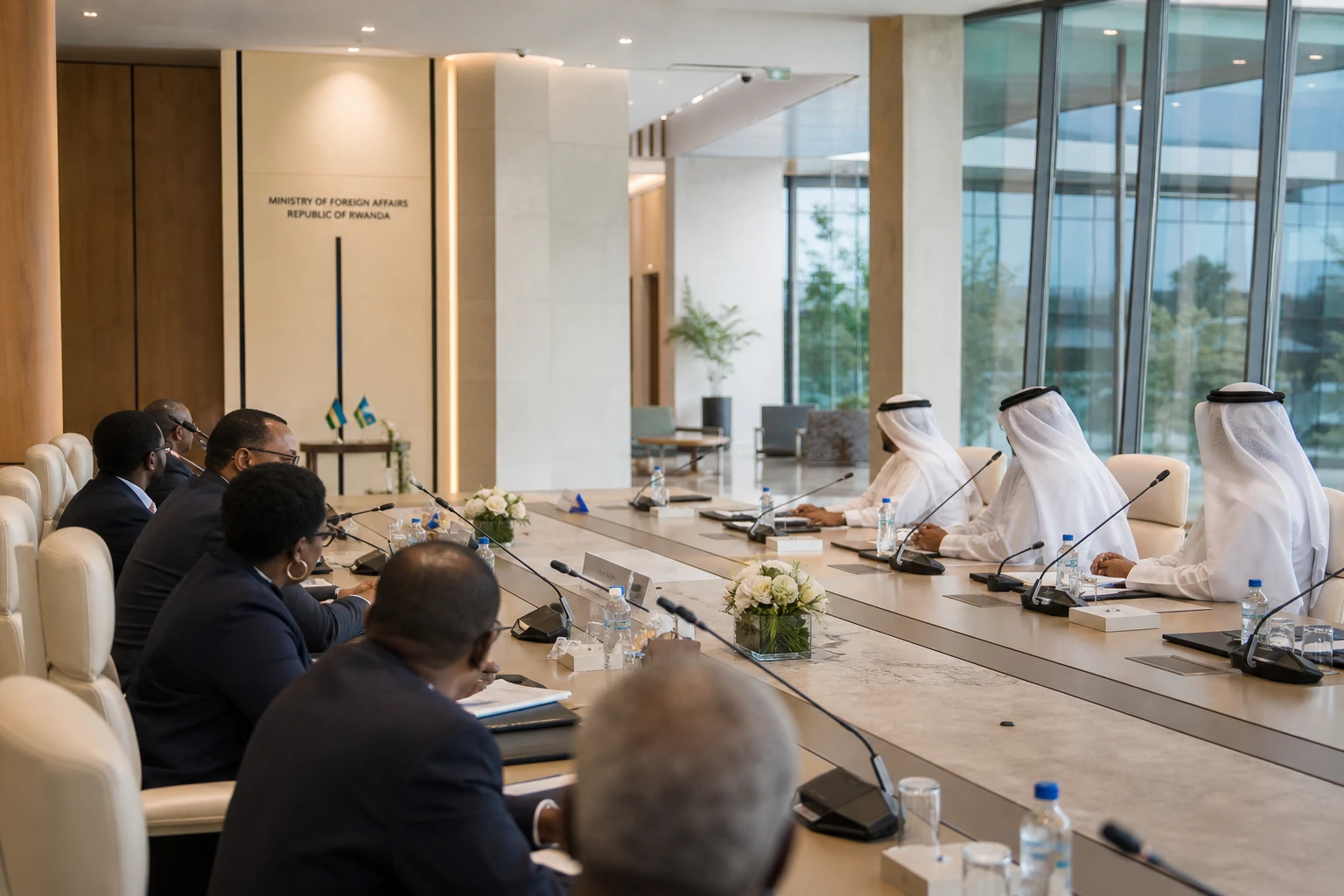
In Kigali, the strategy is well established: build more partnerships, open trade corridors and attract capital into infrastructure, digital technology and services. In Muscat, the approach is different but complementary. Oman is seeking to expand its markets beyond the Gulf and strengthen its links with East Africa. Rwandan President Paul Kagame’s official visit to Oman, scheduled for 7 and 8 September 2026, reflects this convergence of interests. Oman’s foreign ministry described the visit as a step towards consolidating the two countries’ ties of friendship and cooperation.
Rwanda, a member of the East African Community, has pursued an active economic diplomacy for several years. The approach aims to make Kigali a regional hub for business, logistics and technology. Oman, for its part, is working to diversify its economy and expand its foothold in Africa, particularly along the continent’s eastern seaboard. The closer ties between the two capitals therefore address the same question: how can a still-limited diplomatic relationship be turned into useful, visible and profitable cooperation?
Agreements already in place, with a visit to give them substance
This meeting did not come out of nowhere. In January 2026, Rwanda’s foreign minister, Olivier Nduhungirehe, had already led a delegation to Muscat. On that occasion, Kigali and Oman signed four memorandums of understanding. They cover logistics services; the development of inland ports and supply chains; aviation; investment around the Bugesera airport district; and information technology and innovation, including data hosting, cloud services and data centres.
The aviation agreement has a particular place. It provides for direct flights between Muscat and Kigali by Oman Air, with a launch announced for June 2026, subject to regulatory approvals. For a landlocked country such as Rwanda, air connectivity is no technical detail. It determines access to markets, the arrival of investors, the exchange of skills and the movement of business travellers. The Rwandan government has clearly presented it as a lever to support trade, tourism and investment.
The Omani statement issued on the eve of Paul Kagame’s visit follows the same logic. It says the visit will provide an opportunity to discuss issues of common interest and ways to promote them in a manner that serves both countries’ interests. This diplomatic language may seem formulaic. Yet it is revealing: both sides want to move from cordial relations to more structured, sector-specific cooperation.
What Kigali hopes to gain, and what Oman wants in return
For Kigali, the priority is diversification. Rwanda does not want to depend on a limited number of partners, whether African, European or Asian. Gulf capital offers an additional source of financing, as well as a gateway to wider logistics and financial networks. Against a backdrop of robust growth, with the Rwandan authorities reporting 9.4% in 2025, the aim is not simply to attract money. It is also to direct that money into sectors considered strategic: transport, digital technology, infrastructure and high-value-added services.
This momentum is part of a broader economic trajectory. The World Bank says Rwanda maintained strong growth in 2025, following several years of sustained expansion. The International Monetary Fund is projecting a dynamic economy again in 2026. For Kigali, this performance is not enough on its own. It must be converted into jobs, productive capacity and more private investment. This is where partnerships with Middle Eastern players become relevant.
Oman’s calculation is different. The sultanate wants to establish itself as a services, logistics and connectivity platform linking the Middle East and Africa. The agreements with Rwanda show that Muscat is not seeking only conventional trade. It is also targeting tangible assets: airport management, data centres, logistics chains and air connectivity. In short, Oman is seeking economic footholds in a region where transport and digitalisation are becoming instruments of sovereignty as well as growth.
However, the volume of bilateral trade remains modest. That is precisely what gives the visit its significance. When two economies pursue a partnership before it has become substantial, they are making a long-term bet. They are investing in infrastructure, transport links and political trust. This is a familiar feature of South-South relations: diplomacy often precedes trade, and then formalises it.
A relationship to watch beyond Kigali and Muscat
The visit also has regional significance. Rwanda is part of the East African Community, where the smooth flow of trade and infrastructure remain central concerns. New air links and logistics projects could therefore extend beyond the bilateral relationship. They could also strengthen Kigali’s position as a gateway to East Africa, a region where competition between hubs is intensifying.
The continental significance lies in another development: the growing strength of African partnerships with Gulf countries. These are no longer limited to energy or finance. They now extend to ports, airports, data, telecommunications and mobility. For African countries, the issue is not simply to attract capital. It is to negotiate investments that serve national priorities, create skilled jobs and avoid asymmetric dependencies. Rwanda, which has made digital technology and connectivity central to its development policy, clearly intends to use its dialogue with Oman in this way.
In the coming months, the real test will not be the visit’s protocol. It will be implementation: the timetable for direct flights, the delivery of logistics agreements, the conversion of announcements into concrete projects and the ability to increase trade beyond the symbolic. That is where the real value of this closer relationship between Rwandans and Omanis will be determined.