Algeria
 Egypt
 Libya
 Morocco
 Sudan
 Tunisia
 Benin
 Burkina Faso
 Cabo Verde
 Côte d'Ivoire
 Ghana
 Guinea
 Guinea-Bissau
 Liberia
 Mali
 Mauritania
 Niger
 Nigeria
 Senegal
 Sierra Leone
 The Gambia
 Togo
 Cameroon
 Central African Republic
 Chad
 DR Congo
 Equatorial Guinea
 Gabon
 Republic of the Congo
 São Tomé and Príncipe
 Burundi
 Comoros
 Djibouti
 Eritrea
 Ethiopia
 Kenya
 Madagascar
 Malawi
 Mauritius
 Mozambique
 Seychelles
 Somalia
 South Sudan
 Tanzania
 Uganda
 Angola
 Botswana
 Eswatini
 Lesotho
 Namibia
 South Africa
 Zambia
 Zimbabwe
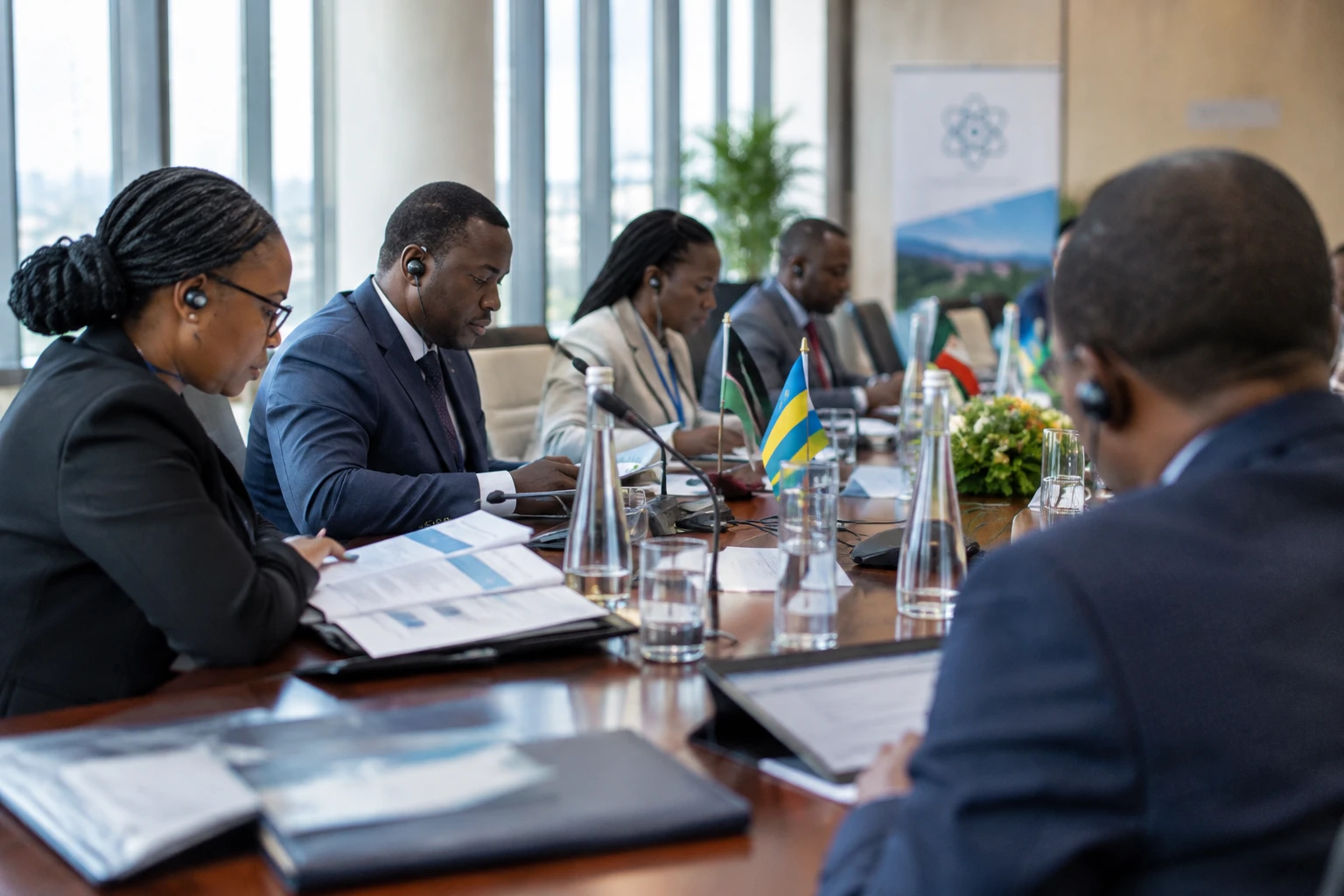
Before producing a single kilowatt of nuclear power, Rwanda must show that it can choose a site, oversee an operator and protect residents in the event of an incident. Regulatory preparedness and emergency response therefore weigh as heavily as the technology in the announced timetable.
A regulatory framework to put to the test
Rwanda’s programme is taking shape in a country seeking to diversify its electricity generation and develop local expertise. Kigali is targeting 110 megawatts of nuclear power between 2030 and 2033. Infrastructure Minister Damien Murwanashyaka told a Senate committee on 22 September 2026 that two sites were still awaiting approval.
The timetable is part of a broader energy plan. The government also plans to develop hydropower, methane and solar power. Nuclear energy is thus presented as an additional component of the grid, not an immediate replacement for other sources.
The division of responsibilities is central. The Rwanda Atomic Energy Board (RAEB), a public body established in 2020, leads and promotes the programme. The Rwanda Utilities Regulatory Authority (RURA), the public utilities regulator, is responsible for authorising activities, inspecting facilities and overseeing safety. This distinction between promoter and regulator must remain effective at every stage.
Rwanda already has legislation on radiation protection. Regulations adopted in 2024 cover, among other things, licences for nuclear facilities and the management of radioactive waste. But their existence is not enough: staffing, operational independence and the capacity to impose corrective measures will need to be assessed.
The nuclear and radiation regulations published by RURA set out the authorisations and obligations in place. Rwanda’s radiation protection law tasks the regulator with protecting people and the environment from the harmful effects of radiation.
Emergency response, waste and expertise: the decisive tests
Another area of work concerns nuclear and radiological emergencies. Rwanda’s ministry responsible for emergency management has revised its national plan with support from the International Atomic Energy Agency (IAEA). The next step is to validate the arrangements, train first responders and medical teams, and then hold a large-scale simulation exercise.
This process must establish how the authorities would detect an incident, issue an alert and coordinate the response. It involves public services as well as communities near the future sites. The radiation sensors announced by the RAEB will also need to be part of a monitoring network with clearly defined results and responsibilities.
The long-term fate of spent fuel and radioactive waste remains an issue. The RAEB says solutions will be specified as the programme progresses, particularly for storage and final management. Until these choices are made, costs, responsibilities and monitoring needs spanning several generations remain to be clarified.
Rwanda also wants to rapidly expand its pool of specialists. According to Rwandan media outlet The New Times, the country had between 30 and 50 nuclear professionals and was aiming for more than 230 specialists by 2028. The target covers regulation, engineering, operations and research. The same outlet reports that a four-year university programme in nuclear science and technology opened in Rwanda in December 2025.
Training these teams locally could increase the project’s benefits beyond the construction of a power plant. But the roles involved require practical experience and specialised skills. The IAEA generally estimates that preparing for a first nuclear power programme takes 10 to 15 years, depending on the approach adopted. Rwanda’s timetable will therefore depend on verifiable progress, not just announcements.
A regional issue for East Africa
The revision of the emergency plan was confirmed by Rwanda’s ministry, which cited validation, training and simulation among the next steps. The IAEA, for its part, announced a mission in March 2026 to review Rwanda’s progress on nuclear infrastructure. These initiatives provide technical support, but responsibility for oversight and public protection remains national.
In the East African Community (EAC), where electricity trade and regional grids feature in energy strategies, a nuclear programme also raises questions about co-operation. Expertise, emergency plans and the exchange of radiological information can extend across borders. Co-ordination becomes all the more important when infrastructure is close to neighbouring territories.
Rwanda’s project is attracting attention from other African countries exploring civil nuclear power, particularly small modular reactors. For Kigali, the next concrete step will be approval of the two sites, followed by decisions on technology, licences and waste. Until then, the credibility of the 2030–2033 timetable will be judged by Rwanda’s ability to ensure independent oversight, train its teams and test its emergency response.