Algeria
 Egypt
 Libya
 Morocco
 Sudan
 Tunisia
 Benin
 Burkina Faso
 Cabo Verde
 Côte d'Ivoire
 Ghana
 Guinea
 Guinea-Bissau
 Liberia
 Mali
 Mauritania
 Niger
 Nigeria
 Senegal
 Sierra Leone
 The Gambia
 Togo
 Cameroon
 Central African Republic
 Chad
 DR Congo
 Equatorial Guinea
 Gabon
 Republic of the Congo
 São Tomé and Príncipe
 Burundi
 Comoros
 Djibouti
 Eritrea
 Ethiopia
 Kenya
 Madagascar
 Malawi
 Mauritius
 Mozambique
 Seychelles
 Somalia
 South Sudan
 Tanzania
 Uganda
 Angola
 Botswana
 Eswatini
 Lesotho
 Namibia
 South Africa
 Zambia
 Zimbabwe
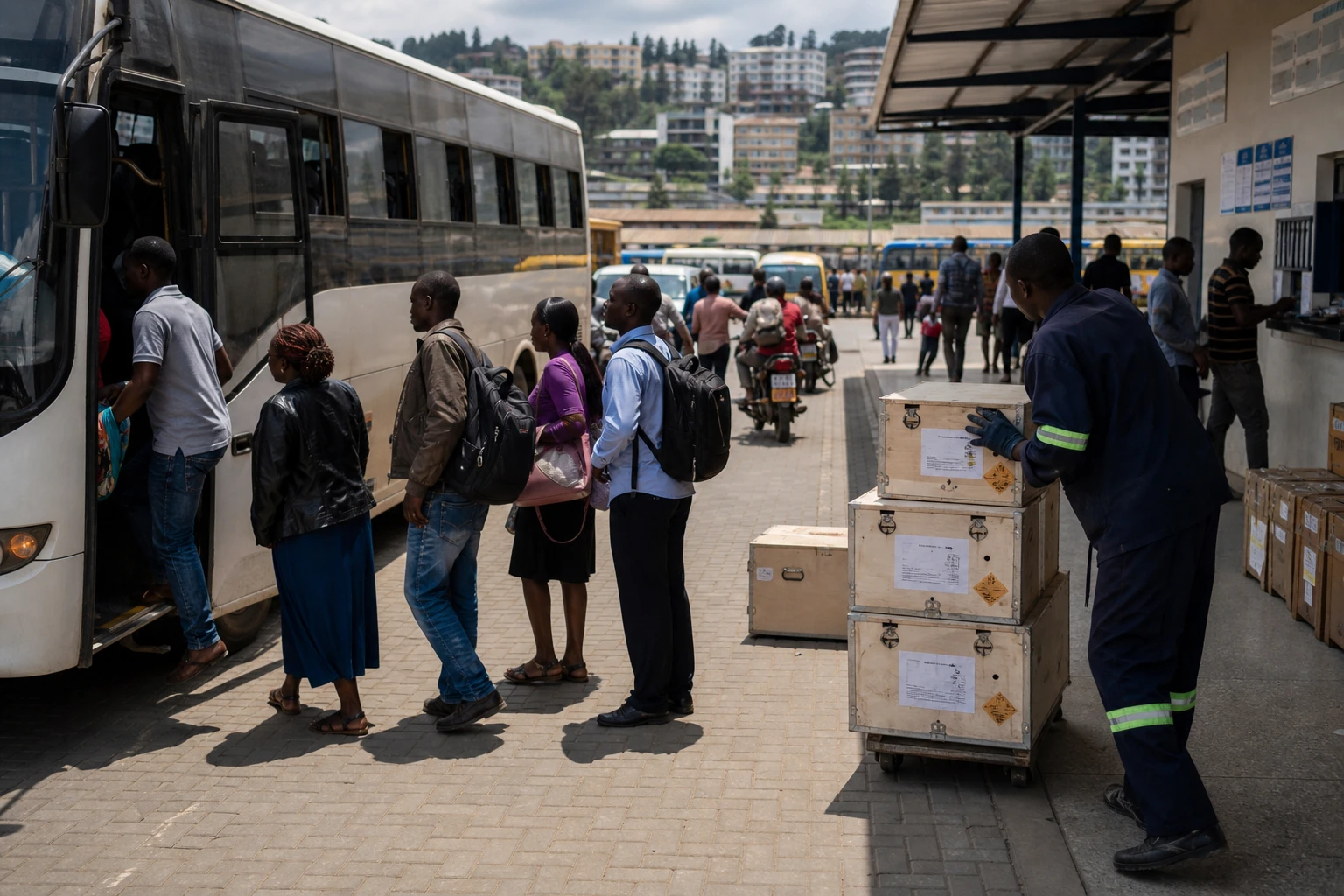
In Kigali, the mining sector no longer wants simply to extract. It must now help fund Rwanda’s industrialisation, create jobs and retain more value in the country. The government has therefore set a target of $2.17bn in annual revenues from mineral exports by 2029.
A target tied to Rwanda’s economic transformation
The target is included in the second National Strategy for Transformation, known as NST2, the economic programme covering 2024-2029. The document forecasts mining revenues rising from $1.1bn at the start of the period to $2.17bn in 2029.
The Rwanda Mines, Petroleum and Gas Board, the public body responsible for overseeing mining activities, says mineral exports reached $1.75bn in 2024. They stood at $373m in 2017. The institution’s figures show that they increased more than fourfold in seven years.
The rise is partly driven by gold, tin, tantalum and tungsten. These minerals feed global value chains linked to electronics, industrial equipment and jewellery. Rwanda is, however, seeking to move beyond its role as a supplier of raw materials.
The official strategy therefore focuses on exploration, mechanisation, professionalising mining operators and local processing. The aim is not only to increase production, but also to capture a larger share of the value created after extraction.
From extraction to local processing
Since 2023, Kigali has been conducting a nationwide exploration campaign covering several resources, including gold and lithium. The initiative aims to improve understanding of the subsoil and attract new investment to a sector where commercially viable deposits remain unevenly documented.
The country already has facilities for refining gold and tantalum, as well as smelting tin. Further processing capacity is being considered. The government says these facilities should reduce exports of raw minerals and encourage the emergence of related industrial activities.
The approach also responds to an economic constraint. International prices can boost export revenues, but they also expose the country to market downturns. More processing within Rwanda could stabilise revenues, develop technical skills and broaden the tax base.
The tax reform adopted in 2024 is intended to support this shift. Law No. 056/2024 of 26 June 2024 replaced the previous mineral taxation regime. Rates now vary according to the mineral category and level of processing, and generally range from 0.5% to 3%.
For gold, the applicable rate can fall to 0.5%. Base metals covered by the new regime can be taxed at up to 3%. This differentiation is intended to prevent processed products and raw minerals from being taxed in the same way. It should therefore encourage investment in refineries, smelters and processing plants.
A job-creating sector exposed to risks
NST2 links export growth to a social objective. Kigali is targeting more than 92,000 jobs in mines and quarries by 2029. Available data suggest this threshold had already been exceeded in 2025, with about 92,000 people employed in the sector, compared with 81,000 in August 2024.
This growth is concentrated in rural areas, where mining provides direct and indirect income. It benefits miners, transporters, equipment suppliers and small businesses. However, an increase in the number of jobs is not enough to measure the quality of work.
Mechanisation can improve productivity and reduce some accidents. It can also change labour demand in artisanal mines. The challenge is therefore to professionalise workers without undermining the incomes of communities that already depend on the activity.
Working conditions and exposure to climate hazards are also taking on greater importance in the debate. Heavy rainfall, landslides and unstable ground can interrupt production and put workers at risk. The introduction of climate insurance mechanisms is among the options being discussed by authorities and industry players.
Kigali’s regional ambition
Rwanda is pursuing this policy as part of its ambition to become a regional hub for mineral processing and trading. Its position in the East African Community, or EAC, gives it access to an integrating regional market, although infrastructure, standards and logistics remain decisive factors.
Mining supply chains extend beyond Rwanda’s borders. They link extraction areas, transport corridors, processing centres and export markets. The country’s competitiveness will therefore depend on mineral traceability, reliable transport and its ability to co-operate with its Great Lakes neighbours.
This issue is particularly sensitive for tin, tantalum and tungsten. International buyers are increasingly demanding assurances about the origin of minerals and compliance with regulations. Rwanda will therefore need to underpin its commercial expansion with credible checks and sufficient transparency.
The $2.17bn target is ambitious, but it does not depend solely on extracting larger volumes. Achieving it will hinge on several conditions: the discovery of new deposits, price stability, access to finance, local processing and worker protection.
For Kigali, the next indicator will therefore be not so much the gross value of exports as the share actually retained in the Rwandan economy. The industrial impact of the mining strategy will be measured on this basis as 2029 approaches.
Data from the Rwanda Mines, Petroleum and Gas Board on mineral exports.
Official NST2 National Strategy for Transformation document.