Algeria
 Libya
 Morocco
 Sudan
 Tunisia
 Benin
 Burkina Faso
 Cabo Verde
 Côte d'Ivoire
 Ghana
 Guinea
 Guinea-Bissau
 Liberia
 Mali
 Mauritania
 Niger
 Nigeria
 Senegal
 Sierra Leone
 The Gambia
 Togo
 Cameroon
 Central African Republic
 Chad
 DR Congo
 Equatorial Guinea
 Gabon
 Republic of the Congo
 São Tomé and Príncipe
 Burundi
 Comoros
 Djibouti
 Eritrea
 Ethiopia
 Kenya
 Madagascar
 Malawi
 Mauritius
 Mozambique
 Rwanda
 Seychelles
 Somalia
 South Sudan
 Tanzania
 Uganda
 Angola
 Botswana
 Eswatini
 Lesotho
 Namibia
 South Africa
 Zambia
 Zimbabwe
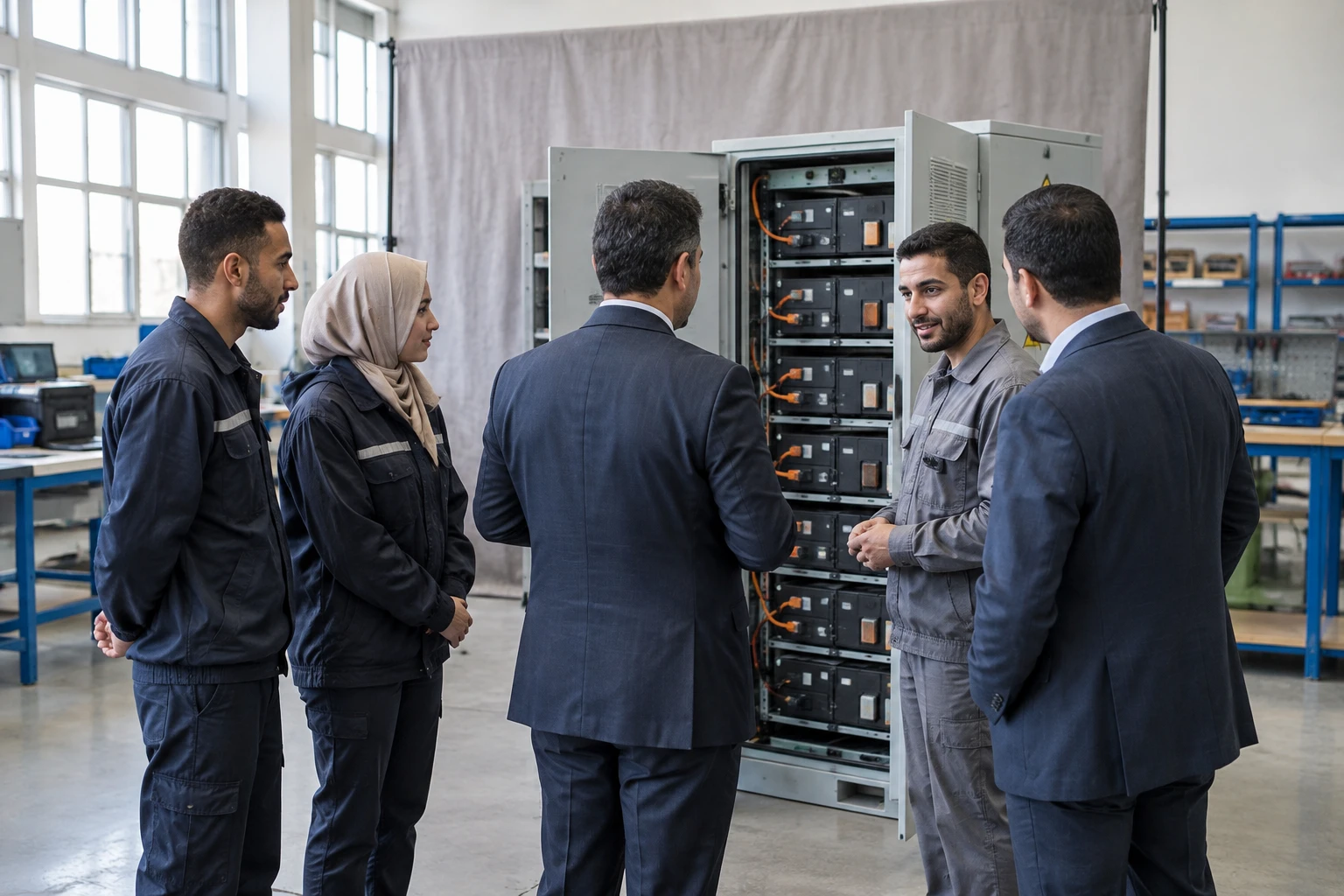
As the sun sets on Egypt’s solar power plants, electricity must not disappear with it. Battery storage is becoming essential to stabilising the grid, meeting peaks in demand and making greater use of solar and wind power.
This shift is also opening up an industrial contest. Cairo is seeking to develop renewable energy while producing more equipment domestically. Chinese groups are already active in the market. A partnership announced on 12 October 2026 adds a Russian player to the race: Rosatom, in partnership with Egyptian company Teletech.
Storage to support the growth of renewables
Egypt must meet growing demand for electricity. Solar and wind power can provide a significant share of the country’s electricity, but their output varies with the time of day and weather conditions. Batteries store surplus power and release it when production falls or demand rises.
The government plans to increase battery storage capacity to 14,320 megawatt-hours by the end of 2028. In July 2026, the Ministry of Electricity also announced an interim target of 11,820 megawatt-hours by the end of 2027. These figures refer to the amount of energy that can be stored, not the installations’ instantaneous power output.
The industrial shift is accompanying these targets. In the Suez Canal Economic Zone, Chinese group Sungrow began construction in August 2026 of a plant to assemble storage systems. The announced investment is $50 million, with a targeted capacity of 10 gigawatt-hours a year. In June, an agreement involving Gotion, China Energy Engineering Group and AMEA Power also announced a battery factory project with capacity of 3 gigawatt-hours a year.
Rosatom enters an already contested market
The agreement between Rosatom and Teletech provides for the installation of local assembly capacity, the training of technicians and a gradual increase in production. The potential capacity announced is 500 megawatt-hours a year. The partners have not specified the investment amount or the implementation timetable.
This is an assembly project, distinct from the complete manufacture of battery cells. The distinction matters: the local industrial value will depend in particular on which components are produced in Egypt, the skills transferred and the proportion of equipment imported. So far, published information does not detail these points.
Rosatom is already involved in the construction of the El-Dabaa nuclear power plant on the Mediterranean coast. The project comprises four 1,200-megawatt reactors, totalling 4,800 megawatts. Battery storage, however, serves a different purpose: it can facilitate the integration of variable energy sources and secure power supplies to some industrial sites, without replacing a continuously operating power plant.
The ambitions announced by the various industrial groups are not directly comparable. The 500 megawatt-hours a year targeted by Rosatom and Teletech refers to annual assembly capacity. The 10 gigawatt-hours announced by Sungrow and the 3 gigawatt-hours in the Gotion project likewise refer to planned production capacity, not electricity already stored or fed into the grid. These projects have yet to be delivered.
Local production, a challenge beyond the announcements
For the Egyptian authorities, attracting these investments could support industrial employment and train technicians. The benefits will depend, however, on implementation: factory timetables, access to components, skills transfers and local orders. The major industrial zones, particularly around the Suez Canal, could benefit directly. The effects on consumers and remote regions will depend instead on the actual deployment of batteries and the reinforcement of the grid.
Storage alone does not guarantee cheaper electricity or a more reliable supply. The facilities must also be financed, connected to the grid and managed. At the same time, Egypt will need to continue balancing investment in renewables, gas and nuclear power while keeping costs under control for businesses and households.
Competition among foreign partners thus presents Cairo with a concrete economic choice: attract equipment and capital quickly while seeking to embed more expertise in the country. The issue is not limited to the number of gigawatt-hours announced by each company. It concerns Egypt’s ability to turn industrial projects into jobs, skills and tools that serve its electricity system.
A North African and continental issue
Egypt is not a member of the Arab Maghreb Union, but its energy choices resonate across North Africa and beyond. Locally produced batteries could help build a regional offering, if costs, standards and grids subsequently allow exchanges. At African Union level, the challenge is similar: developing energy capacity without remaining solely dependent on imported equipment.
The next steps will be decisive in determining the significance of the Rosatom-Teletech partnership: publication of a timetable and budget, launch of assembly, team training and clarification of the origin of components. Until then, the 500 megawatt-hours a year remains a proposed capacity, while the national target of 14,320 megawatt-hours of storage remains a government goal for 2028.