Algeria
 Libya
 Morocco
 Sudan
 Tunisia
 Benin
 Burkina Faso
 Cabo Verde
 Côte d'Ivoire
 Ghana
 Guinea
 Guinea-Bissau
 Liberia
 Mali
 Mauritania
 Niger
 Nigeria
 Senegal
 Sierra Leone
 The Gambia
 Togo
 Cameroon
 Central African Republic
 Chad
 DR Congo
 Equatorial Guinea
 Gabon
 Republic of the Congo
 São Tomé and Príncipe
 Burundi
 Comoros
 Djibouti
 Eritrea
 Ethiopia
 Kenya
 Madagascar
 Malawi
 Mauritius
 Mozambique
 Rwanda
 Seychelles
 Somalia
 South Sudan
 Tanzania
 Uganda
 Angola
 Botswana
 Eswatini
 Lesotho
 Namibia
 South Africa
 Zambia
 Zimbabwe
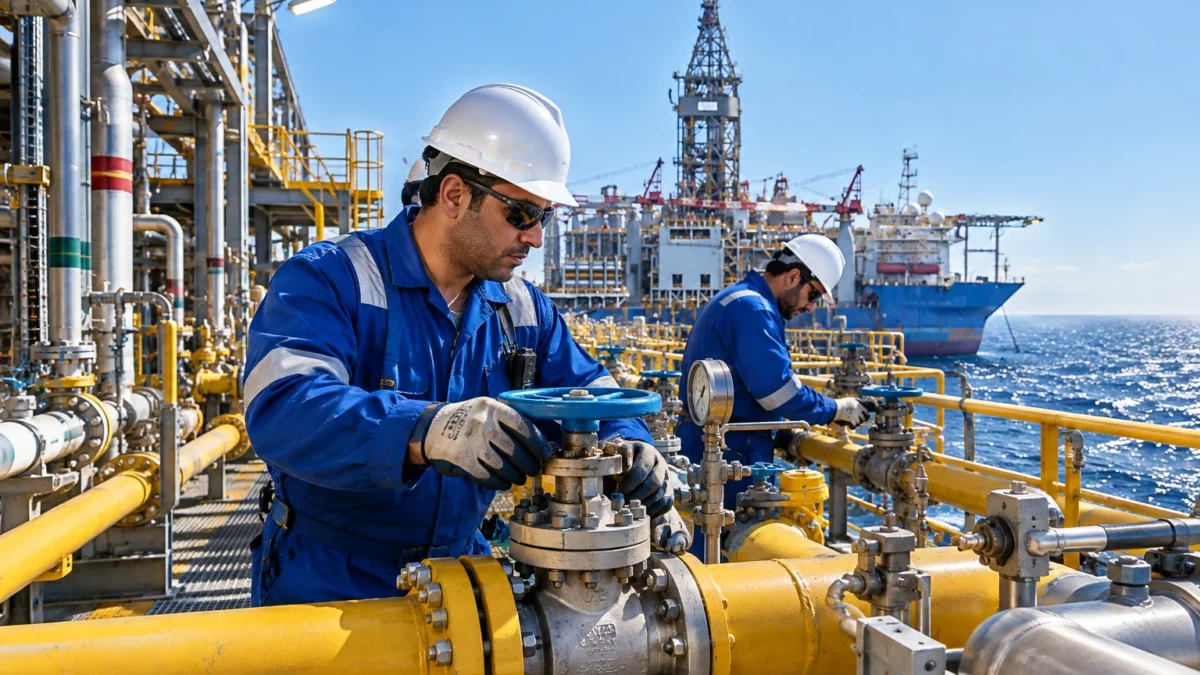
In Egypt, every new volume of gas now counts twice: it feeds the national network and can, even modestly, reduce the need for purchases from abroad. Mina West’s start-up adds capacity, but is not enough to reverse the imbalance between supply and demand.
An offshore project connected to existing facilities
The Mina West field is in the Mediterranean, in the North East El Amriya concession. Shell announced the start of production on 15 November 2026. The company holds 60% of the project, alongside Kuwait’s KUFPEC, which owns 40%. The final investment decision was taken in June 2025.
The first phase is targeting gross production of 160 million cubic feet of gas a day. Egypt’s Ministry of Petroleum estimates recoverable resources at 245 billion cubic feet of gas and about five million barrels of condensate, a liquid hydrocarbon associated with gas. The development programme for this phase is worth about $390 million. These volumes and estimates were presented by the Egyptian authorities before start-up. The Egyptian Ministry of Petroleum’s statement details the well tests and the project’s targets.
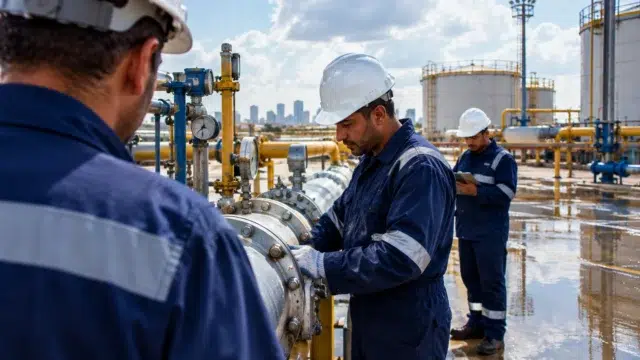
The connection uses infrastructure already in place. A seven-kilometre subsea pipeline links the field to the West Delta Deep Marine network. The gas will then be processed at Burullus before being fed into the national network. Using existing facilities can speed up development and limit the need to build an entire dedicated transport chain. Shell and Egyptian media outlet Ahram Online confirmed the start-up, the route of the connection and the target capacity. Shell Egypt and Ahram Online published the information on 15 November.
A partial response to falling production
Mina West is coming on stream as Egypt’s gas needs rise, particularly with electricity demand during the hot season. The ministry said average consumption reached 7.28 billion cubic feet a day in July and August 2026, compared with about 6.46 billion during the previous winter. The summer increase is due in particular to greater use of gas to generate electricity. The figures presented by the ministry put the increase at 12.7%.
At the same time, August data show domestic production falling to about 3.65 billion cubic feet a day, its lowest level in several decades. This estimate, drawn from the ministry’s monthly data, is also reported by regional energy specialist MEES. The gap between production and consumption explains the need to supplement supply with imports. It does not mean that the entire shortfall is covered by a single supplier or one route of supply.
Mina West’s ramp-up must therefore be seen in the right perspective. Its target capacity represents a fraction of the summer demand reported by the ministry. It will strengthen domestic supply, but cannot by itself make up for the decline recorded at existing fields. Further start-ups and sustained investment in exploration remain crucial to stabilising supply.
Imported gas in the form of liquefied natural gas (LNG), transported by ship and then regasified on arrival, is playing an increasing role in balancing the market. Egypt also depends on pipeline flows from Israel. Disruptions to these supplies can increase pressure on LNG purchases and costs, while international markets expose the country to price fluctuations. The International Energy Agency notes that interruptions to regional flows have already affected gas trade. Its gas market report describes these disruptions.
The Mediterranean, a regional energy issue
For Cairo, the challenge is to secure the energy needed by households, power stations and economic activity while keeping the import bill under control. Periods of high electricity demand can put particular pressure on industry if supply tightens. Conversely, a more regular supply benefits the network as a whole, although new volumes alone do not guarantee lower prices for consumers.
This equation extends beyond Egypt’s borders. The country occupies an important position in the Eastern Mediterranean’s gas infrastructure, where offshore fields, pipelines and LNG terminals connect several markets. North Africa is not, however, organised around a common supply system: the Arab Maghreb Union, created to promote regional co-operation, is not an integrated gas market capable of automatically offsetting national pressures.
At continental level, changes in Egyptian production also matter to the African Union, which brings together countries with very different energy profiles. Mina West illustrates both the value of investing in domestic resources and the limits of a single project in the face of sustained demand. The next production figures, the pace of development at other wells, and the stability of supplies by pipeline and ship will show whether this new capacity is genuinely curbing the growing reliance on imports.