Algeria
 Libya
 Morocco
 Sudan
 Tunisia
 Benin
 Burkina Faso
 Cabo Verde
 Côte d'Ivoire
 Ghana
 Guinea
 Guinea-Bissau
 Liberia
 Mali
 Mauritania
 Niger
 Nigeria
 Senegal
 Sierra Leone
 The Gambia
 Togo
 Cameroon
 Central African Republic
 Chad
 DR Congo
 Equatorial Guinea
 Gabon
 Republic of the Congo
 São Tomé and Príncipe
 Burundi
 Comoros
 Djibouti
 Eritrea
 Ethiopia
 Kenya
 Madagascar
 Malawi
 Mauritius
 Mozambique
 Rwanda
 Seychelles
 Somalia
 South Sudan
 Tanzania
 Uganda
 Angola
 Botswana
 Eswatini
 Lesotho
 Namibia
 South Africa
 Zambia
 Zimbabwe
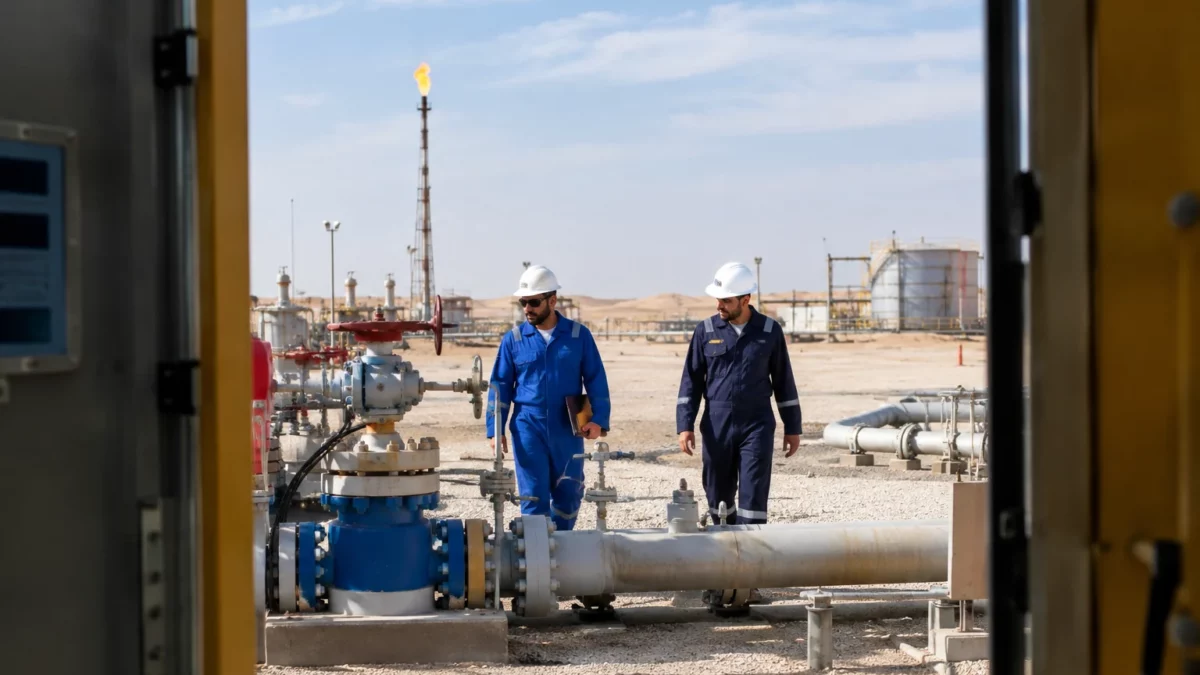
In Egypt, producing more does not depend solely on new discoveries. Part of the challenge is extracting hydrocarbons already present in rocks where conventional methods are reaching their limits. An agreement with Halliburton opens a new stage in this strategy, but it does not yet mean that 50 wells will be drilled.
A project under study, not yet a drilling operation
On 12 November 2026, the Egyptian General Petroleum Corporation (EGPC) and Halliburton signed a cooperation agreement. It provides for preparatory studies for a programme covering 50 wells in areas operated by the General Petroleum Company, a state-owned company in the sector. The studies are due to run for 18 months.
The distinction is important: the agreement concerns the technical preparation of the programme. It confirms neither the start of the 50 drilling operations, nor their timetable, nor the cost of the project. The partners must first examine the geological formations and determine which methods would be suitable for each well. Details announced by the Egyptian authorities were also reported by the French-language public media outlet Ahraminfo.
The initiative is part of a policy by Egypt’s Ministry of Petroleum to improve recovery from existing fields. It does not replace the exploration of new deposits. Instead, it seeks to extract more resources from known reservoirs that are difficult to exploit using conventional vertical drilling.
Techniques suited to low-permeability rocks
Horizontal drilling first descends towards the layer containing hydrocarbons, then proceeds laterally through the rock. This means the well is in contact with a longer section of the reservoir. The configuration can make it easier for oil or gas to flow towards the well when the rock allows fluids to pass through only with difficulty.
Multi-stage hydraulic fracturing complements this method. A fluid injected under pressure creates fractures in the targeted formation. Hydrocarbons can then flow more easily into the well. The process is technical and costly: its value depends on the characteristics of the subsoil, the expenditure required and the recoverable volumes.
Egypt already has a recent example in the Western Desert. At the NES-8 well, fracturing enabled gas production from the Abu Rawash F formation, described as having low permeability. The rate announced by the authorities is close to three million cubic feet per day. This is an operational test at one well; on its own, it cannot predict production at other sites.
Another trial is planned at the H-18 gas well in the Al Abyad field. The ministry has presented multi-stage fracturing as a way to raise the targeted daily production rate from about three million to 12 million cubic feet. This is an announced target, not a result already achieved. Information on the expansion of these techniques and ongoing projects has also been published by the Egyptian Gazette.
Production prospects will depend on profitability
For the authorities, the potential benefits are twofold: extending the life of existing fields and mobilising resources that would otherwise remain difficult to access. A preliminary study by oilfield services company NESR estimated that applying these techniques in the Western Desert could add between 50,000 and 100,000 barrels per day to Egyptian oil production. This range is an estimate of potential, not a validated forecast or an established capacity.
The move from study to production will depend in particular on geological findings, the cost of equipment and operations, and the ability to transport and process the extracted volumes. The planned 18 months are intended precisely to assess the technical conditions. Without a public budget or detailed timetable, it is too early to measure the impact on national supply or sector revenues.
The consequences will not be the same for all stakeholders. The EGPC and operating companies will have to weigh investment, geological risks and expected returns. Halliburton brings expertise and technology, but the available information does not yet specify the scope of future execution contracts. For workers and local suppliers, any benefits will depend on decisions made after the studies and on the skills deployed locally.
Environmental considerations also matter. Fracturing involves injecting fluids and requires rigorous management of water and waste. In the arid areas of the Western Desert, the use of water resources must be assessed carefully. Publicly available information on the agreement does not yet detail the measures planned to address these issues. They will need to be part of the project assessments, alongside economic feasibility.
A national and regional energy issue
The project comes as Egypt seeks to consolidate domestic production and make better use of its resources. For Cairo, the successful adoption of new techniques could ease some of the pressure on hydrocarbon supplies. But no result can be inferred from the number of wells under study alone: several decisions and operational steps remain between a technical target and marketable production.
Regionally, Egypt is an energy player in North Africa and the Mediterranean basin. Its production choices may therefore matter to its partners, its trade and the country’s place in regional gas and oil flows. They do not, however, guarantee additional exports or lower import needs. Those effects will depend on the volumes actually produced and how they change over time.
The next indicator to watch will be the publication of the study findings: which wells are deemed technically and economically viable, and which will move on to drilling. Until then, the 50 wells refer to a programme in preparation, not 50 new production units. This distinction sums up the challenge for Egypt: turning geological potential into actual supply without confusing ambition with results.