Algeria
 Egypt
 Libya
 Sudan
 Tunisia
 Benin
 Burkina Faso
 Cabo Verde
 Côte d'Ivoire
 Ghana
 Guinea
 Guinea-Bissau
 Liberia
 Mali
 Mauritania
 Niger
 Nigeria
 Senegal
 Sierra Leone
 The Gambia
 Togo
 Cameroon
 Central African Republic
 Chad
 DR Congo
 Equatorial Guinea
 Gabon
 Republic of the Congo
 São Tomé and Príncipe
 Burundi
 Comoros
 Djibouti
 Eritrea
 Ethiopia
 Kenya
 Madagascar
 Malawi
 Mauritius
 Mozambique
 Rwanda
 Seychelles
 Somalia
 South Sudan
 Tanzania
 Uganda
 Angola
 Botswana
 Eswatini
 Lesotho
 Namibia
 South Africa
 Zambia
 Zimbabwe
A campus seeking its place in Africa’s AI race
In Rabat, the challenge is no longer just to train engineers capable of writing code. It is also to design useful tools in French, Arabic, Amazigh and African languages for very practical applications: mobility, education, health, heritage and public services. With this in mind, Mohammed VI Polytechnic University has established a research centre dedicated to artificial intelligence at Technopolis, conceived as a platform for training, experimentation and transferring work to the field.
Morocco’s choice is no accident. Rabat brings together several institutional levers: higher education, digital policies, international partnerships and, more broadly, knowledge diplomacy. In the African landscape, the country is seeking to become a crossroads between North Africa, the rest of the continent and multilateral networks. AI is therefore a strategic issue, not merely a passing trend.
From research to social applications
Ai Movement, the centre affiliated with UM6P, describes itself as a hub for applied research in AI and data science. Its stated ambition is clear: to develop Moroccan and African expertise while offering ethical, responsible and inclusive solutions. The institution says it wants to play the role of a regional hub, with a focus on cooperation rather than simply importing technologies designed elsewhere.
On the ground, this approach involves targeted projects. One example often highlighted by the centre’s team is an application that can help someone who cannot read understand a document through an audio explanation. The aim is not to replace people with machines, but to make information more accessible. This kind of application speaks directly to African realities, where illiteracy, the digital divide and linguistic diversity demand tailored solutions.
The centre does not work only for businesses. It also runs training initiatives, particularly for young people. The idea of playful learning, using small robots and simplified programming exercises, points to a long-term strategy: preparing a generation that will not be at the mercy of AI, but will know how to use it, question it and improve it. It is also a way of widening access to a technology still often reserved for major urban centres and the most selective courses.
Modest funding, but ambitious positioning
The debate about AI in Africa is often dominated by the question of resources. Globally, research budgets are on an entirely different scale. In Morocco, Ai Movement remains a relatively small centre. In 2023, its budget reached €3.5 million, thanks to research contracts with companies and revenue from training, while around a third came from the OCP Group, the Moroccan fertiliser giant.
This level of funding says much about the centre’s approach. It is not trying to rival the largest American or Asian laboratories in terms of scale. Instead, it is focusing on a specialism: African applications, training, ethics and sector-specific uses. This strategy is consistent with the position advocated by UNESCO, which emphasises local ownership of AI and the need to manage its risks, particularly for states that do not yet have a comprehensive national strategy dedicated to the technology.
The centre has also gained multilateral recognition. In 2024, UNESCO and Morocco formalised the creation of Ai Movement as a Category 2 centre under the auspices of the UN organisation, a first in Africa according to UNESCO. This status does not make the centre a UN body, but it places it within a network of international cooperation and expertise.
Why Rabat matters beyond Morocco
This is an important moment for Morocco, which is seeking to bring together research, digital sovereignty and the development of young graduates’ skills. It is also taking place in a broader context: several African countries are considering their own AI governance frameworks, often with institutions lagging behind the pace of technological change. The challenge is not just to adopt tools developed elsewhere. It is also to build datasets, models and rules that are compatible with local realities.
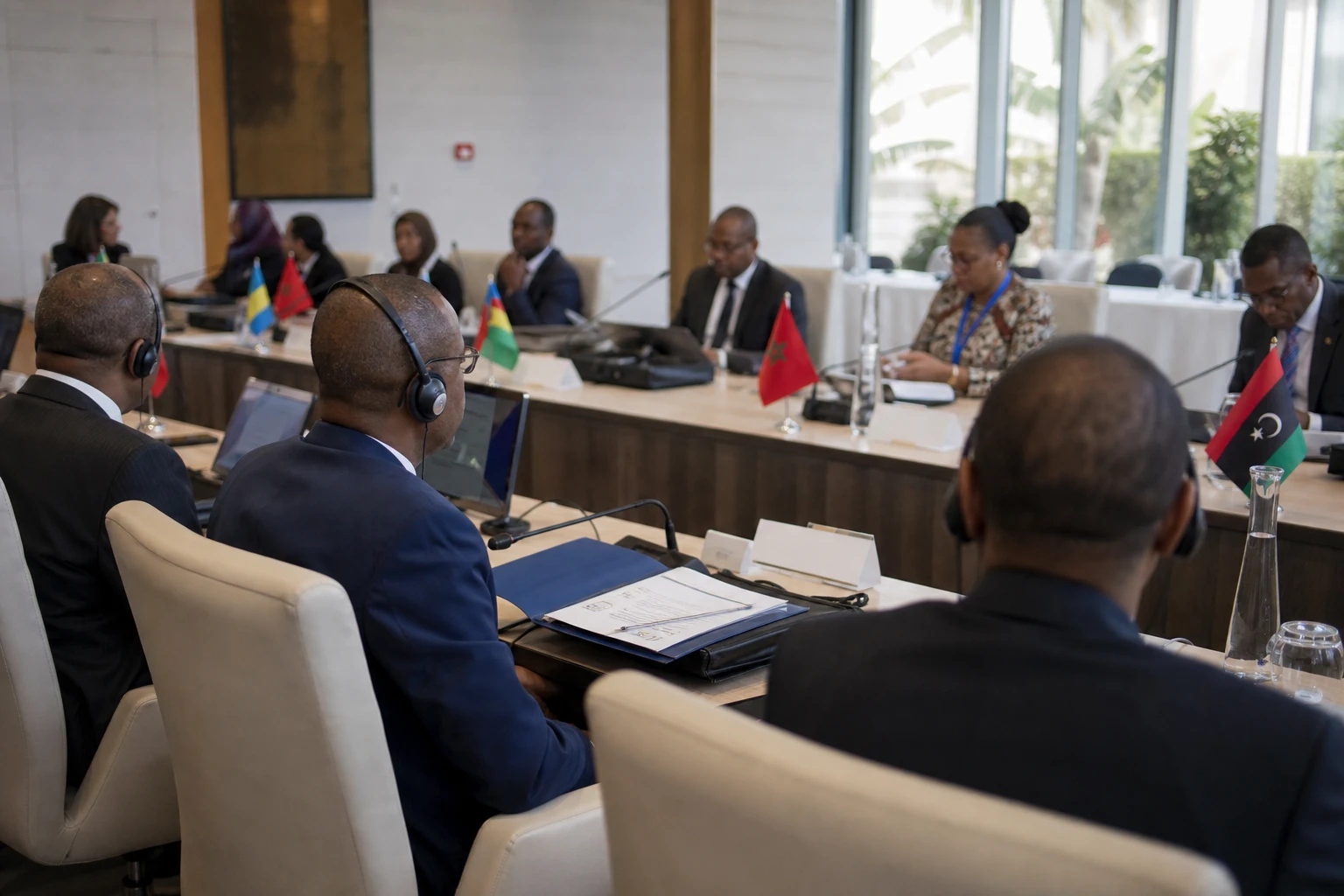
The High-Level Forum on Artificial Intelligence held in Rabat from 3 to 5 June 2024 illustrated this drive to establish a regional framework. Held under the High Patronage of King Mohammed VI, it resulted in the Rabat Consensus, which calls for strengthening African capabilities, adapting AI governance to the continent’s priorities and encouraging cooperation between African centres and international partners.
For North Africa, this sequence of events has particular significance. It shows that a country can try to build an innovation policy without waiting for a signal from the major technological powers alone. It also serves as a reminder that the question is not binary: AI should neither be celebrated as a miracle solution nor rejected on principle. Instead, applications must be chosen, safeguards put in place and talent trained to retain control over the tools.
What comes next will depend on Morocco’s ability to move from symbolism to scale. The next steps will be less visible than launching a centre or holding a forum, but more decisive: strengthening training, multiplying useful projects, securing sustainable funding and building genuine African cooperation. That is where Rabat’s value as a base for artificial intelligence designed on the continent, for its own needs, will be measured.