Algeria
 Libya
 Morocco
 Sudan
 Tunisia
 Benin
 Burkina Faso
 Cabo Verde
 Côte d'Ivoire
 Ghana
 Guinea
 Guinea-Bissau
 Liberia
 Mali
 Mauritania
 Niger
 Nigeria
 Senegal
 Sierra Leone
 The Gambia
 Togo
 Cameroon
 Central African Republic
 Chad
 DR Congo
 Equatorial Guinea
 Gabon
 Republic of the Congo
 São Tomé and Príncipe
 Burundi
 Comoros
 Djibouti
 Eritrea
 Ethiopia
 Kenya
 Madagascar
 Malawi
 Mauritius
 Mozambique
 Rwanda
 Seychelles
 Somalia
 South Sudan
 Tanzania
 Uganda
 Angola
 Botswana
 Eswatini
 Lesotho
 Namibia
 South Africa
 Zambia
 Zimbabwe
A Mamluk monument at the heart of a changing Cairo
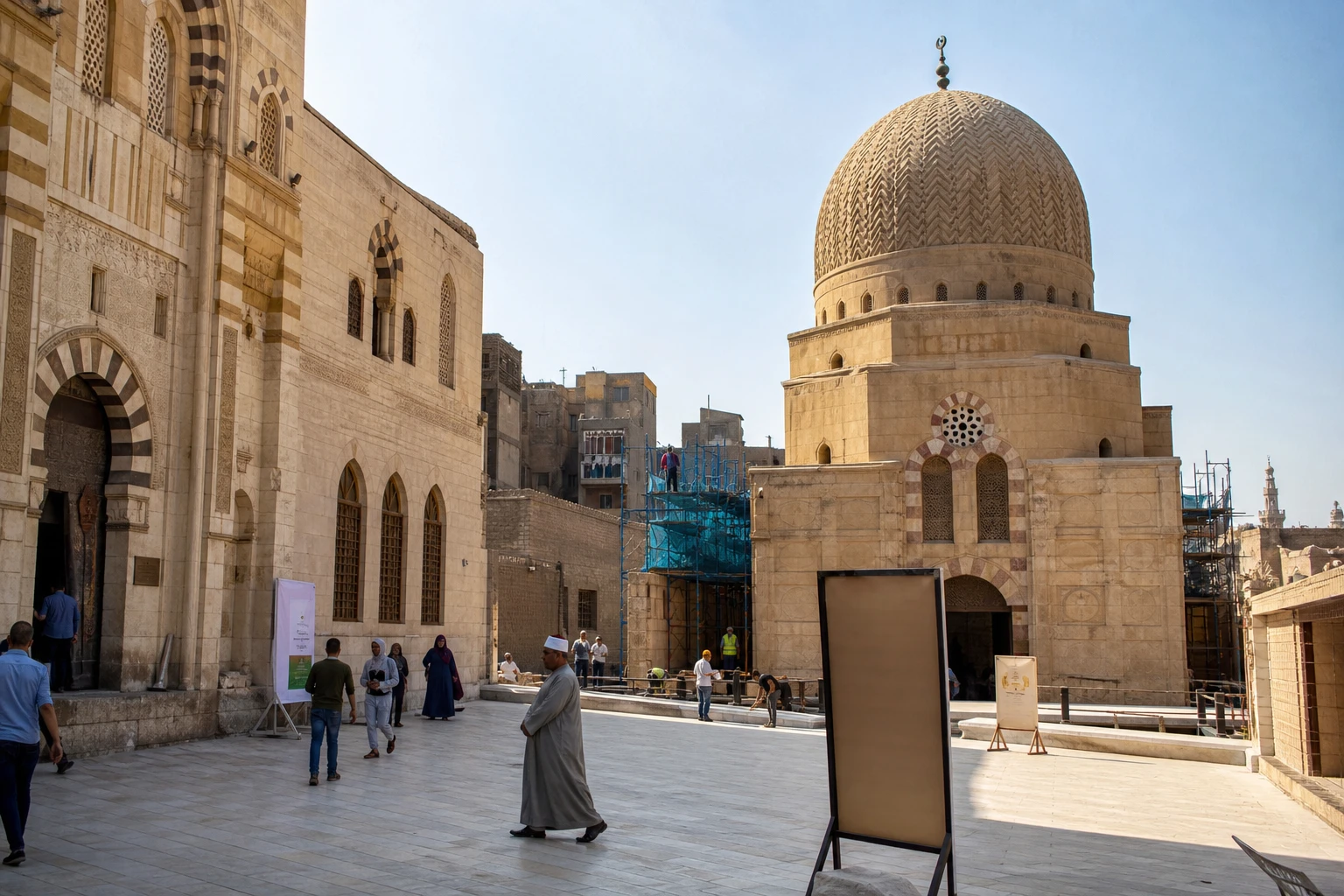
In north-eastern Cairo, stone still speaks of the power of the Mamluks. The mausoleum of Sultan Al-Ashraf Abu al-Nasr Qaitbay has reopened after a long and discreet restoration, in a neighbourhood where heritage is not a backdrop but a living part of the city. Such a reopening matters far beyond archaeological circles: it speaks to how Egypt protects its history while preparing for its tourist and urban future.
The site is in the City of the Mamluks, in Al-Gamaleya, an area within the boundaries of Historic Cairo, which has been a UNESCO World Heritage site since 1979. This zone contains religious, funerary and urban monuments that form one of the richest medieval ensembles in North Africa and the Islamic world. In this context, every restoration is also a political signal: the Egyptian state wants to show that it can protect a fragile heritage fabric without freezing it in time.
What was restored, and why it matters
The Qaitbay mausoleum was built between 1472 and 1474, during the reign of the Mamluk sultan Al-Ashraf Qaitbay. It is part of a larger complex that includes a mosque-madrasa, a sabil—a public fountain for distributing drinking water—a kuttab, or Quranic school, and other funerary annexes. The restoration focused on the exterior masonry and the dome. It also included a thorough cleaning of the interior and exterior, intended to reveal the original colours and details.
The programme ran from October 2022 to November 2024, following a grant awarded in August 2022 by the US Ambassadors Fund for Cultural Preservation to Cairo-based firm Archinos Architecture. The official inauguration was attended by Egypt’s Minister of Tourism and Antiquities, Sherif Fathy; the US Embassy’s chargé d’affaires in Cairo, Robert Silverman; and Agnieszka Dobrowolska, founder of Archinos Architecture. The project illustrates a common model of cooperation in Egyptian heritage: external funding, local expertise and state oversight.
In heritage terms, the monument is one of the great examples of Mamluk funerary architecture. Its square plan, black-and-white marble flooring, stone carvings and dome bearing Quranic inscriptions make it a major reference point for art historians. The tomb contains the remains of the sultan, who died in 1496. The restoration also makes a complex more legible that is often overlooked by visitors who know only the most famous monuments of Islamic Cairo.
Heritage, tourism and cultural sovereignty
The reopening is not just for specialists. It is part of Egypt’s broader strategy to bring Historic Cairo back into prominence and strengthen its appeal to tourists. For several years, the Egyptian government has been carrying out projects in old neighbourhoods, from renovated mosques to restored funerary complexes. The aim is twofold: to preserve an exceptional urban memory and to give these places an economic, cultural and social role once again.
The decision to restore a Mamluk mausoleum also reveals how Egypt interprets its own past. In the capital, Islamic monuments are not merely relics. They shape neighbourhoods, attract visitors and recall a long political and religious continuity. Through these projects, the Egyptian state seeks to show that it controls its heritage narrative, without relying on an external perspective to determine its value. This stance matters in a region where heritage is often instrumentalised by diplomacy, tourism or symbolic competition between capitals.
For residents of Al-Gamaleya and neighbouring districts, the stakes are more immediate still. A reopened monument can boost visitor numbers and benefit small businesses, tour guides, local transport and the informal services that depend on footfall. But it also entails trade-offs over traffic, maintenance, security, access and how heritage use can coexist with everyday life. In a dense old city centre, a successful restoration is not merely aesthetic. It must remain liveable.
Significance beyond Cairo
Across Africa, the case is a reminder that great heritage is not confined to showcase museums. It also lives in historic urban fabric, mausoleums, mosques, markets and old streets. Egypt, which holds a central share of the heritage of North Africa and the Arab world, is seeking to show that it can combine conservation, visitor access and local benefits. The message resonates in several capitals across the continent facing the same dilemma: how to restore without distorting.
There is also a regional dimension. Historic Cairo remains a place where Islamic heritage, urban memory and cultural diplomacy intersect. Restorations backed by foreign partners, such as the US Ambassadors Fund, strengthen international cooperation, but they also underscore the importance of robust Egyptian expertise to retain control over scientific and architectural decisions. This is where the country’s credibility is at stake: preserving its heritage without turning it into a mere exhibition product.
The reopening of the Qaitbay mausoleum is therefore part of a broader moment of heritage reclamation and urban repositioning. It says something about Egypt today: an African power relying on its monuments to tell its story, attract visitors and strengthen Cairo’s identity, stone by stone.