Algeria
 Libya
 Morocco
 Sudan
 Tunisia
 Benin
 Burkina Faso
 Cabo Verde
 Côte d'Ivoire
 Ghana
 Guinea
 Guinea-Bissau
 Liberia
 Mali
 Mauritania
 Niger
 Nigeria
 Senegal
 Sierra Leone
 The Gambia
 Togo
 Cameroon
 Central African Republic
 Chad
 DR Congo
 Equatorial Guinea
 Gabon
 Republic of the Congo
 São Tomé and Príncipe
 Burundi
 Comoros
 Djibouti
 Eritrea
 Ethiopia
 Kenya
 Madagascar
 Malawi
 Mauritius
 Mozambique
 Rwanda
 Seychelles
 Somalia
 South Sudan
 Tanzania
 Uganda
 Angola
 Botswana
 Eswatini
 Lesotho
 Namibia
 South Africa
 Zambia
 Zimbabwe
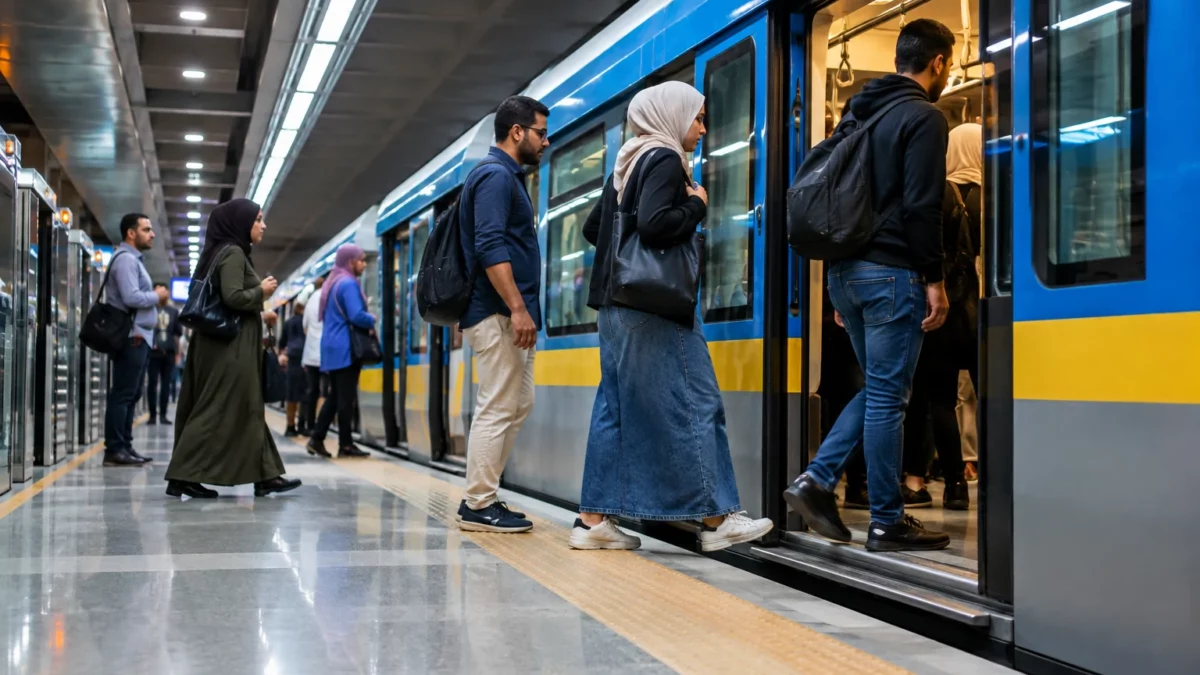
In Cairo, a new train is immediately noticeable. But for passengers, the real change also lies in waiting times on the platform, the reliability of services and connections. The introduction of new trains on Line 1 marks an important step, but on its own it is not enough to transform daily journeys.
An old route at the heart of Cairo’s transport network
Opened in 1987, Line 1 is Cairo Metro’s oldest line. It connects densely populated parts of the urban area and carries a significant share of its passengers. In a metropolis of more than 20 million people, its regularity has a direct bearing on access to work, education and services.
The modernisation forms part of a broader transformation of Egypt’s transport system: the renewal of rail networks, the development of new lines and light rail or monorail projects. Connections between these services are also a key issue. A fast train is of little help if transfers involve long waits or journeys from outlying districts remain poorly coordinated.
Egypt is not a member of the Arab Maghreb Union (AMU). Its regional economic ties run in particular through COMESA, a common market bringing together countries in eastern and southern Africa, as well as the African Union. Metro modernisation is first and foremost a national issue, but it forms part of the continental debate on urban transport and access to economic opportunities.
First trains enter service
On 15 November 2026, the first two Alstom Metropolis trains began carrying passengers on Line 1. The manufacturer announced the launch of commercial services the following day. It says the line carries around 2.5 million passengers a day. That figure is attributed to the company: an official Egyptian announcement published in August 2024 cited 1.5 million passengers a day. Published on different dates by different sources, these figures do not by themselves establish a comparable current passenger count.
The contract signed in 2021 between Alstom and the National Authority for Tunnels provides for 55 trains and eight years of maintenance. Valued at a stated €876 million, it includes air-conditioned trains, facilities for people with reduced mobility, spaces reserved for women, video surveillance and real-time passenger information. The manufacturer says the trains are being built in Valenciennes, France.
The start of services does not mean that all 55 trains are already in operation. Published information gives no detailed timetable for the remaining deliveries and no verified measure of the frequency gains achieved since the first two trains arrived. Maintenance planned in Cairo and the training of local teams will also matter over the longer term: a new train improves the service only if it remains available and can be maintained regularly.
Frequency also depends on tracks and signalling
The new trains are only one part of the programme. The line is also due to undergo work on signalling, telecommunications, centralised control, power supply and tracks. A consortium comprising Colas Rail, Egyptian company Orascom Construction and Hitachi Rail won the contract in 2024. The project, announced as a 64-month undertaking, is to be carried out while commercial services continue.
Signalling controls train movements and the spacing between trains. The power supply and track equipment must also keep pace with the planned service. Project documents set a target of reducing the theoretical interval between trains to 2.5 minutes, from 4.5 minutes previously. This is a technical target, not a result passengers have already experienced. Work-related disruptions, testing and the actual availability of trains will all affect the timetable.
The line is also the subject of a programme to refurbish existing trains. This approach combines fleet renewal with upgrades to systems: it aims to increase capacity without making all improvements dependent on the delivery of new trains alone. For passengers, the difference will be measured above all by the frequency actually maintained at peak times and the stability of services from day to day.
Journey times matter for access to jobs
The 2024 annual report of the Global Facility to Decarbonize Transport, a fund administered by the World Bank, highlights limits on access to jobs in Greater Cairo. According to its estimate, an average public transport user can reach 20% of jobs in the urban area within 60 minutes. The report links this low level of accessibility to fragmented services and their lack of reliability.
More frequent and predictable services can therefore increase the number of jobs accessible within a given time. But the benefits will not automatically be distributed equally. Passengers from outlying districts may continue to be disadvantaged by long transfers or irregular feeder services. People with reduced mobility will depend on stations being genuinely accessible, beyond the facilities available on the trains. And women will need the announced provisions to be accompanied by safe travel conditions throughout the journey.
The indicators to watch next are concrete: observed intervals, punctuality, breakdowns, train availability and the quality of connections with buses and other modes. They will help distinguish an announced programme from its day-to-day effects. For Egypt, as for other large African cities, the challenge is to make vehicles, infrastructure and services work together so that modernisation translates into time genuinely saved for residents.