Algeria
 Egypt
 Libya
 Morocco
 Sudan
 Tunisia
 Benin
 Burkina Faso
 Cabo Verde
 Ghana
 Guinea
 Guinea-Bissau
 Liberia
 Mali
 Mauritania
 Niger
 Nigeria
 Senegal
 Sierra Leone
 The Gambia
 Togo
 Cameroon
 Central African Republic
 Chad
 DR Congo
 Equatorial Guinea
 Gabon
 Republic of the Congo
 São Tomé and Príncipe
 Burundi
 Comoros
 Djibouti
 Eritrea
 Ethiopia
 Kenya
 Madagascar
 Malawi
 Mauritius
 Mozambique
 Rwanda
 Seychelles
 Somalia
 South Sudan
 Tanzania
 Uganda
 Angola
 Botswana
 Eswatini
 Lesotho
 Namibia
 South Africa
 Zambia
 Zimbabwe
A new oil frontier opens off Côte d’Ivoire
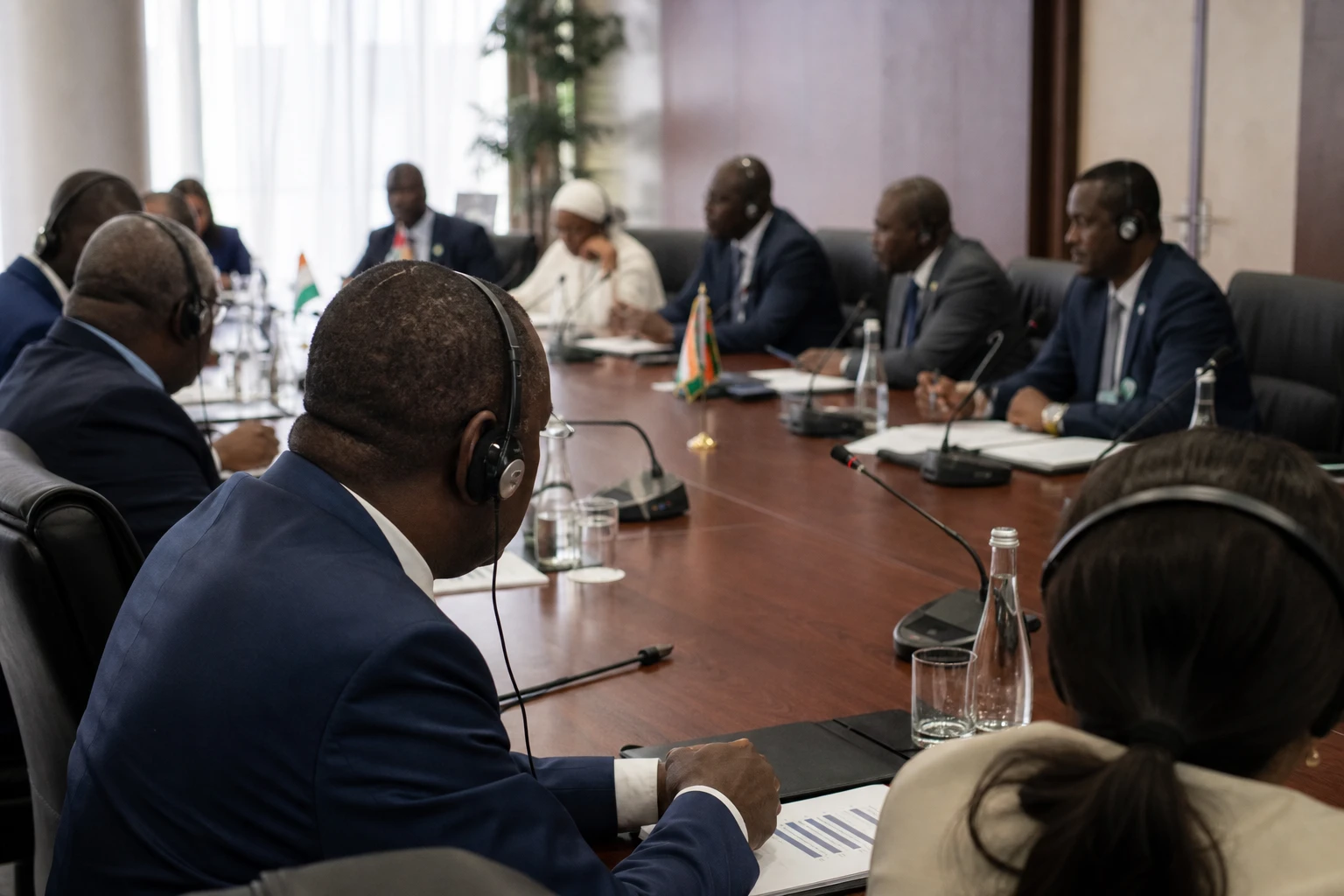
Along the Ivorian coast, the battle is not being fought only on platforms already in operation. It is also taking place in the still poorly mapped areas of the sedimentary basin, where an exploration success could change the energy balance of a country seeking to diversify its revenues and secure its supply. It is in this context that Côte d’Ivoire signed eight production-sharing contracts with Petrobras, Brazil’s national oil company, in Abidjan.
The deal is part of a trajectory that has already accelerated since the Baleine field came on stream off the country’s coast, and of a broader Ivorian strategy to expand the hydrocarbons sector. The Ivorian sedimentary basin covers about 87,000 km², including 54 offshore blocks, and 20 blocks are already in operation, according to the Ministry of Mines, Petroleum and Energy.
What the agreement signed in Abidjan provides for
The contracts cover eight offshore blocks in the western part of the basin, identified as CI-513, CI-600, CI-601, CI-602, CI-603, CI-605, CI-701 and CI-702. The blocks are in deep waters, with areas ranging, according to the Ivorian News Agency, from about 1,500 to 4,000 metres of water column. Petrobras will hold a 90% operating stake, while Petroci will retain 10%.
The agreement is initially focused on exploration. Petrobras plans an initial investment of more than 250 billion CFA francs, or over €380 million, for geological and geophysical studies. The operator will then have to carry out at least eight wells over an estimated period of between five and seven years. The Ivorian government also says that, if hydrocarbons are discovered, nearly two-thirds of the volumes produced will go to the Ivorian side after recovery of the costs incurred.
Why Abidjan is betting on Petrobras now
This is not an isolated development. In June 2026, the Ivorian government had already announced the signing of eight new production-sharing contracts with Petrobras, presenting the move as a way to expand coverage of the national sedimentary basin to 75%. The signing on 17 September 2026 therefore gave the deal a more concrete contractual form, after several months of negotiations. The Ministry of Mines, Petroleum and Energy had also reported that Petrobras had expressed interest in the eight blocks in question as early as May 2025.
For Côte d’Ivoire, the stakes are twofold. First, it aims to attract capital and expertise to more challenging offshore areas, where exploration is costly and requires substantial technical expertise. Second, it needs to consolidate a domestic energy base capable of supporting industrialisation and growth. The country is no longer at the beginning of this process: the Baleine field, developed with Eni, Petroci and Vitol, has become a symbol of this new phase, with production already under way and phase 3 approved at the end of May 2026 with an investment of $4 billion.
In this context, Petrobras is entering a landscape in which several major and national companies are competing for access to the blocks that remain available. Brazil’s presence also reflects a diversification of Côte d’Ivoire’s partners: the country no longer depends on a single group of investors to develop its oil portfolio. This is an important signal for the country’s decision-making sovereignty, as well as its ability to negotiate more favourable contracts over time.
Interest that extends beyond Côte d’Ivoire
Petrobras’s arrival in Côte d’Ivoire has regional significance. The Gulf of Guinea has for several years attracted players seeking new exploration frontiers, as more investment is needed to find new resources in mature basins. The Brazilian company says it wants to replenish its oil and gas reserves through exploration in new areas, both in Brazil and abroad. This strategy explains its interest in Africa’s Atlantic margin, where it is now seeking to establish a more lasting presence.
For Côte d’Ivoire, a member of ECOWAS, this kind of agreement also matters in the sub-regional competition. West African states remain highly attentive to how they develop their resources at a time when public revenues, investment needs and the energy transition are all competing with severe budgetary constraints. In Abidjan, oil is therefore a lever for growth, an issue of sovereignty and a test of contractual governance. The question now is not simply whether to sign. It is whether drilling in the coming years will confirm the expected potential, and whether the value created will benefit the state, Petroci and, more broadly, the Ivorian economy.
This deal is also part of a broader continental trend. Several African countries are seeking to capture more value from their hydrocarbons while strengthening their energy autonomy. Côte d’Ivoire clearly wants to be among the rising centres on this map. The next steps will therefore be decisive: the effective start of work, the first wells, and then any discoveries in these deep blocks in the west of the basin.