
 Algeria
 Egypt
 Libya
 Morocco
 Sudan
 Tunisia
 Benin
 Burkina Faso
 Cabo Verde
 Ghana
 Guinea
 Guinea-Bissau
 Liberia
 Mali
 Mauritania
 Niger
 Nigeria
 Senegal
 Sierra Leone
 The Gambia
 Togo
 Cameroon
 Central African Republic
 Chad
 DR Congo
 Equatorial Guinea
 Gabon
 Republic of the Congo
 São Tomé and Príncipe
 Burundi
 Comoros
 Djibouti
 Eritrea
 Ethiopia
 Kenya
 Madagascar
 Malawi
 Mauritius
 Mozambique
 Rwanda
 Seychelles
 Somalia
 South Sudan
 Tanzania
 Uganda
 Angola
 Botswana
 Eswatini
 Lesotho
 Namibia
 South Africa
 Zambia
 Zimbabwe
Love stories, lively streets and familiar interiors: in Paul Kodjo’s photo-novels, 1970s Côte d’Ivoire tells its story from within. These popular images show a society forging its own urban and cultural codes in the years after independence.
This visual memory will be at the heart of the exhibition “Photoromance”, on show at the Palais de Tokyo in Paris from 21 October 2026 to 14 February 2027. It brings together photographs from Kodjo’s stories and other works, several of them little known to the public. The exhibition traces the work of an Ivorian photographer who made still images a tool for storytelling and testimony. The Palais de Tokyo’s exhibition page confirms the announced dates and content.
Abidjan, a living backdrop to popular storytelling
Born in 1939, Paul Kodjo returned to Abidjan in 1970 after a spell in Paris, where he worked as a photojournalist. There he founded MAMEDIS — Mass Media Service — an agency active in photography, film and publishing. This crossover between disciplines informed his staging: cinema-inspired framing, expressive characters and scenes constructed like episodes in a serial.
From 1971, his photo-novels appeared in the Ivorian weekly Ivoire Dimanche. The genre, which combines photographs with dialogue and a plot, attracted a wide readership with its romantic twists and turns. But the stories were not limited to love affairs. They showed the clothing, leisure activities, domestic spaces and new social interactions of a changing Abidjan. Les Rencontres d’Arles, co-producers of the Paris exhibition, confirm the weekly publication and place these images within post-independence Ivorian visual culture. Les Rencontres d’Arles’ presentation of Paul Kodjo also describes MAMEDIS’s role in this production.
Street scenes and private settings are equally important here. The images do more than show a city becoming modern: they reveal how its residents use new spaces, dress, socialise and meet. Readers are not cast merely as spectators of an imported modernity. The international storytelling conventions of the photo-novel are adapted to Ivorian places, customs and characters.
An archive to preserve, not merely exhibit
The “Ivorian miracle” refers to a period of economic growth and transformation that marked the 1960s and 1970s. The phrase does not sum up the country’s entire experience. Kodjo’s photographs offer a particular perspective: that of an urban society, especially visible in Abidjan, and a popular culture taking shape. They do not, by themselves, portray the realities of every region of Côte d’Ivoire.
The photographer also captured festive nights, clothing styles and ways of coming together. These details give the images documentary value without reducing them to mere evidence of a bygone era. Each frame constructs a story. It is precisely this combination of staging and observation that allows the photographs to be reread today as traces of a society, rather than as nostalgic illustrations of a vanished age.
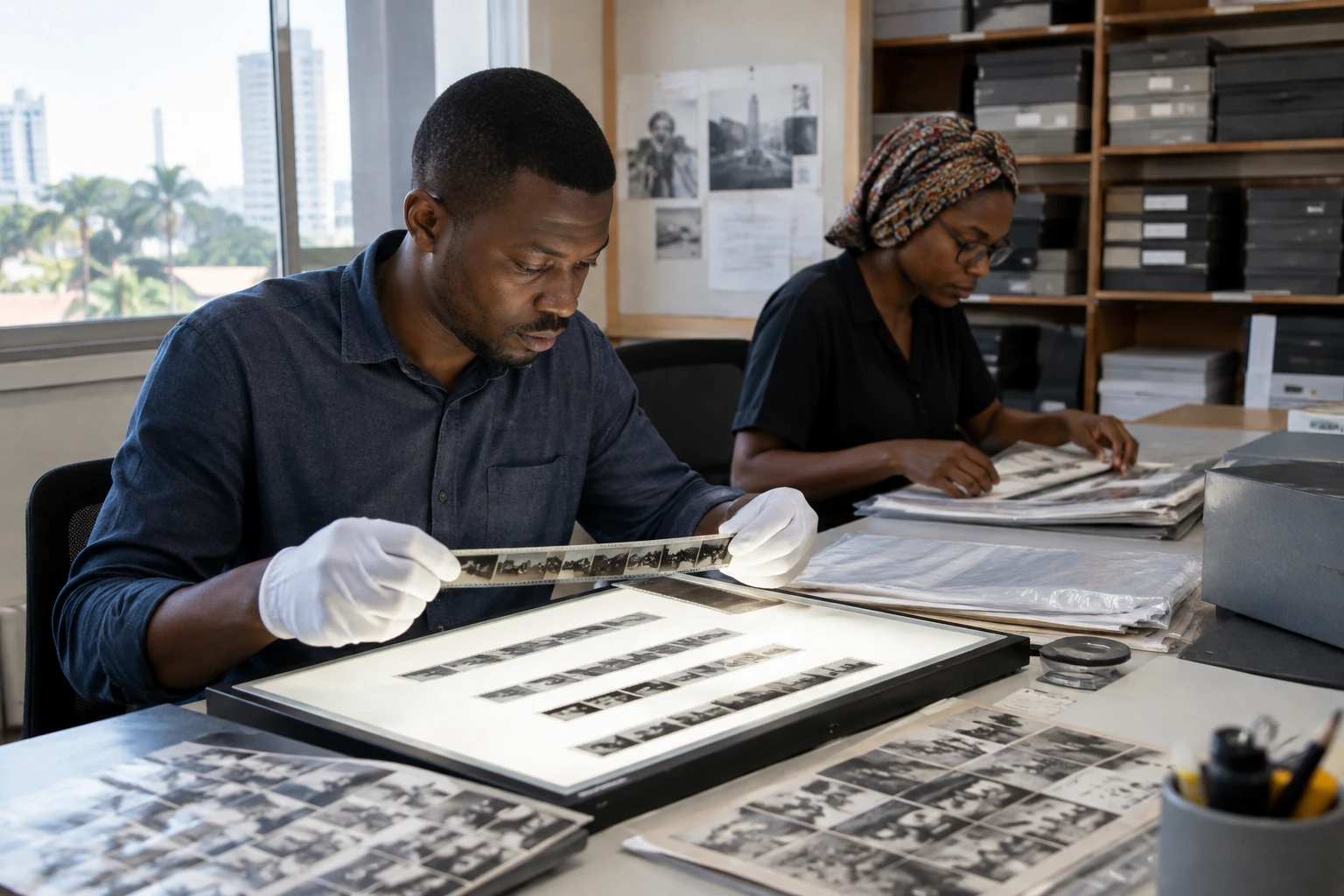
This memory nearly disappeared. For more than 15 years, Ivorian photographer Ananias Léki Dago and the organisation Les Rencontres du Sud have worked to preserve Kodjo’s collection. A new phase of negative preservation began in 2025, with support from the University of California, Los Angeles’s Modern Endangered Archives programme. Les Rencontres d’Arles gives details of this conservation work, which is essential to making the works accessible without separating the images from their material history.
Paul Kodjo died in Ghana on 7 August 2021, aged 82. The Ivorian daily Fraternité Matin reported his death and preparations for his burial at Frenchman Village. Fraternité Matin reported these details. His life thus connected several places: Abidjan, where he built a significant part of his body of work, Paris, where he worked, and Ghana, where he chose to spend his final years.
The circulation of works, a question of Ivorian memory
The Paris exhibition raises the international profile of a heritage created in Côte d’Ivoire. But recognition is not achieved solely in exhibition halls abroad. It also depends on the lasting preservation of the negatives, their documentation and their transmission to Ivorian audiences. The preservation work led by Ananias Léki Dago is a reminder that this rediscovery rests first and foremost on the efforts of people working on the continent.
For Ivorians, these photographs open a window onto the imaginations of the post-independence period and the changes in everyday life. For researchers and artists, they provide material to study: the movement of forms between film, the press and photography, as well as the emergence of a local visual expression. Their significance also extends beyond the national context, shedding light on how West African societies adapted popular genres to tell their own stories.
The Paris exhibition follows an initial presentation of the work at Les Rencontres d’Arles, before its arrival at the Palais de Tokyo. What happens next will also depend on access to the archives and their roots in Côte d’Ivoire. Preserving these images means keeping not only the faces and places of an era, but also the stories a society chose to tell about itself.



