Algeria
 Egypt
 Libya
 Morocco
 Sudan
 Tunisia
 Benin
 Burkina Faso
 Cabo Verde
 Côte d'Ivoire
 Ghana
 Guinea
 Guinea-Bissau
 Liberia
 Mali
 Niger
 Nigeria
 Senegal
 Sierra Leone
 The Gambia
 Togo
 Cameroon
 Central African Republic
 Chad
 DR Congo
 Equatorial Guinea
 Gabon
 Republic of the Congo
 São Tomé and Príncipe
 Burundi
 Comoros
 Djibouti
 Eritrea
 Ethiopia
 Kenya
 Madagascar
 Malawi
 Mauritius
 Mozambique
 Rwanda
 Seychelles
 Somalia
 South Sudan
 Tanzania
 Uganda
 Angola
 Botswana
 Eswatini
 Lesotho
 Namibia
 South Africa
 Zambia
 Zimbabwe
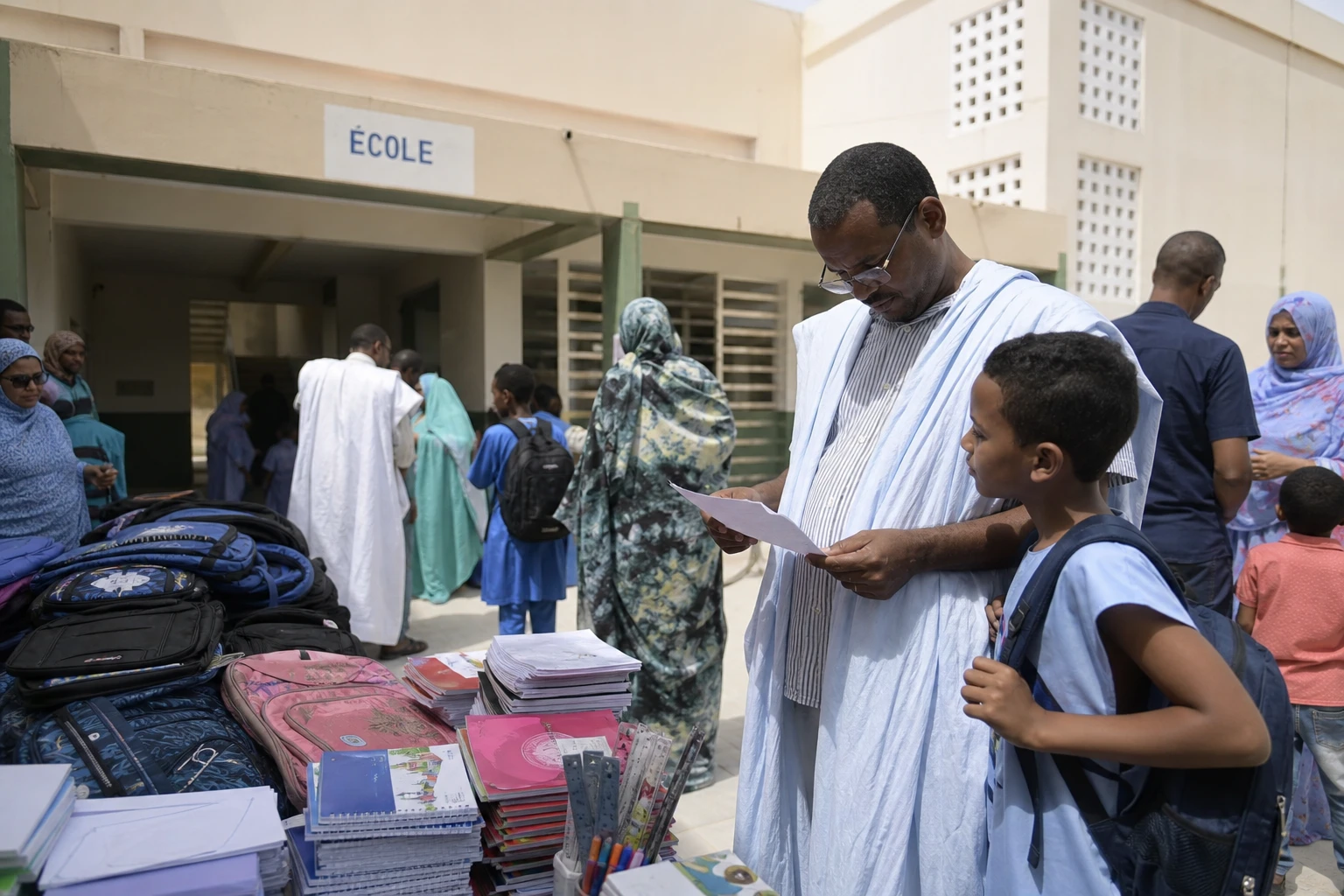
In Nouakchott, the start of the school year is not played out only in classrooms. It also begins in the markets, where Mauritanian families weigh each purchase against notebooks, bags, pens and other everyday expenses. For many parents, the goal is simple: to enable their children to return to lessons without having to do without some of the materials they need.
A school year beginning under pressure
The 2026-2027 school year opens this Monday, 5 October, in Mauritania. The date was confirmed on 4 October by Houda Babah, Minister of Education and Reform of the Education System. The government presents the start of the school year as an important step in implementing the Republican School, a project aimed at expanding access to public education and reducing disparities between pupils.
In the days before schools reopened, the authorities held a series of preparatory meetings. An inter-ministerial committee met in Nouakchott on 29 September, in particular, to review the state of schools, material needs and measures to be taken in the event of possible rainfall. The ministry had also announced the recruitment of 3,852 staff for the education sector.
This institutional planning does not, however, resolve the question of family budgets. For households, the start of the school year means expenses concentrated over just a few days. Purchases come on top of transport costs, clothing, meals and, in some cases, the cost of enrolment at private schools.
The available data do not establish a single national price for school supplies. Prices vary according to neighbourhood, shop, product quality and children’s ages. However, accounts gathered at a market in the capital describe pressure that has become visible in purchasing behaviour.
Buying in stages at Nouakchott’s markets
On the evening of Sunday, 4 October, parents walked through the aisles of a Nouakchott market to complete their school lists. Some filled their bags in one go. Others chose the most urgent items and put off the rest until the following week.
Guéladio Diabira had come with his 13-year-old daughter. He had already bought notebooks, a bag, pencils, a pencil sharpener and pens. But he said he was buying things gradually because of the prices and the number of children involved.
“For now, I’ve bought notebooks, bags, pencils, pencil sharpeners and pens. We pay for them gradually,” he said. The father of three school-age children considered the shopping manageable, but difficult to cover in a single outlay.
The same caution was evident among traders. Salem Mohamed, a market vendor and parent of schoolchildren himself, said he sometimes waited several hours before making a sale. “Everything has become expensive today. I have two children to send to school; I need to sell so I can pay their enrolment fees,” he explained.
This situation is causing restraint on both sides. Families are cutting back on purchases or spreading them out. Traders, meanwhile, have to maintain their stocks while dealing with less regular demand. In Nouakchott’s large informal economy, a few days of weak sales can have a direct effect on a household’s spending.
An education reform changing the landscape
The pressure of the new school year comes as Mauritania continues to transform its education system. The Republican School reform aims to strengthen public education and gradually harmonise educational pathways. It is part of the National Programme for the Development of the Education Sector, which runs from 2024 to 2030.
According to the ministry, the strategy includes expanding access to pre-school education, strengthening basic education and improving the transition from primary to middle school. Its stated aim is also to ensure a more consistent basic education, at a time when families do not all have the same means to fund educational support.
The reform is already having a tangible effect on how schools are organised. The minister announced that 575 classrooms had been received during 2026 and that a further 3,340 would be delivered shortly. She also reported that 165,350 school uniforms had been distributed and that 1,738 canteens were serving 249,461 pupils.
These measures can reduce some costs for families, particularly when uniforms or meals are provided. They do not, however, automatically cover notebooks, bags, art supplies or travel costs. The impact therefore varies according to the level of schooling, the type of school and the place of residence.
The challenge of the real cost of schooling
In Nouakchott, urban households generally have more direct access to markets and schools. But they also face frequent cash expenses: transport, housing, food and school costs. In rural areas, the challenge may take a different form, with longer distances, a more limited range of shops and unequal access to education services.
The issue is therefore not simply the price of a notebook. It is the total cost of keeping a child in school for the whole year. A successful start to the school year requires families to be able to buy the initial materials, but also to replace worn supplies and meet unexpected expenses.
Mauritania’s 2026 national budget also provides for an allocation of 100 million new ouguiyas for printing and distributing school textbooks. The measure is intended to improve the availability of teaching materials. Its reach will depend on effective distribution to schools and the ability to reach pupils beyond the capital.
A national issue with regional significance
Mauritania is not a member of the Economic Community of West African States, ECOWAS, but remains closely connected to the West African region through trade, mobility and regional cooperation. Its position between the Maghreb, the Sahel and the Atlantic gives its public policies a particular dimension.
The start of the school year is therefore a broader indicator. It offers a way to assess a state’s ability to turn national reform into accessible services, including for families with irregular incomes. It also shows that the success of the Republican School will depend as much on infrastructure as on the tangible costs borne by parents.
In the short term, the authorities will need to monitor school attendance, textbook distribution, teacher availability and the situation of the most exposed families. In Nouakchott and across Mauritania’s other regions, the challenge will be to ensure that 5 October is not merely an administrative date, but the effective start of an accessible and stable school year.
Read the official announcements on the opening of the 2026-2027 school year.
See the inter-ministerial preparations for the start of the school year in Mauritania.