Algeria
 Egypt
 Libya
 Morocco
 Sudan
 Tunisia
 Benin
 Burkina Faso
 Cabo Verde
 Côte d'Ivoire
 Ghana
 Guinea
 Guinea-Bissau
 Liberia
 Mali
 Mauritania
 Nigeria
 Senegal
 Sierra Leone
 The Gambia
 Togo
 Cameroon
 Central African Republic
 Chad
 DR Congo
 Equatorial Guinea
 Gabon
 Republic of the Congo
 São Tomé and Príncipe
 Burundi
 Comoros
 Djibouti
 Eritrea
 Ethiopia
 Kenya
 Madagascar
 Malawi
 Mauritius
 Mozambique
 Rwanda
 Seychelles
 Somalia
 South Sudan
 Tanzania
 Uganda
 Angola
 Botswana
 Eswatini
 Lesotho
 Namibia
 South Africa
 Zambia
 Zimbabwe
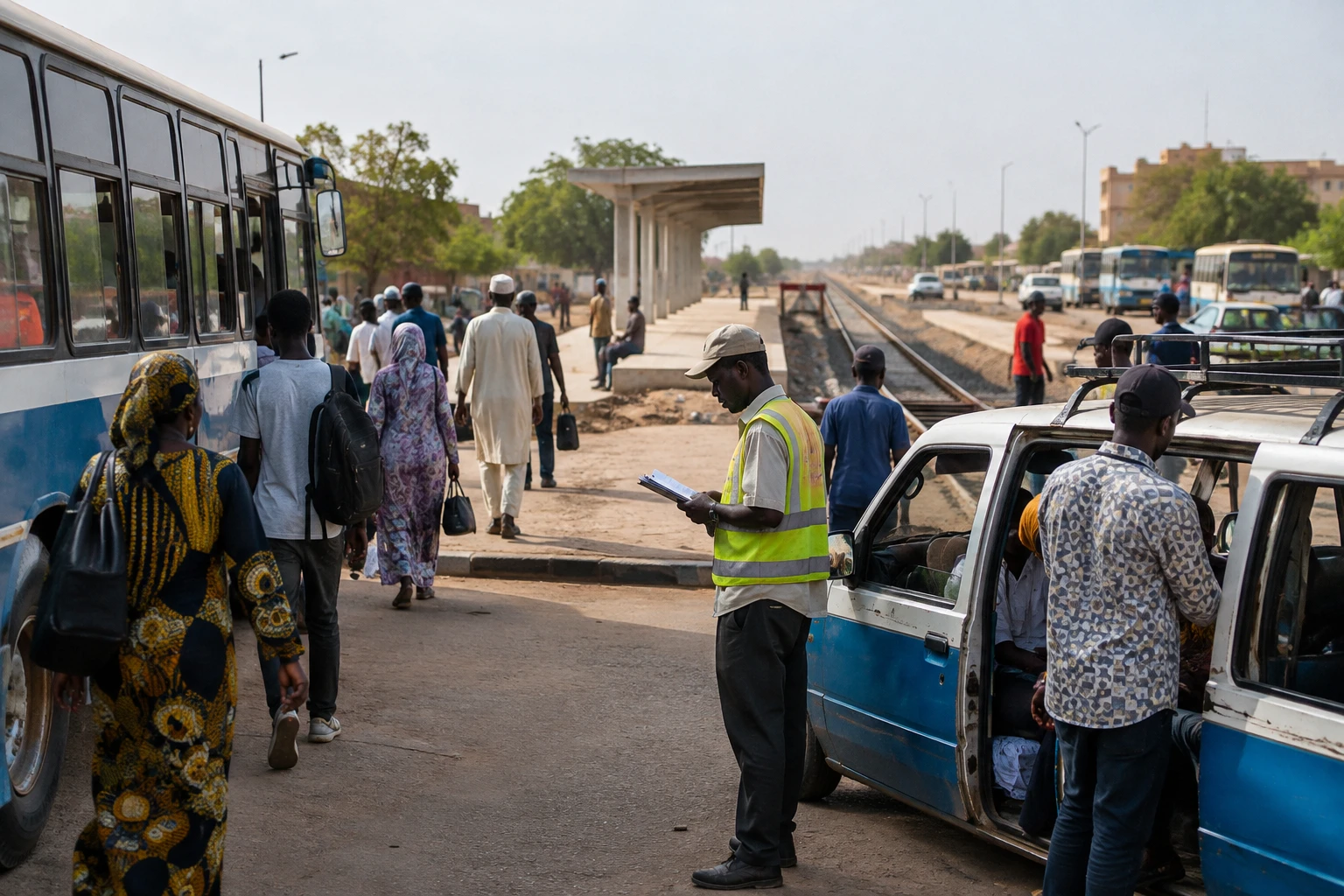
Can a rail company run trains where the tracks do not yet form a usable network? In Niger, the creation of the Nigerien Rail Transport Company (SNTR) first raises a very practical question: how can an institutional ambition be turned into useful connections for passengers and businesses?
An operator before commercial services
On 29 October 2026, Niger’s Council of Ministers adopted the decree establishing SNTR. According to the government statement reported by the Nigerien News Agency, the mixed-economy company will manage rail traffic in line with safety and security standards, and provide a reliable and sustainable service. A mixed-economy company combines public and private capital; the precise terms of participation were not detailed in the information available.
SNTR forms part of the Alliance of Sahel States’ (AES) strategy to develop rail transport. The alliance comprises Niger, Mali and Burkina Faso. But its creation does not mean commercial trains will be running soon. It establishes an operator; the network, its funding and the services remain to be defined. The Nigerien News Agency reports the Council of Ministers’ decision, also covered by Nigerien outlet Infos du Sahel.
An unfinished project, corridors to connect
Niger has no regular commercial rail service. Yet the Niamey-Dosso track was built as part of a project launched in 2014 to extend Benin’s Cotonou-Parakou line to Niamey. This infrastructure has not been integrated into a continuous link with Benin’s network. The World Bank describes the extension project from Parakou to Niamey as unfinished and notes the difficulties facing rail operations in Benin. Its analysis of transport infrastructure in Benin and Niger helps illustrate the gap between laid track and an operational corridor.
The precedent is a reminder that rail depends as much on agreements between states as on construction work. The former Benin-Niger Common Organisation for Railways and Transport (OCBN) was intended to manage joint rail activities. But co-operation did not enable the link to Niamey to be completed. For SNTR, the challenge will therefore also be to co-ordinate customs, technical standards and operators in neighbouring countries.
Economic geography makes these choices important. As a landlocked country, Niger depends on roads to reach ports and regional markets. Routes through Benin, Togo or Ghana are among the possible options for its trade. In 2026, the Nigerien government also referred to the Kano-Maradi rail link project, which depends on a connection with Nigeria. Niger’s transport ministry outlined the prospects for the project. These options do not replace a continuous AES line; rather, they show that ending the country’s isolation can draw on several partners and corridors.
Viability depends on freight flows
Rail can complement roads for heavy freight or regular journeys. But it will be competitive only if volumes are sufficient, schedules remain predictable and lines connect production centres with real markets. Importers in Niamey, mining companies, traders and producers in the regions will not all benefit equally from a network designed around a single route.
The bill goes beyond building tracks. Funding is needed for rolling stock, stations, maintenance, staff training and security. Tariffs must also be set and connections to neighbouring networks arranged. A management company can prepare for these functions, but it guarantees neither the resources nor passenger numbers. The project’s cost, how it will be divided between states and partners, and the construction timetable were not specified in the announcements reviewed.
Burkina Faso, for its part, has begun setting up Faso Rails, a majority state-owned company focused on producing rails, sleepers and equipment. The investment needed for the plant was estimated at 70bn CFA francs in the 2024 supplementary budget law. This points to industrial ambition; the figure should not be confused with the cost of a cross-border railway line. Burkinabè daily L’Économiste du Faso details this budget allocation.
A test of regional co-operation
For residents, the impact will depend on the routes chosen. A line connecting Niamey with productive regions would meet different needs from a corridor designed mainly for imported freight. Road hauliers could lose some business on certain routes, while local companies could gain more regular access to markets. The effects will also depend on fares, the stations served and last-mile connections.
For the AES, rail is a test of economic co-operation: the three countries will have to turn a shared strategy into funded, co-ordinated decisions that are compatible with existing regional corridors. The AES does not replace the infrastructure of coastal countries or the agreements needed to reach ports. It can, however, widen the range of routes if networks are connected and rules for their use are put in place.
The next step to watch for is therefore less the announcement of an operator than the publication of a concrete plan: priority lines, funding, a timetable, cross-border agreements and target volumes. Without these elements, SNTR will remain a company waiting for a network. With continuous links and services suited to the needs of Nigeriens, it could become a tool for transport and regional integration.