Algeria
 Egypt
 Libya
 Morocco
 Sudan
 Tunisia
 Benin
 Burkina Faso
 Cabo Verde
 Côte d'Ivoire
 Ghana
 Guinea
 Guinea-Bissau
 Liberia
 Mali
 Mauritania
 Nigeria
 Senegal
 Sierra Leone
 The Gambia
 Togo
 Cameroon
 Central African Republic
 Chad
 DR Congo
 Equatorial Guinea
 Gabon
 Republic of the Congo
 São Tomé and Príncipe
 Burundi
 Comoros
 Djibouti
 Eritrea
 Ethiopia
 Kenya
 Madagascar
 Malawi
 Mauritius
 Mozambique
 Rwanda
 Seychelles
 Somalia
 South Sudan
 Tanzania
 Uganda
 Angola
 Botswana
 Eswatini
 Lesotho
 Namibia
 South Africa
 Zambia
 Zimbabwe
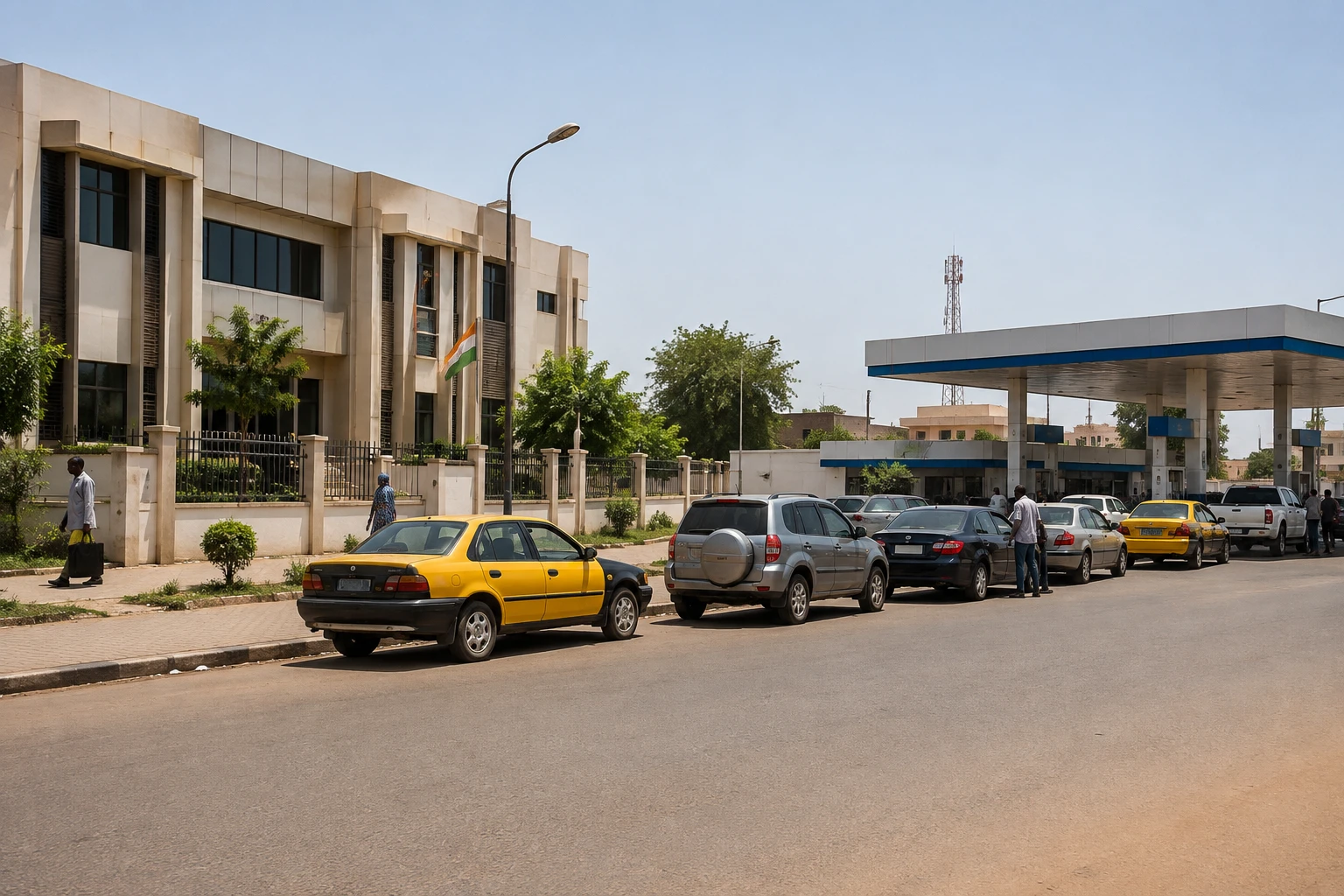
Finding petrol in Niamey can now take hours. Since the weekend of 17 and 18 October, queues have formed outside filling stations, as several other Nigerien cities were already experiencing supply difficulties. The strain reveals a tangible gap: Niger produces oil, but does not refine and distribute enough fuel to meet demand consistently.
A crisis reaches the capital
Niamey had been relatively spared the shortages recorded in other towns in recent months. The situation changed towards the end of the week, after the Ministry of Trade published a list of stations where petrol was still available. Customers quickly flocked to these outlets.
Motorists reported long waits and stations running dry. Some outlets were said to have limited the quantities distributed. However, these restrictions, reported by customers, do not establish that the same rationing was in place across the capital.
The Nigerien News Agency reports that shortages have affected several regions for months. The government, for its part, has acknowledged persistent pressure on petrol and diesel supplies. On 12 October, it set up a technical committee to examine production, transport and distribution difficulties. The Nigerien News Agency’s announcement of the oil crisis committee sets out, among other things, the aims assigned to the body.
Producing oil is not enough
Niger has a refinery in Zinder, SORAZ. But its nominal capacity does not mean that it operates at full capacity every day, or that all its output matches market needs. The Minister of Petroleum said the facility is currently processing around 15,000 barrels a day, against installed capacity of 20,000. The committee is to work with Chinese company CNPC to gradually increase processing and address supply and operational constraints.
The mix of refined products also matters. According to figures presented by the ministry, yields are about 26% for petrol and 55% for diesel. A refinery can therefore process crude without producing enough of the specific fuel consumers need. This distinction helps explain why having oil underground does not guarantee fuel at the pumps. The figures released by the Nigerien government show a deficit in the first eight months of 2026 of 196.62 million litres of premium petrol and 52.60 million litres of diesel.
This assessment is consistent with information given to the press about the situation in Niamey: available capacity does not adequately cover demand, and supplies need to be supplemented. The national figures indicate a significant gap, but on their own do not measure the share attributable to breakdowns, imports, diversion or logistical delays.
Neighbouring Nigeria, a weakened supplementary source
Informal channels from Nigeria have long helped supply some areas along Niger’s border. Their decline, together with Nigeria’s removal of fuel subsidies in 2023, has made this petrol less attractive to traders and buyers. However, this flow was neither official nor stable: it could not sustainably replace a regular national supply chain.
Nigerien authorities also blame fraud and informal channels, which can divert volumes or make stock monitoring more difficult. On 12 October, the Minister of Trade signed an order banning the export of premium petrol and diesel produced in the country, except with special authorisation. The Nigerien News Agency reported the measure. It aims to give priority to the domestic market for national production, but by itself cannot guarantee that stations will be supplied on time.
The public response is therefore caught between two priorities. Available volumes must be protected and losses reduced, while refining, imports, storage and transport must also be improved. The technical committee is to prepare emergency storage capacity and examine the constraints holding back SORAZ. These efforts take time, while consumers face shortages day to day.
Prices held steady, pressure on households
The disruption affects people in different ways. Motorists lose time in queues. Taxis and other transport operators may make fewer journeys or pass their costs on to passengers. Small businesses and activities reliant on generators are also exposed. In regions far from the capital, distance and the availability of depots can make resupply even more uncertain.
The Consultative Council for the Refoundation, which met on 5 and 6 October, recommended raising pump prices to ease the cost of the system. But on 9 October, the government ruled out that option and announced that prices would remain unchanged, in order not to increase the cost of living. The decision protects consumers from an immediate official price rise. It does not, however, solve the availability problem: a regulated price offers little comfort if the product is missing or the wait becomes too long.
In the short term, Niamey needs regular deliveries and reliable information about which stations have been supplied. In the medium term, the challenge is to narrow the gap between production, needs and distribution capacity without placing the entire burden of adjustment on households.
A national issue in a changing region
The shortage is primarily a matter of managing Niger’s domestic oil sector, but it also highlights dependence on cross-border trade. Neighbouring Nigeria remains a key player in the region’s fuel markets and flows, even when the channels used are informal. Any change in its prices or energy policy can alter supplies in border areas.
The regional framework has also changed: Niger, Mali and Burkina Faso’s withdrawal from ECOWAS took effect on 29 January 2025. This institutional break does not mean an end to trade between neighbours, but it makes maintaining practical mechanisms for movement and cooperation all the more important. ECOWAS specified the effective date of the withdrawal.
What happens next will depend on measurable results: increased production in Zinder, better-planned imports, emergency stocks and more transparent distribution between Niamey and the regions. Until these measures translate into regular supplies, the contrast will remain stark between Niger’s oil resources and consumers’ everyday experience at the pump.