Algeria
 Egypt
 Libya
 Morocco
 Sudan
 Tunisia
 Benin
 Burkina Faso
 Cabo Verde
 Côte d'Ivoire
 Ghana
 Guinea
 Guinea-Bissau
 Liberia
 Mali
 Mauritania
 Nigeria
 Senegal
 Sierra Leone
 The Gambia
 Togo
 Cameroon
 Central African Republic
 Chad
 DR Congo
 Equatorial Guinea
 Gabon
 Republic of the Congo
 São Tomé and Príncipe
 Burundi
 Comoros
 Djibouti
 Eritrea
 Ethiopia
 Kenya
 Madagascar
 Malawi
 Mauritius
 Mozambique
 Rwanda
 Seychelles
 Somalia
 South Sudan
 Tanzania
 Uganda
 Angola
 Botswana
 Eswatini
 Lesotho
 Namibia
 South Africa
 Zambia
 Zimbabwe
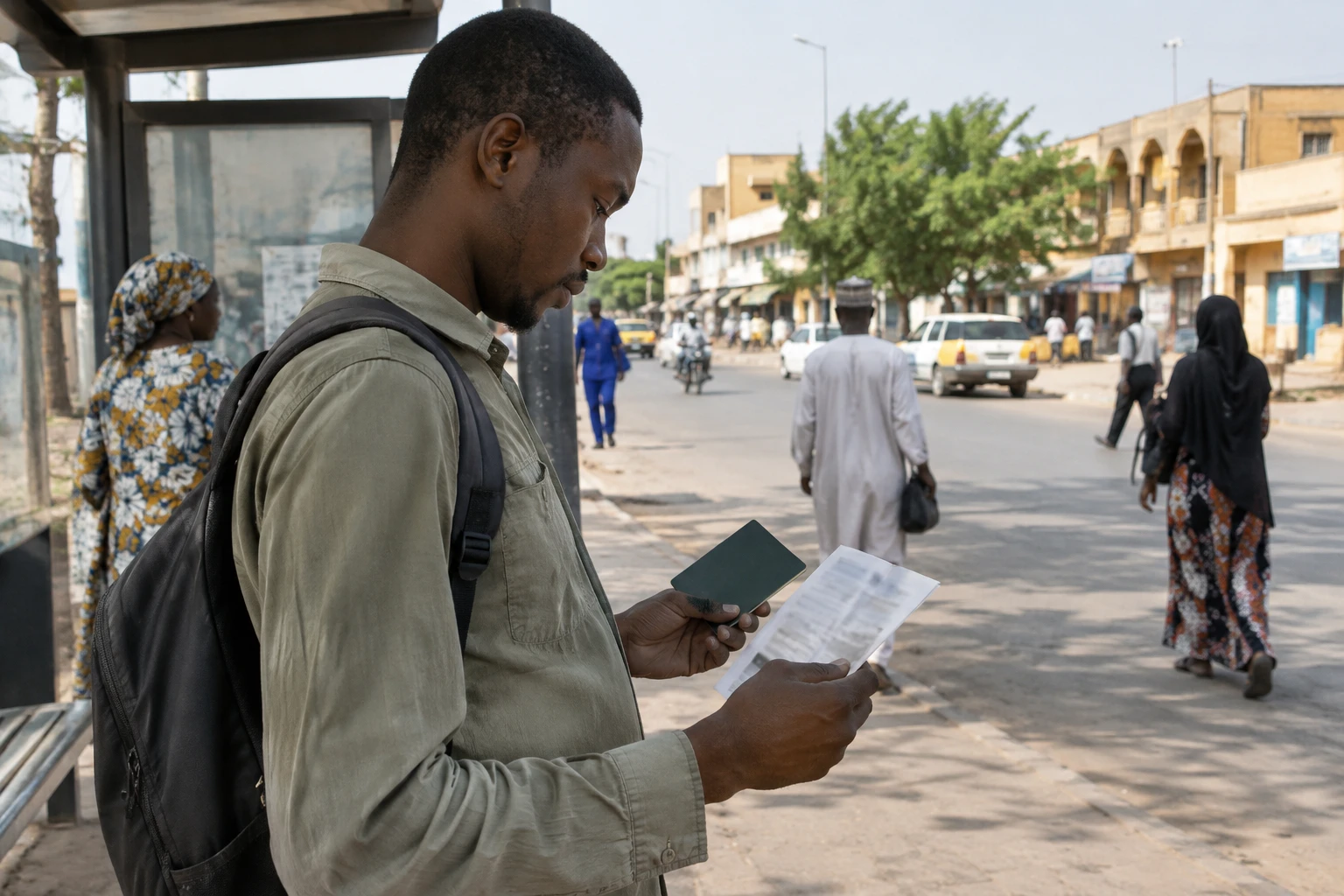
An expiring passport can turn a political decision into a daily obstacle. For people stripped of their Nigerien nationality while living abroad, the effects reach travel, residence and work. But the gravest risk is losing all nationality and no longer having consular protection.
A measure rooted in Niger’s political trajectory
Since the coup d’état of 26 July 2023, Niger has been governed by the military authorities grouped around General Abdourahamane Tiani. In August 2024, an ordinance created a register targeting people suspected of terrorist acts or offences undermining the state’s fundamental interests and public security. A supplementary text followed in October.
The mechanism is at the heart of the controversy. The authorities invoke national security. Human rights organisations challenge the broad nature of some offences and raise concerns about the safeguards afforded to those listed. Amnesty International notes that acts linked to communications or the dissemination of information could fall under categories defined imprecisely. These are the organisation’s assessments, not judicial rulings establishing a violation in each case.
The controversy is unfolding amid regional military transitions and tensions between Niamey and the Economic Community of West African States (ECOWAS), a West African political and economic integration organisation. Niger, Mali and Burkina Faso announced their withdrawal from ECOWAS in 2024 and created the Alliance of Sahel States. For Nigeriens in the diaspora, these realignments can complicate consular procedures and opportunities for mobility, but do not in themselves determine their individual legal status.
Practical consequences beyond the decree
On 17 September 2026, Abdourahamane Tiani signed a decree targeting five people living outside Niger, including former Prime Minister Ouhoumoudou Mahamadou and three former advisers to ex-president Mohamed Bazoum. Activist Boubacar Seyni Souley is also among those affected. The authorities accuse them, among other things, of offences relating to the dissemination of data, intelligence with a foreign power and undermining state security. These are official accusations: they do not, on their own, constitute proof of guilt.
Human Rights Watch says the decision brings to 25 the number of people provisionally stripped of their nationality under the mechanism established in 2024. The Nigerien News Agency also reported that five people were targeted by the September decree. This tally places the measure within a series of cases rather than as an isolated instance.
For those affected, difficulties can begin when a passport expires. Without a renewable travel document, a work or family trip becomes more difficult. They must also renew a residence permit, prove their identity to an employer or maintain a contract. Procedures depend on the country of residence and individual circumstances: loss of nationality therefore does not have the same practical effects everywhere.
Mayra Djibrine, also known as Mariama Djibrine, was targeted by a measure in June 2026. The Alliance of Democrats of the Sahel activist said she was seeking an administrative solution, as she had no other nationality. The Nigerien authorities had then announced her provisional loss of nationality and listed the offences of which she was accused. Here too, these grounds should be presented as accusations, not as facts established by a court.
Another case illustrates the diversity of people’s circumstances. Hamid Amadou Ngadé, a former head of communications at the presidency under Mohamed Bazoum, obtained political asylum abroad, according to reported information. Asylum and statelessness are not synonymous: the former is protection granted by another state, while statelessness means the absence of nationality recognised by any state. A person can therefore obtain protection without their travel or status difficulties automatically disappearing.
The risk of statelessness and safeguards in question
The situation first depends on one key point: does the person hold another nationality? Human Rights Watch reports that at least four of the five people targeted in September are said to hold only Nigerien passports. This is not enough to prove that they have no other nationality, but it makes the risk of statelessness serious. Only an individual assessment can establish their exact status.
Niger is a party to the 1961 United Nations Convention on the Reduction of Statelessness. It strictly regulates deprivation of nationality where this would render a person stateless. The right to a nationality is also recognised by the Universal Declaration of Human Rights. These commitments do not automatically resolve the situation of each person: compliance depends in particular on the texts applied, the facts of the case and the remedies that are effectively accessible.
The procedural framework is also disputed. Human Rights Watch and the Committee for Justice point to a tension between the provisional deprivation mechanism created in 2024 and Niger’s Nationality Code, which provides, among other things, for prior notification and a period in which to present a defence. The Committee for Justice notes that the 2024 text would allow a measure to be taken in the context of prosecution before a final conviction. In the information consulted, the authorities have not publicly responded to these specific criticisms.
The decision’s impact therefore goes beyond the administrative fate of those targeted. For their relatives, it can affect family procedures and the stability of their residence abroad. For people reliant on contracts or self-employment, renewing an identity document may determine access to work or services. And if a person becomes stateless, returning to Niger and obtaining consular protection can become particularly complex.
A test for rights and regional relations
The debate concerns the boundary between state security and individual safeguards. The Nigerien authorities present the measure as part of the fight against serious offences. Critics question the breadth of the criteria, the possibility of challenging decisions and the risk that an administrative measure may precede a final conviction. The task is to scrutinise the procedures without treating the accusations as established or the concerns as a judgment handed down by a court.
Across West Africa, the case is a reminder that national decisions on citizenship can have effects beyond borders: on diasporas, travel and relations between host states and consular authorities. What happens next will depend in particular on whether those concerned can access the reasons for the decrees, whether independent remedies are available and whether their nationality status is confirmed. These factors will make it possible to assess whether so-called provisional deprivation remains a measure that can be challenged in law or leads, in practice, to lasting exclusion.
For more information on the available evidence, see Human Rights Watch’s information on the 17 September decree, the Committee for Justice statement on procedural safeguards, Amnesty International’s report on civic space in Niger and the official Nigerien announcement concerning Mariama Djibrine in June 2026.