Algeria
 Egypt
 Morocco
 Sudan
 Tunisia
 Benin
 Burkina Faso
 Cabo Verde
 Côte d'Ivoire
 Ghana
 Guinea
 Guinea-Bissau
 Liberia
 Mali
 Mauritania
 Niger
 Nigeria
 Senegal
 Sierra Leone
 The Gambia
 Togo
 Cameroon
 Central African Republic
 Chad
 DR Congo
 Equatorial Guinea
 Gabon
 Republic of the Congo
 São Tomé and Príncipe
 Burundi
 Comoros
 Djibouti
 Eritrea
 Ethiopia
 Kenya
 Madagascar
 Malawi
 Mauritius
 Mozambique
 Rwanda
 Seychelles
 Somalia
 South Sudan
 Tanzania
 Uganda
 Angola
 Botswana
 Eswatini
 Lesotho
 Namibia
 South Africa
 Zambia
 Zimbabwe
In northern Niger, the security of a border also depends on relations forged beyond the Sahara. Prime Minister Ali Mahaman Lamine Zeine’s visit to Benghazi opens a new channel with the authorities in eastern Libya, as Niamey is also strengthening its ties with Algiers.
Cooperation signed in a divided Libya
On 1 November 2026, Ali Mahaman Lamine Zeine was received in Benghazi by Saddam Haftar, deputy commander of the forces in eastern Libya, in the presence of Oussama Hammad, who heads the government established in that part of the country. The Nigerien delegation included military and political officials, according to the Nigerien News Agency (ANP).
The two sides signed a strategic cooperation protocol. The prime minister announced the signing and called for consultations to continue and commitments to be followed up. Niamey and Benghazi have, however, not made the detailed text public or specified the measures to be implemented.
Media outlets have referred to plans for security cooperation, intelligence-sharing and combating trafficking. But these elements have not been confirmed in the official communications reviewed. It would therefore be premature to present these proposals as agreed clauses of the deal.
The choice of Benghazi matters as much as the protocol. Libya remains divided between rival institutions in the east and west, with the Government of National Unity based in Tripoli. In February 2026, the UN noted that the political deadlock persisted and that parallel judicial institutions were deepening the divisions. An agreement with one camp therefore does not automatically amount to a commitment by the entire Libyan state.
A strategic border that is hard to control
The border between Niger and Libya stretches for about 340 kilometres, across a Saharan expanse where distances, tracks and poor infrastructure make checks difficult. Armed groups and smuggling networks move through the area. For Niamey, cooperation with actors established in southern Libya may offer a channel for coordination, but cannot by itself guarantee a lasting presence on the ground.
The case of Mahmoud Salah illustrates the political dimension of these relations. The leader of the Nigerien rebel movement, the Patriotic Liberation Front, was arrested in southern Libya in 2025. Reports published in 2026 refer to his release by forces linked to Haftar, but the circumstances and significance of the episode remain matters to attribute to the sources reporting it. Exchanges between Niamey and Benghazi thus take place within a relationship where border security and armed rivalries intersect.
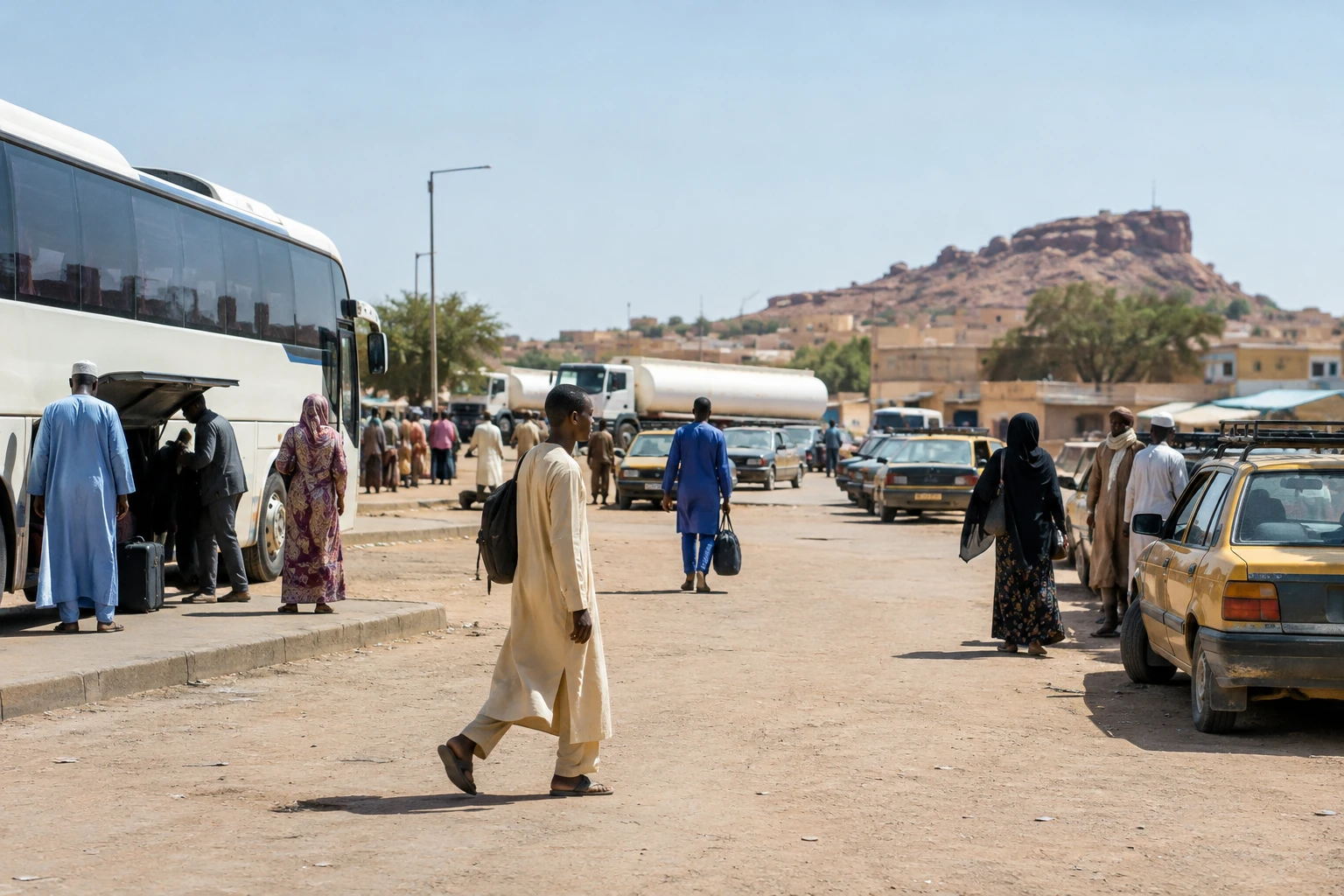
The visit also comes amid a rapid rapprochement with Algeria. On 31 October, a convoy of about 60 fuel tankers escorted by Algerian troops arrived in Agadez, according to the regional agency Madar, which also reported the arrival of Nigerien soldiers at the border. The ANP, for its part, announced the receipt of 53 Algerian fuel tankers on 1 November. These figures do not necessarily describe the same stage of the convoy, but confirm the delivery of fuel and Algeria’s logistical involvement.
This sequence is not enough to demonstrate that the Benghazi agreement directly responds to the Algerian deployment. It nevertheless shows that Niger is seeking several points of support among its northern neighbours, at a time when protecting routes, supplies and energy infrastructure is weighing on the authorities.
Niamey opens multiple channels in the north
Since the July 2023 coup, Niger’s rulers have redirected their security and political partnerships. Cooperation with Algeria has grown stronger, while ties with the Haftar camp are once again more prominent. These relations may meet practical coordination needs. They also expose Niamey to competing balances of power, since Algiers, the authorities in Tripoli and those in Benghazi do not share the same priorities or interests.
Russia is present in this landscape, with documented links to the Nigerien authorities and the Haftar camp. Earlier analyses have described Benghazi’s role as a regional logistics hub. This does not make it possible to conclude that Moscow negotiated the protocol or will act as a mediator in this matter. Any such claim would require new and independent evidence.
For residents and businesses in northern Niger, the results will be measured less by announcements than by their effects: safer travel, regular access to fuel, continuity of trade and reduced risks on the roads. A system focused on checkpoints and exchanges between forces would not, on its own, meet the needs of communities far from administrative centres.
An issue that extends beyond the two capitals
The issue also concerns the regional architecture. Niger’s withdrawal from ECOWAS, effective from 29 January 2025, has changed its West African cooperation frameworks, although the organisation has maintained transitional arrangements for travel and trade. Niamey also relies on the Alliance of Sahel States with Mali and Burkina Faso. But the Libyan border also involves the Maghreb and the routes linking the Sahara to the Sahel.
The next step will be to establish whether the protocol leads to public, operational mechanisms: follow-up meetings, clearly assigned responsibilities, consular cooperation or border coordination. It will also be important to see whether Niamey maintains exchanges with Tripoli. For now, the agreement marks a diplomatic opening towards eastern Libya, not yet proof of a more secure border.