Algeria
 Egypt
 Libya
 Morocco
 Sudan
 Tunisia
 Benin
 Burkina Faso
 Cabo Verde
 Côte d'Ivoire
 Guinea
 Guinea-Bissau
 Liberia
 Mali
 Mauritania
 Niger
 Nigeria
 Senegal
 Sierra Leone
 The Gambia
 Togo
 Cameroon
 Central African Republic
 Chad
 DR Congo
 Equatorial Guinea
 Gabon
 Republic of the Congo
 São Tomé and Príncipe
 Burundi
 Comoros
 Djibouti
 Eritrea
 Ethiopia
 Kenya
 Madagascar
 Malawi
 Mauritius
 Mozambique
 Rwanda
 Seychelles
 Somalia
 South Sudan
 Tanzania
 Uganda
 Angola
 Botswana
 Eswatini
 Lesotho
 Namibia
 South Africa
 Zambia
 Zimbabwe

A new face for Ghanaian gold
In Ghana, gold production is no longer measured solely by the historic mines that have shaped the country’s story. It also depends on major companies’ ability to ramp up new deposits, as Accra seeks to capture more value from its mineral resources. In this landscape, the Ahafo complex has become a practical test of Newmont’s performance in Ghana, as well as of the country’s place in African gold.
This perspective is part of a broader context. In 2025, Ghanaian gold production surged to 5.94 million ounces, according to the Ghana News Agency, citing figures from the national mining sector. The increase was driven mainly by small-scale operators, while the major companies followed more mixed trajectories. Ghana thus remains a major gold power in West Africa, with mining policy increasingly focused on formalisation and tax revenue capture.
What the first-half figures show
According to the operating report published on 23 July 2026, Newmont produced 358,000 ounces of gold in Ghana in the first half of the year. This volume represents about 47% of the group’s annual target in the country, set at 755,000 ounces. Ahafo South produced 228,000 ounces, while Ahafo North contributed 130,000 ounces.
The US group expects Ahafo South to produce 440,000 ounces over the course of 2026 and Ahafo North 315,000 ounces. The new asset, which entered commercial production in autumn 2025, still needs to ramp up. Newmont says Ahafo North’s production is expected to increase quarter by quarter in 2026, while output at Ahafo South is expected to fall slightly because of lower ore grades.
On paper, the equation is clear. Ahafo North is expected to absorb part of the anticipated decline at Ahafo South. The next-generation production site achieved commercial production in October 2025, with a ramp-up planned throughout 2026. Newmont describes it as a key asset in its global portfolio, with an initial mine life of 13 years and targeted annual production of 275,000 to 325,000 ounces over the first five years.
Why the project matters to Accra
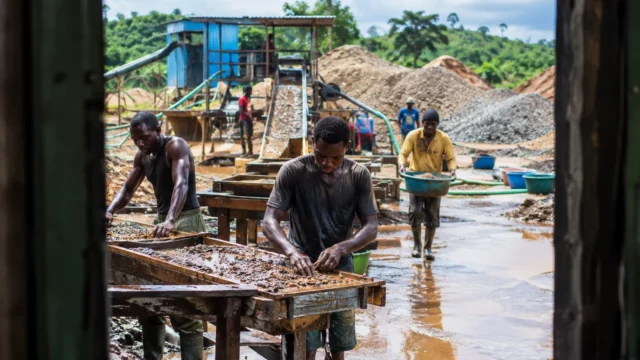
For Ghana, the stakes go beyond the volume extracted. Gold affects government revenue, exports and foreign exchange reserves. At the same time, the government has taken a tougher approach to the sector with the creation of GoldBod, the body responsible for regulating the purchase, sale and export of gold produced by licensed small-scale operators. The reform aims to reduce revenue leakages and better organise the value chain.
Ahafo North’s ramp-up therefore has a direct economic impact. It supports indirect employment, subcontracting, local procurement and mining tax revenue. But it also highlights a structural constraint: mineral wealth does not automatically generate more local value if most refining, financing and trading remain dominated by large external players. In the formal sector, industrial companies are required to maintain their level of investment. In the informal sector, thousands of workers still depend on the pace of gold prices and export rules.
The contrast between Ahafo South and Ahafo North is revealing in this respect. The former remains the group’s historic base in Ghana, with more than 10 million ounces produced since 2006. The latter represents the expansion phase. Together, the two assets are expected to bring the group’s production to around 755,000 ounces in 2026, which would be a slight increase on the 734,000 ounces announced for Ghana in 2025.
Regional perspective: a signal for West Africa
Beyond Ghana, the case is relevant to mining across West Africa. ECOWAS, which brings together the region’s economies, is closely monitoring tensions between extraction, economic sovereignty and local processing. When a new asset such as Ahafo North reaches full capacity, it becomes a benchmark for other producing countries seeking to attract capital without settling for the role of raw-material exporter.
The Ghanaian case also reflects a broader trend across the continent: producing states want to take back control of the gold value chain, while mining groups adjust their portfolios across Africa, Australia, Papua New Guinea and the Americas. Newmont expects attributable gold production of about 5.3 million ounces worldwide in 2026, placing Ghana within a much broader set of investment and mining-sequencing decisions.
In the short term, the key issue is straightforward: Ahafo North’s ramp-up must offset the expected decline in ore grades at Ahafo South without disrupting the local supply chain. If that happens, Ghana will consolidate its position among the continent’s major gold producers. If the ramp-up is delayed, the effects will be felt in export volumes, government revenue and market expectations.