Algeria
 Egypt
 Libya
 Sudan
 Tunisia
 Benin
 Burkina Faso
 Cabo Verde
 Côte d'Ivoire
 Ghana
 Guinea
 Guinea-Bissau
 Liberia
 Mali
 Mauritania
 Niger
 Nigeria
 Senegal
 Sierra Leone
 The Gambia
 Togo
 Cameroon
 Central African Republic
 Chad
 DR Congo
 Equatorial Guinea
 Gabon
 Republic of the Congo
 São Tomé and Príncipe
 Burundi
 Comoros
 Djibouti
 Eritrea
 Ethiopia
 Kenya
 Madagascar
 Malawi
 Mauritius
 Mozambique
 Rwanda
 Seychelles
 Somalia
 South Sudan
 Tanzania
 Uganda
 Angola
 Botswana
 Eswatini
 Lesotho
 Namibia
 South Africa
 Zambia
 Zimbabwe
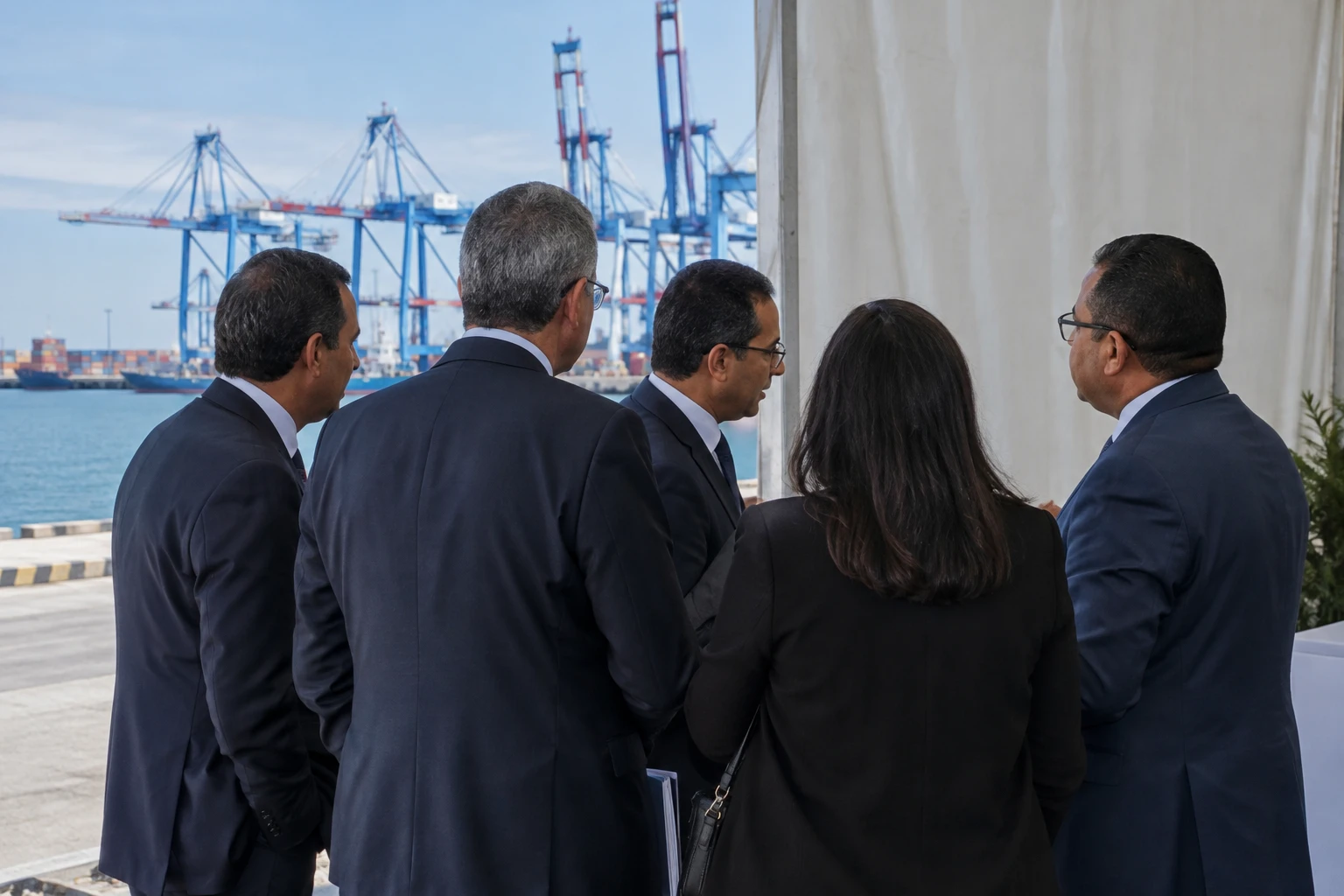
In Nador, the opening of a major terminal will not be measured solely by the number of cranes lined up along the quays. For people in Morocco’s Oriental region, the decisive questions will be jobs, local suppliers and connections that will move goods beyond the port.
Morocco launched operations at the first container terminal at Nador West Med on 31 October 2026. The start marks a new stage for a complex that is due to come into service gradually. The project involves 54 billion dirhams in public and private investment, according to the Royal Cabinet’s statement of 28 October. The official statement on Nador West Med presents the port as a complement to Tanger Med, rather than a standalone project.
A new port hub in the Oriental region
The first terminal, in the eastern part of the complex, has 1,520 metres of quay, a depth of 18 metres and 70 hectares of storage yards. It will be able to handle up to 3.5 million TEUs at full capacity. A TEU, or twenty-foot equivalent unit, is the standard unit used to measure container traffic. The first phase had been announced for the final quarter of 2026 by operator Marsa Maroc. Marsa Maroc outlines the specifications of the East Terminal.
It will be operated for 25 years by West Med Container Terminal, a company bringing together Marsa Maroc and Terminal Investment Limited (TIL), a subsidiary of shipping group MSC. The partnership combines a Moroccan operator with an international player that has its own shipping network. It could help attract port calls, but the announced capacity alone does not guarantee corresponding traffic: that will depend on shipping companies’ choices and the frequency of vessel calls.
A second container terminal is planned to the west. With an announced capacity of 1.8 million TEUs a year, it is due to begin operations in April 2027, according to the Royal Cabinet. Marsa Maroc and CMA Terminals, a subsidiary of CMA CGM, will operate it. Together, the two terminals could therefore offer a theoretical capacity of 5.3 million TEUs. This figure describes potential at full capacity, not the volume of containers that will actually be handled from the outset.
The port is not limited to containers. The programme also provides for facilities for general cargo, bulk goods, hydrocarbons and liquefied natural gas (LNG). LNG is gas cooled so that it can be transported in liquid form. The announced project includes an LNG terminal capable of handling up to 5 billion cubic metres a year. The schedules and capacities of the energy components will need to be monitored as construction and operational decisions progress.
From quays to local benefits
The complex’s success will also depend on its links with the surrounding region. The rail connection is included in the Moroccan network’s investment programme through to 2030, announced in Rabat in October 2026. The link is intended to allow more goods to be transported without relying solely on roads. But access, journey times, logistics services and connections with industrial zones will matter as much as port equipment. Morocco’s rail programme includes a connection to Nador West Med.
For businesses in the Oriental region, the challenge is to secure a lasting share of the activity: transport, warehousing, maintenance, processing and services to ships. The benefits, however, are not automatic. They will depend in particular on available training, small businesses’ access to port contracts and the ability to attract industrial activities rather than simply handle transhipment, meaning the transfer of containers between ships.
The Royal Cabinet’s statement stressed the need to ensure that neighbouring provinces benefit from the project’s economic and social impact, and to adapt training to new occupations. This ambition will be judged by tangible results: jobs actually created, qualifications available to young people in the region, contracts won by local businesses and improvements to transport infrastructure. Otherwise, a very active port could remain relatively disconnected from the economy around it.
Complementing Tanger Med, without confusing capacity with traffic
Nador West Med is part of a national strategy to strengthen several maritime gateways. Tanger Med remains Morocco’s main transhipment hub in the western Mediterranean. The new complex, near Nador, is intended to diversify capacity and support the development of the Oriental region. The issue is therefore not simply competition with other ports: complementarity between platforms, rail and road services, and the quality of maritime links will determine Nador’s place in trade chains.
At regional level, Morocco is a member of the Arab Maghreb Union (AMU), which also brings together Algeria, Libya, Mauritania and Tunisia. The organisation provides a framework for co-operation between North African countries. The official overview of the AMU’s five members recalls this regional dimension. Maghreb integration alone, however, cannot guarantee trade flows: Nador’s performance will depend first and foremost on the links actually opened, trade agreements and shipping companies’ decisions.
The port could also strengthen trade between Mediterranean and African markets, but its continental reach will develop in stages. African businesses will benefit from the new infrastructure only if they can access its services and if land corridors efficiently connect the quays to production and consumption centres. Morocco’s membership of the African Union gives this development a broader pan-African framework, without removing the practical constraints of transport and cost.
The next milestone will be the ramp-up of the East Terminal, followed by the announced arrival of the West Terminal in April 2027. Until then, the most telling indicators will be regular port calls, the volumes actually handled, progress on the rail connection and the share of benefits captured in the Oriental region. It is these factors, rather than nominal capacity, that will determine whether Nador West Med delivers on its economic promise.