Algeria
 Egypt
 Libya
 Morocco
 Sudan
 Tunisia
 Benin
 Burkina Faso
 Cabo Verde
 Côte d'Ivoire
 Ghana
 Guinea
 Guinea-Bissau
 Liberia
 Mali
 Mauritania
 Niger
 Nigeria
 Senegal
 Sierra Leone
 The Gambia
 Togo
 Cameroon
 Central African Republic
 Chad
 DR Congo
 Equatorial Guinea
 Gabon
 Republic of the Congo
 São Tomé and Príncipe
 Burundi
 Comoros
 Djibouti
 Eritrea
 Ethiopia
 Kenya
 Madagascar
 Malawi
 Mauritius
 Mozambique
 Rwanda
 Seychelles
 Somalia
 South Sudan
 Tanzania
 Uganda
 Botswana
 Eswatini
 Lesotho
 Namibia
 South Africa
 Zambia
 Zimbabwe
An air corridor under surveillance
In Maputo, drug trafficking is no longer confined to ports or southern roads. It is also taking place in aircraft holds, among consignments declared harmless, and along networks linking Latin America, southern Africa and, sometimes, the rest of the continent. The seizure announced at Maputo International Airport shows that Mozambique remains a sought-after transit point for networks counting on the speed of air freight and gaps in inspections.
The country is not alone in facing this challenge. Across the region, the Southern African Development Community (SADC) has been monitoring the growth of cross-border trafficking for several years, while the United Nations Office on Drugs and Crime says synthetic opioids are now circulating in new and deceptive forms. For the authorities, the issue goes beyond border policing: it concerns public health, security and the credibility of supply chains.
The facts and the supply chain
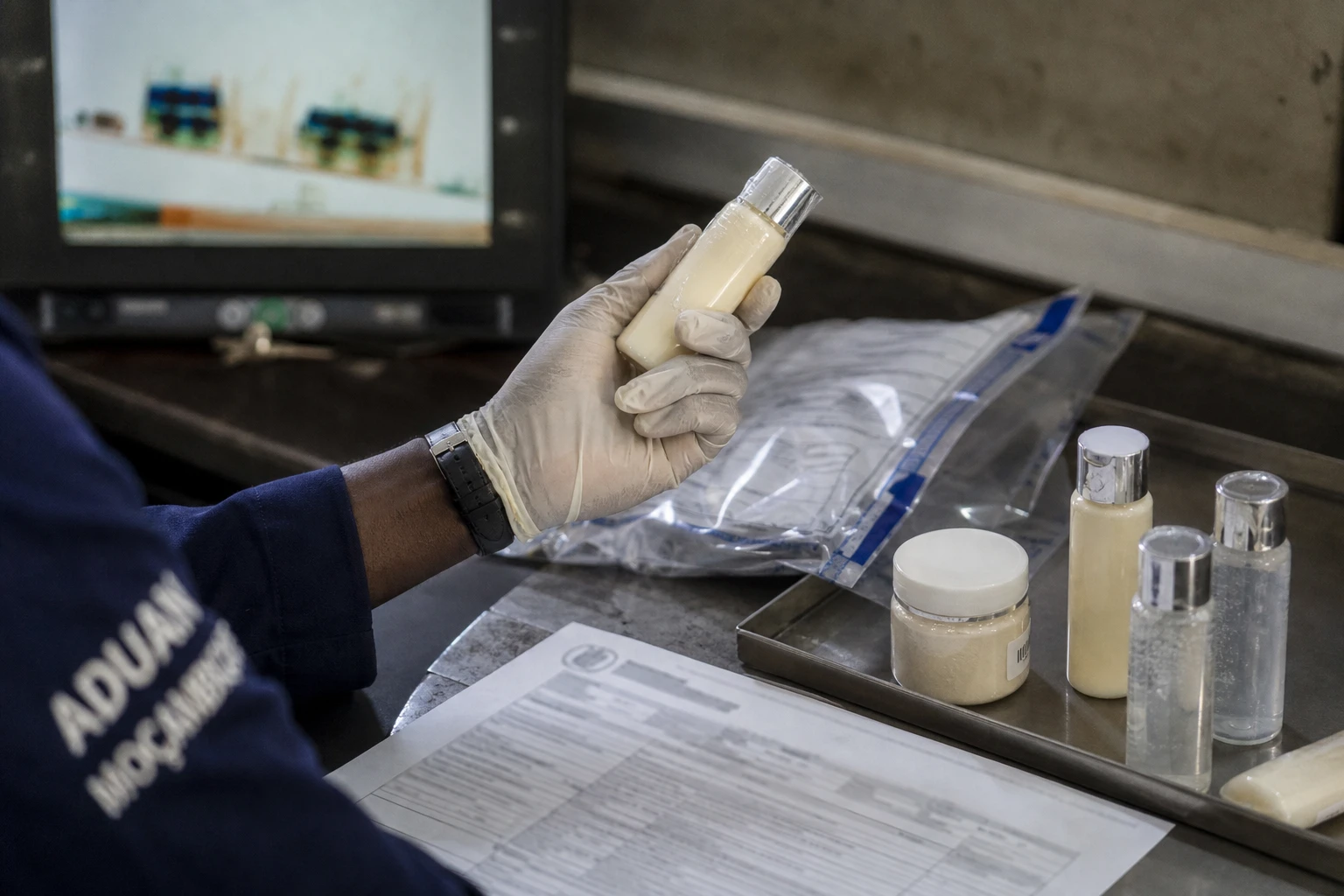
According to information corroborated by several media outlets operating in Mozambique, a consignment of 1.4 tonnes of fentanyl was seized at Maputo airport. The drug was reportedly hidden in cosmetic bottles. It is said to have departed from Campinas, in Brazil’s São Paulo state, with a stopover in Luanda, Angola. Investigators are now seeking to establish whether this route signals the emergence of a new corridor for synthetic drugs.
The case comes shortly after another major operation. On 12 June 2026, Mozambican services announced the discovery of 3.7 tonnes of fentanyl in the warehouses of a private company at Maputo airport. The goods had been declared as multivitamins and were then tested in a laboratory. The Tax Authority later specified that the consignment had entered Mozambique on 7 June 2026 from India, via Doha, Qatar. The two incidents, close together in time, raise questions about the repeated use of the same airport hub.
Mozambican authorities have also recalled that the investigation into the June seizure led to several arrests, including that of a Nigerian national named as the suspected recipient of the goods. In the same case, allegations of customs officers’ involvement prompted a denial from the Tax Authority, which said that checks had been conducted in accordance with procedures and that any individual misconduct would be a matter of personal responsibility.
Why fentanyl is so concerning
Fentanyl is a highly potent synthetic opioid. The UNODC warns that its analogues can cause fatal overdoses at very low doses and that the substance is already circulating in new forms, sometimes presented as harmless products. The threat is not theoretical. It first moves to where networks find discreet routes, fast infrastructure and entry points capable of concealing a consignment among thousands of others.
For Africa, the risk is twofold. Trafficking markets may use the continent as a transit zone to other destinations. At the same time, the availability of synthetic opioids could fuel more dangerous local consumption, with health effects that are poorly measured and treatment capacity often limited. The UNODC notes that fentanyl seizures remain heavily concentrated in North America, but its recent warnings emphasise the emergence of new forms and new locations for its circulation.
The issue is all the more sensitive in Mozambique because the authorities have stepped up messages of resolve against drug trafficking and consumption. The government has made it a priority in connection with youth and the country’s international image. On 26 June 2026, President Daniel Chapo called for stronger action against trafficking and consumption, in connection with the international day dedicated to the fight. The political message is therefore clear: do not allow drug trafficking to become an ordinary feature of air transport.
What Maputo reveals beyond the single incident
The repeated seizures at the same airport point to more than the capacity of inspection services. They show that networks are testing the system’s blind spots. They change the product, packaging, declared origin and route. A consignment of cosmetics can conceal an opioid; a consignment of multivitamins can do the same. The problem is therefore not just the goods. It is the entire chain: declaration, handling, storage, inspection and information-sharing between services.
For the public, the stakes are tangible. In Maputo’s neighbourhoods, as in other African cities connected by air freight, an increase in synthetic drugs could lead to more frequent medical emergencies, higher hospital costs and new risks for young people. For the state, the challenge is institutional. Customs, the criminal investigation police, civil aviation, the forensic laboratory and the justice system must work together. Without coordination, trafficking exploits the gaps.
Mozambique also occupies a sensitive regional position. Its coastline, airports and links with South Africa, Angola and Brazil make it a focus for traffickers as well as investigators. That is why these seizures matter across southern Africa. If a new route is confirmed, it could prompt copycat operations elsewhere in SADC, with knock-on effects for transport security and regional police cooperation.
The continental implications are clear. Fentanyl has not yet made the same inroads in Africa as it has in North America. But the warning is unmistakable: criminal networks move fast, and states must move faster still in sharing information, conducting chemical analysis and inspecting cargo. In Maputo, the battle is not limited to a high-profile seizure. Above all, it will show whether Mozambique can prevent a discreet corridor from becoming an established route for synthetic drugs in southern Africa.