Algeria
 Egypt
 Libya
 Morocco
 Sudan
 Tunisia
 Benin
 Burkina Faso
 Cabo Verde
 Côte d'Ivoire
 Ghana
 Guinea
 Guinea-Bissau
 Liberia
 Mali
 Mauritania
 Niger
 Nigeria
 Senegal
 Sierra Leone
 The Gambia
 Togo
 Cameroon
 Central African Republic
 Chad
 DR Congo
 Equatorial Guinea
 Gabon
 Republic of the Congo
 São Tomé and Príncipe
 Burundi
 Comoros
 Djibouti
 Eritrea
 Ethiopia
 Kenya
 Madagascar
 Malawi
 Mauritius
 Rwanda
 Seychelles
 Somalia
 South Sudan
 Tanzania
 Uganda
 Angola
 Botswana
 Eswatini
 Lesotho
 Namibia
 South Africa
 Zambia
 Zimbabwe
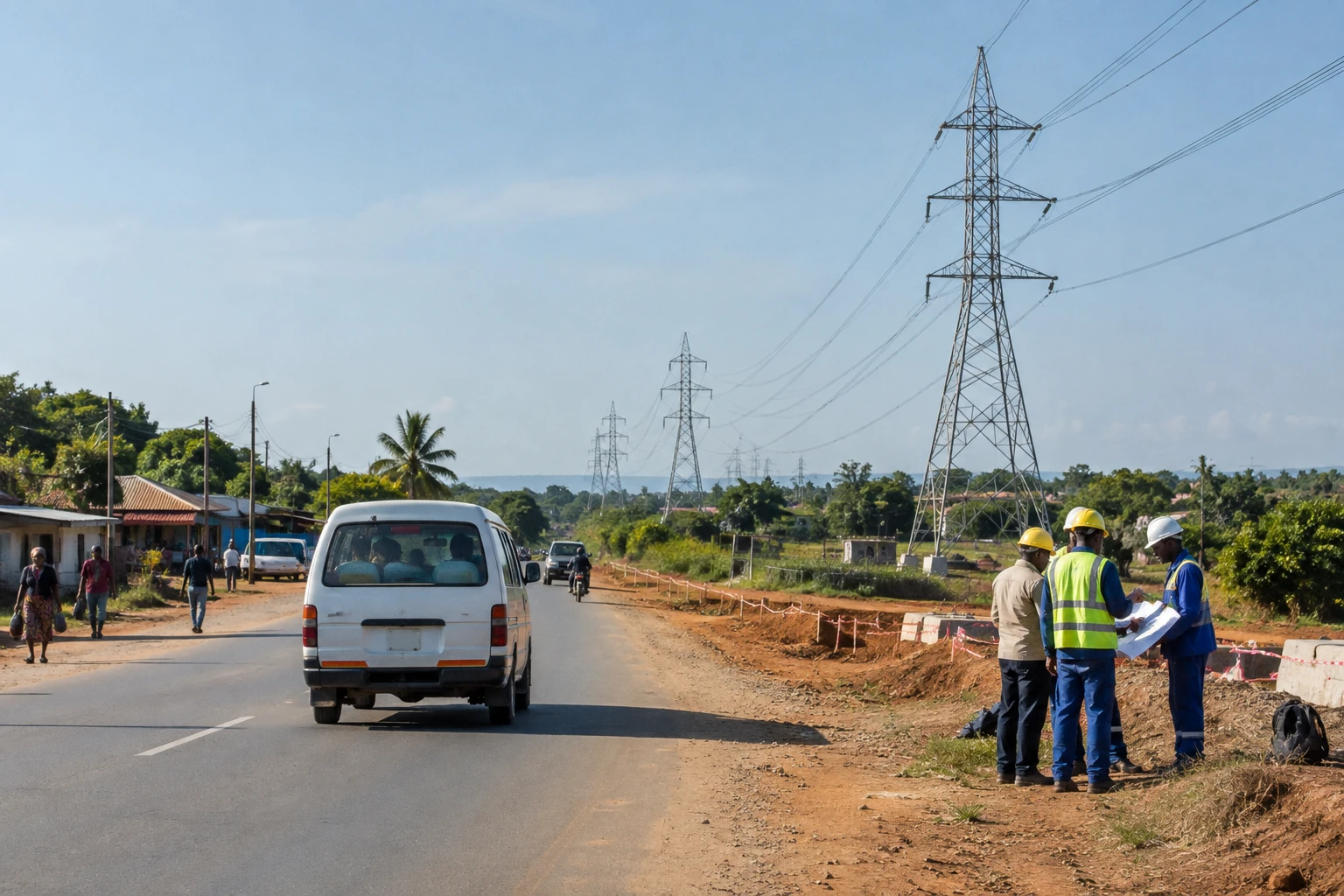
Generating electricity is not enough to make it available everywhere. In Mozambique, the gap between generation capacity and access for residents also depends on lines capable of carrying power to the central and northern provinces.
Extending the grid beyond generation centres
The Mozambican government is aiming for universal access to electricity by 2030. The national rate rose from about 31% in 2018 to 60% in 2024, according to the National Energy Compact and data from Electricidade de Moçambique (EDM), the state-owned electricity company. This progress does not, however, mean that all households have a reliable connection: disparities between provinces and between urban and rural areas remain significant.
The transmission network is a decisive link. It connects power plants to cities, businesses and local distribution networks. Without sufficiently robust lines, a new power plant does not guarantee that electricity will reach the areas where needs are greatest. The International Energy Agency points in particular to the persistent lag in rural electrification and the prominence of Nampula and Zambezia among the provinces most affected by lack of access.
This issue is also part of the country’s energy strategy. Mozambique has hydroelectric, gas and solar resources, but must at the same time expand connections, strengthen the grid and improve the reliability of supply. The 2030 target is therefore as much an infrastructure challenge as a generation one.
Tender for two new phases
On 8 October 2026, Gridworks announced that companies had been shortlisted for phases 2 and 3 of the Chimuara–Nacala line, which it is developing with EDM. Applications must be submitted by 24 November 2026. This is a candidate-selection stage, not the final award of the works.
The contract covers the design, supply, installation, testing and commissioning of infrastructure under a turnkey arrangement. It includes more than 400 kilometres of new lines, three substations and a compensation device designed to stabilise the grid. Project documentation describes a network of about 460 kilometres between Alto Molócuè and Nacala-a-Velha, in the north-east of the country.
According to Gridworks, the complete project represents an estimated investment of $450 million. The company says the link is intended to facilitate the transmission of solar and hydroelectric power to the north, support up to 600 megawatts of generation capacity and prepare for a future interconnection with Tanzania. These stated benefits will nevertheless depend on the infrastructure being built, its financing and the actual availability of electricity to transmit.
The first phase, linking Chimuara to Alto Molócuè, is a separate project being carried out by EDM. The phases covered by the shortlist would then extend the route towards Namialo, Nampula and Nacala-a-Velha. This distinction matters: the current announcement concerns preparations for contracts for the subsequent phases, not the commissioning of the entire line.
Private finance, public obligations
Gridworks is an electricity-network investment platform backed by the UK institution British International Investment. The International Finance Corporation (IFC), a member of the World Bank Group, is involved in developing the project and provides technical and financial support. The IFC describes the operation as a privately financed transmission project developed with EDM.
This structure may mobilise additional funding and expertise in a sector whose needs exceed public resources alone. But private investment does not remove questions of governance: the financing terms, allocation of risks, arrangements for access to the grid and any potential impact on costs borne by EDM and users will need to be clarified. The public documents reviewed do not yet provide a firm contract-award timetable or commissioning date.
Several steps remain before work can begin, including financial close, permits and environmental and social studies. Shortlisted companies will have to comply with the project’s environmental and social monitoring and management plan. In the areas crossed by the line, practical issues include land use, local activities and the safety of residents during construction. Consultation arrangements and the handling of impacts will therefore be crucial to the quality of the project.
The National Energy Compact estimates that $4.8 billion will need to be invested by 2030 in transmission lines of more than 66 kilovolts, with a share expected from the private sector. The Chimuara–Nacala line will therefore not, on its own, be enough to achieve the national target. It is one project in a wider portfolio, which must also include local connections and off-grid solutions where main lines cannot meet needs quickly.
A national and regional issue
For residents and small businesses, the impact will not be measured only in kilometres of lines or megawatts transmitted. It will depend on local connections, continuity of service and the ability of local operators to serve communities. Major transmission routes can strengthen supply to cities and economic zones, while remote villages risk being left behind without additional investment in distribution or mini-grids.
Regionally, the project is part of efforts by the Southern African Development Community (SADC) to expand interconnections and facilitate electricity trade through the Southern African Power Pool, the network through which operators in the region co-operate. A future link with Tanzania could strengthen connections between southern and East Africa, but remains an objective to be prepared, not an outcome already secured.
The next verifiable milestone is 24 November 2026, the deadline for submitting applications for prequalification. After that, the selection of companies, completion of financing and environmental permits will need to be monitored. These are the stages at which an announced transmission project can become infrastructure capable of bringing electricity closer to Mozambicans.